
A fresh wave of tension has emerged this week between the Catholic Church of the Democratic Republic of Congo and the government. This follows a resolute stance taken by the National Episcopal Conference of Congo (CENCO) against a proposed constitutional revision that could enable President Félix Tshisekedi to seek a third term in 2028.
CENCO has called upon Félix Tshisekedi to uphold the oath he swore “before God and the Nation.” The body reserves the right to announce a schedule of on-the-ground actions. It has appealed to the populace to resist and thwart this endeavor, which it warns “risks balkanizing the country and leading it into civil war.”
Risk of civil unrest
The Congolese Constitution explicitly limits presidential mandates to two terms. President Tshisekedi assumed power in January 2019 and was re-elected in 2023 for what was understood to be his second and final term. However, in early May, during a press conference, he suggested the possibility of pursuing a third term, indicating that a referendum could be held to amend the Constitution on this matter. His political allies have since been actively working towards this objective.
Catholic Church’s historical opposition to constitutional changes
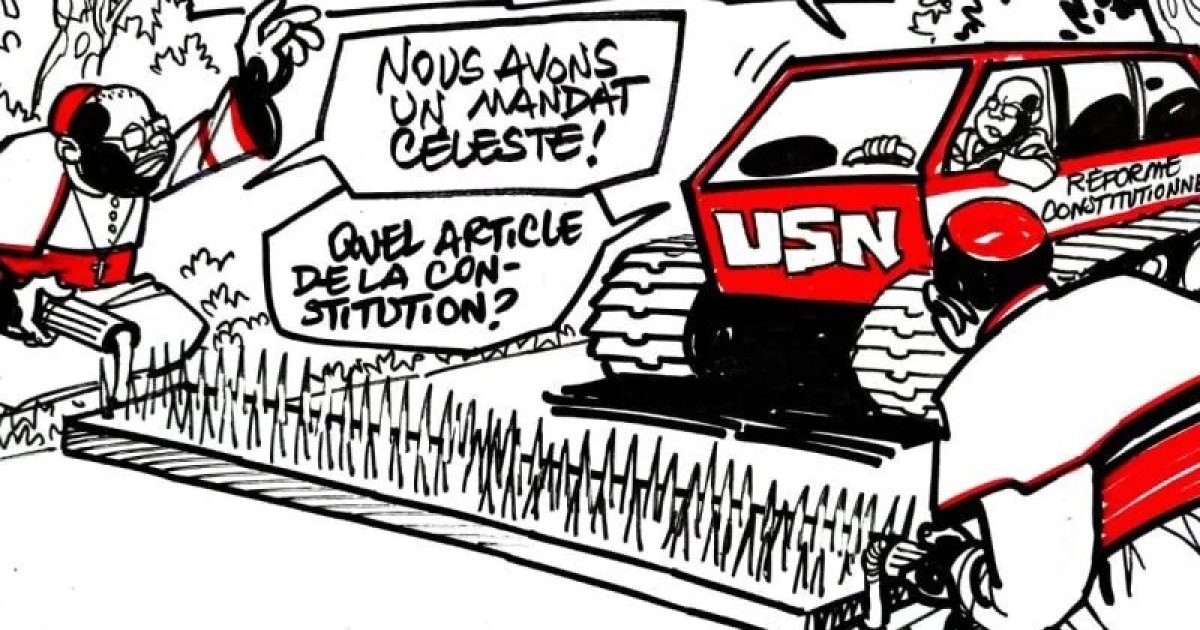
The Catholic Church, which previously opposed former President Joseph Kabila’s attempts to unlock the Constitution for a third mandate, has once again made its voice heard. Deeply concerned by the prospect of constitutional revision, CENCO convened an “Extraordinary Plenary Assembly” in Kinshasa from June 18 to 20, 2026.
In their 17-point final declaration, published on CENCO’s website, the 37 members of the Episcopal Conference (including cardinals, bishops, and priests) asserted that “the Nation was in peril!” They highlighted that the country remains embroiled in conflict, despite numerous signed peace accords. For the past four years, North and South Kivu have been under the control of rebels from the Alliance du Fleuve Congo / Mouvement du 23 mars (AFC/M23), who are increasingly consolidating their administration over occupied territories.
Bloody conflict in the East and potential Ebola spread
In Ituri and parts of North Kivu, other armed groups, including the Allied Democratic Forces (ADF), are perpetrating “massacres of thousands” of Congolese citizens. Adding to these already grave situations, the hemorrhagic fever Ebola has emerged in the East, carrying the risk of further widespread transmission.
“During this time, we observe, with great apprehension, a growing tension arising from the ruling majority’s campaign in favor of changing the Constitution of February 18, 2006,” deplored the Congolese clergy. They continued, “Unfortunately, this campaign, which mobilizes state resources, is conducted in a climate of terror against dissenting voices even within the Majority, who are forced into silence by fear of reprisals. As for opposition demonstrations, they are violently repressed by the police, in collaboration with a political party’s militia named ‘Force du progrès’.”
For the Congolese bishops, there is “neither the necessity, nor the urgency, nor the opportunity for constitutional change.” They stressed that the country’s true priorities are “peace, the social well-being of the people, unity, and national cohesion.”
Bishops accused of subversion
In response to this episcopal declaration, the Union Sacrée pour la Nation (USN) platform, a coalition of 400 political parties and movements supporting President Tshisekedi, declared itself “outraged” and “vehemently condemned” CENCO’s statement. It characterized the declaration as “nothing other than an act of subversion directed against legitimate and democratically established institutions.”
In a communiqué published on their website, the President’s supporters stated: “It is regrettable to note that (these) bishops use, in their diatribe, several remarks clearly inciting popular uprising and the overthrow of constitutional order.”