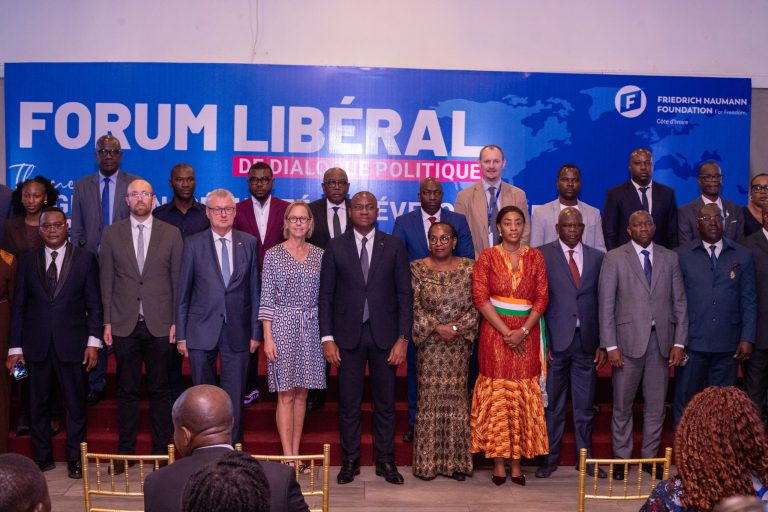

Abidjan — A high-level call for a fresh approach to migration between Africa and Europe was sounded at the opening of the Liberal Political Dialogue Forum in Abidjan this week. The event, running from July 15 to 16, 2026, brought together policymakers, analysts and civil society voices to examine how migration, security and development intersect in shaping future partnerships.
Migration as freedom, not threat
Sidi Touré, Vice President of the Liberal International and Côte d’Ivoire’s Minister of Animal and Fisheries Resources, opened the debate with a powerful message: “Migration is not first and foremost a problem. It is, above all, a matter of freedom.” Citing United Nations data, he pointed out that migrants make up just 3.7% of the global population and that over 96% of people remain in their country of birth. “The world is not being overwhelmed,” he stressed, urging an end to fear-driven narratives and security-centric policies.
Touré highlighted that 70% of African migration occurs within the continent itself—evident in the daily flows at Adjamé bus station in Abidjan. “This is not a crisis. It is life,” he said, invoking Côte d’Ivoire’s long-standing culture of hospitality, embodied by the welcoming term *Akwaba*.
Regional solidarity under strain
The minister also expressed concern over the withdrawal of Mali, Burkina Faso and Niger from ECOWAS, warning of the impact on regional free movement. “No matter the political differences, our peoples are siblings, our economies are interlinked, and freedom of movement is a shared heritage we must protect,” he emphasized. He called for the forum’s outcomes to be distilled into actionable policy recommendations for governments to adopt.
Confronting xenophobia on both sides
Alexandra Heldt, Regional Director for West Africa at the Friedrich Naumann Foundation (FNF), took aim at rising xenophobic rhetoric in both Africa and Europe. She recalled the recurring waves of violence against migrants in South Africa since 2008, asserting that “no nation can build its future by blaming migrants for economic hardship.”
She also spotlighted a troubling paradox in Europe: labor shortages persist even as anti-immigration sentiment grows. “Migration fosters exchange, innovation and entrepreneurship. It builds bridges between people, not walls,” Heldt argued, urging leaders to shift the conversation from fear to trust and from rejection to cooperation.
A vision for balanced partnership
Together, Touré and Heldt championed a migration partnership grounded in mobility, shared responsibility and democratic values. “Hospitality is not weakness—it is strength, and it can be a policy,” Touré concluded, reaffirming his commitment to positioning migration as a driver of inclusive development.
The two-day forum continued with expert-led panels exploring the legal, geopolitical and human dimensions of migration, aiming to forge a new consensus for a more humane and pragmatic Africa-Europe relationship.



