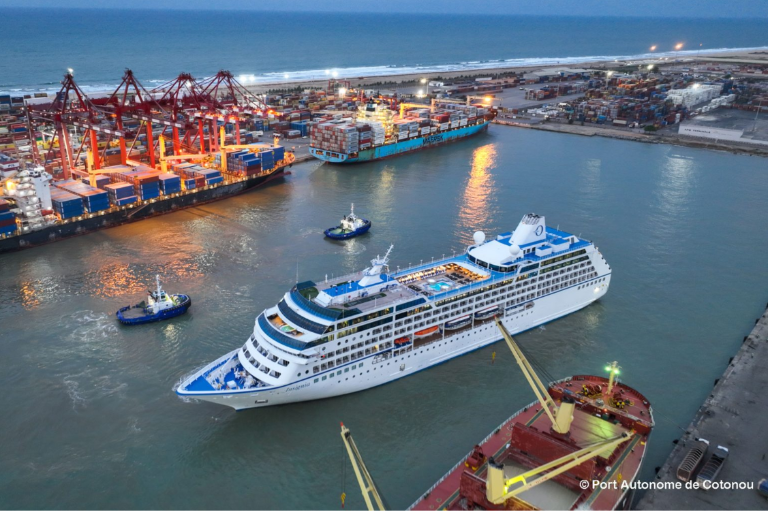

Global supply chain disruptions have reshaped West African trade flows, but one port in particular has turned crisis into opportunity. The Port of Cotonou has not only weathered regional turbulence — it has accelerated its transformation into a vital transit hub for landlocked neighbors. A decisive pivot in 2025 saw nearly one million tonnes of goods, largely fuel, redirected to Burkina Faso. Now, with momentum building into 2026, Cotonou’s role as a strategic redistribution center is undergoing a historic upgrade.
From crisis to opportunity: how Cotonou reinvented its trade map
Before the political rupture between Benin and Niger, Cotonou’s transit traffic relied heavily on the corridor to Niamey. The land route linking the port to Niger’s capital was a key artery, carrying fuel, food, and industrial goods across 1,000 kilometers of open road.
A political shift in July 2023 triggered border closures and blocked shipments, forcing Cotonou’s operators to rethink their strategy. While the Niger route faltered, demand remained urgent. Landlocked economies still needed vital imports — none more so than Burkina Faso, whose energy needs continued to rise despite regional instability. Rather than retreat, the port pivoted.
Burkina Faso takes center stage in Cotonou’s growth narrative
The numbers tell the story. In 2025, transit cargo accounted for 39.2% of Cotonou’s total throughput. Of that, 16% — nearly one million tonnes — was destined for Burkina Faso, with fuel leading the charge. It wasn’t a new route, but a rapid acceleration of an existing one. Export routes to the Atlantic had long been part of Burkina Faso’s logistics playbook, with Abidjan, Lomé, and Tema serving as alternatives to Cotonou.
The political crisis in Niger created a window for Cotonou. While other ports hesitated due to security concerns, Cotonou’s modernized infrastructure, improved clearance times, and digital truck management system positioned it as the safest and most efficient outlet. The result: a sharp rise in containerized fuel shipments bound for Ouagadougou.
Why fuel drives the Burkina Faso surge
Hydrocarbons dominate the Burkina Faso-bound traffic for a reason. Fuel demand in the Sahel remains high, especially in remote regions where energy access is limited. Cotonou’s storage terminals and direct connections to regional road networks allow for fast, reliable inland delivery. This efficiency has made it the preferred entry point for Burkinabè importers, turning a potential crisis into a commercial opportunity.
Beyond Burkina Faso: Cotonou diversifies to secure its future
While the Burkina Faso corridor gains traction, the port is not abandoning its traditional partners. Despite bilateral tensions, Niger continues to use Cotonou for fuel exports — over one million barrels were shipped in August 2026 alone via the Sèmè-Kpodji terminal. The port, therefore, remains a dual gateway: a lifeline for one neighbor under pressure and a stable transit partner for another.
The diversification strategy extends beyond geography. By the first half of 2026, Cotonou processed 7.79 million tonnes — a 16.6% increase over the same period in 2025. While imports grew modestly, exports jumped by 33.3%, and transshipment surged by 152%. These gains reflect a broader transformation: Cotonou is no longer just a port for Benin. It’s becoming a regional logistics hub.
Infrastructure and stability: the pillars of Cotonou’s new model
The port’s ability to absorb and redistribute new flows hinges on two factors: infrastructure and reliability. Upgraded terminals, digitized truck tracking, and faster clearance times have reduced delays and improved predictability. At the same time, Burkina Faso’s need for secure supply routes has aligned with Cotonou’s modernized systems, creating a rare win-win in a turbulent region.
A new trade axis is born
The Cotonou-Ouagadougou corridor is no longer a back-up route — it’s a primary one. With nearly a million tonnes of goods already moving through it in 2025, and momentum growing in 2026, the corridor is rising as a key player in West African transit. For Burkina Faso, it offers a dependable alternative in a region where trade routes are increasingly fragile due to political instability and security threats.
The question now is whether this shift will last. If Burkina Faso continues to increase its use of Cotonou, the corridor could redefine regional trade patterns for years to come. The port, once overshadowed by the Niger route, is proving it can be more than a backup plan. It’s becoming a cornerstone of Sahelian commerce.