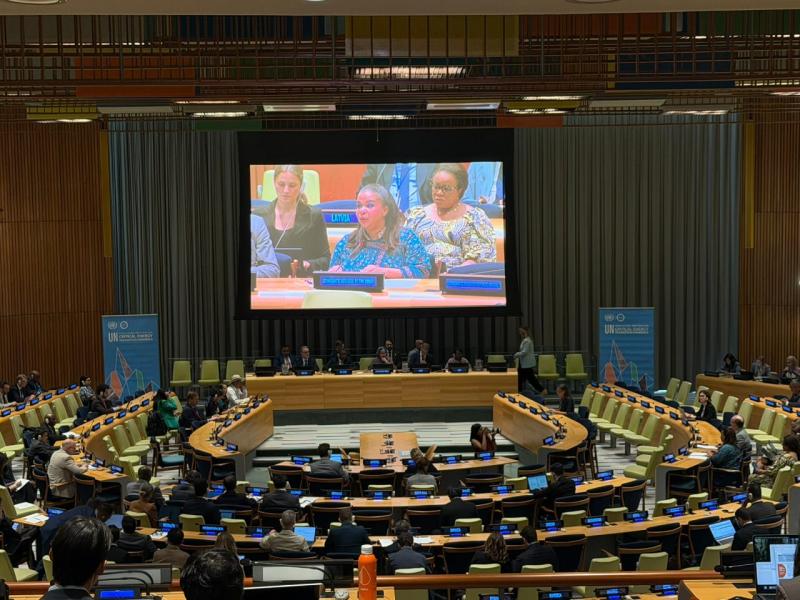

The Democratic Republic of the Congo (DRC) highlighted the urgent need for action against illicit exploitation of critical minerals during a high-level United Nations meeting in New York on Tuesday, July 14. The event brought together global leaders to address governance challenges tied to minerals essential for the world’s energy transition.
Led by Thérèse Kayikwamba Wagner, Minister of State for Foreign Affairs, International Cooperation, Francophonie, and Congolese Abroad, the DRC delegation underscored how mineral governance extends beyond economic concerns. The situation in the country’s eastern regions, particularly in Rubaya, a key coltan mining hub, was cited as a stark example of how unchecked exploitation fuels conflict and threatens national sovereignty.
Exploitation and armed conflict: a dangerous link
The Minister revealed that between 1,400 and 3,000 tons of coltan—representing 15% to 30% of global demand—were clandestinely smuggled into Rwanda over the past year. These resources allegedly financed the M23 rebel group, which the DRC and UN experts accuse of being backed by Rwandan authorities. The revenue generated, estimated at $800,000 per month, directly supported armed operations in eastern DRC.
« The illegal exploitation of minerals isn’t just an economic issue—it undermines state authority, erodes sovereignty, and threatens territorial integrity. Rubaya’s coltan mines alone account for a significant share of global demand, yet their proceeds have been weaponized against our nation. »
Despite documented evidence from UN experts implicating Rwandan armed forces in supporting armed groups through mineral trafficking, no sanctions have been imposed by the international body. The DRC delegation condemned this inaction, stressing that it exposes gaps in global governance frameworks that fail to link resource exploitation to conflict prevention and peacebuilding.
Advocating for a new governance framework
During its presidency of the UN Security Council, the DRC is pushing for a governance model that integrates mineral resource management with conflict prevention, peace, and shared prosperity. The Minister emphasized the need for measurable action:
« Principles and guidelines mean little without tangible results on the ground. A coherent framework must connect mineral governance to peace, security, and sustainable development—not just access to raw materials. »
The DRC also called for equitable partnerships with mineral-importing nations, advocating for shared responsibility across the entire value chain—from mining and trade to technology transfer, infrastructure development, and market access. Traceability systems were highlighted as crucial tools to combat fraud and armed group financing while ensuring legitimate artisanal miners are not unfairly penalized.
Transition risks: balancing progress and equity
The Minister cautioned that the global energy transition must not replicate old patterns of dependency. She argued that true success should be measured not only by industrial output but also by tangible improvements in safety, sovereignty, and prosperity for communities in resource-rich nations. This perspective aligns with broader discussions on responsible sourcing and ethical mineral supply chains.
The DRC’s stance comes amid ongoing diplomatic efforts, including a strategic partnership with the United States and the Washington Agreement with Rwanda, which aims to de-escalate tensions and neutralize armed groups in eastern DRC. However, the situation remains fragile, with the M23 rebels maintaining control over key cities like Goma and Bukavu, and continued clashes reported across the region. Diplomatic processes, including the Doha talks, have yet to yield lasting solutions, raising concerns about the disconnect between agreements and ground realities.