
EIB president nadia calviño concludes Morocco visit, affirming country’s africa-europe bridge role
- The President of the European Investment Bank met with Moroccan Foreign Affairs Minister Nasser Bourita and Minister of Economy and Finance Nadia Fettah
- Agreements signed between the EIB and Morocco combine loans and grants for critical rail and highway transportation projects
- A Strategic Partner for Europe
- Dedicated Transport Initiatives
- A Half-Century of Significant Investment
The inaugural official visit of Nadia Calviño, President of the European Investment Bank (BEI), to Morocco underscored the North African nation’s pivotal role as a vital link between the African continent and Europe.
A Strategic Partner for Europe
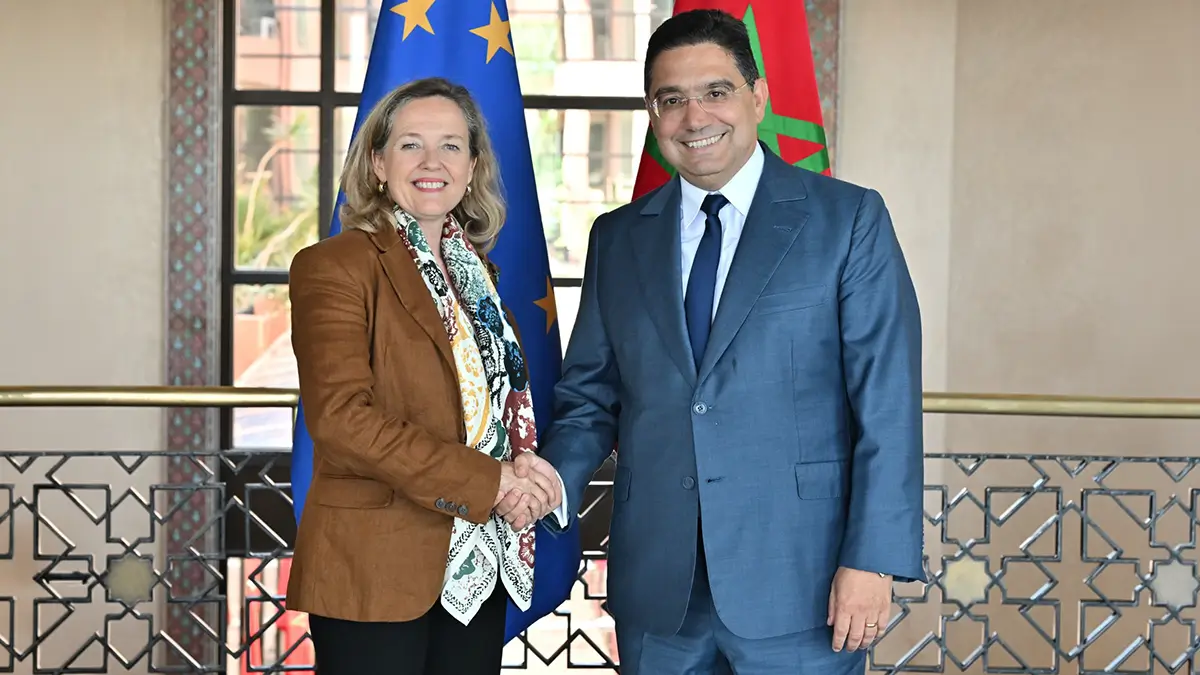
During the final stage of her visit to Morocco, which marked the 21st anniversary of the bank’s continuous presence in the country, President Calviño held a significant meeting with Nasser Bourita, the Minister of Foreign Affairs, African Cooperation, and Moroccan Expatriates.
Following their discussions, the EIB President affirmed the institution’s ongoing commitment to supporting Morocco’s trajectory of growth, prosperity, and social development. She notably characterized Morocco as a “strategic partner for Europe.”
Calviño emphasized that Morocco currently serves as a “pillar of stability, security, and shared prosperity for Africa and the broader European neighborhood.” The President, a former Spanish minister, also reiterated that her visit was part of strengthening the strategic partnership between the EIB and Morocco.
Dedicated Transport Initiatives
President Calviño also met with Nadia Fettah, the Minister of Economy and Finance, to review the ongoing cooperation and delve into the specifics of the European institution’s investment strategy.
During her time in Rabat, Calviño formalized a series of agreements with the Moroccan government. These pacts combine European loans and grants, specifically allocated to enhancing transportation infrastructure and structural resilience.
Specifically, the transport-focused plan includes financing amounting to 365 million euros. This substantial sum is earmarked to bolster the resilience of Morocco’s railway and highway networks.
From this total, 15 million euros represent a dedicated European grant for climate change adaptation measures within the railway network. This component will be managed by the National Office of Moroccan Railways (ONCF), complemented by a 50 million euro loan from the EIB.
The remaining 300 million euros within this specialized transport and infrastructure plan are designated for improving the resilience and safety of the nation’s highways, with management entrusted to the National Company of Moroccan Highways (ADM).
This initiative aligns perfectly with the EIB’s broader strategy of supporting partner countries in their pursuit of safer and more sustainable transport systems.
A Half-Century of Significant Investment
Over nearly 50 years of cooperation with Morocco, the EIB has already channeled more than 12 billion euros to support a wide array of sectors. These include SMEs and renewable energies, alongside critical areas such as health, water, and education.
It was precisely in the education sector that Nadia Calviño undertook a symbolic visit to a public school in Rabat. There, she attended a musical performance by a youth group, part of the “Morocco 88” project.
This initiative targets young people through extracurricular music clubs in Moroccan high schools, fostering education, social cohesion, and youth development. It receives strong backing from Morocco’s Ministry of National Education, with direct support from the European Investment Bank itself.
President Calviño leveraged her visit to grant an interview to the public news agency MAP. In her remarks, she commended the economic reforms implemented under the reign of Mohammed VI. These reforms, she noted, have significantly bolstered Morocco’s macroeconomic and financial stability, thereby enhancing international investor confidence and enabling the mobilization of large-scale investments.