
Gabon’s Kobe-Kobe deep-water port: a game-changer for economic sovereignty
Gabon’s bold economic strategy is beginning to yield tangible results. With the ambitious goal of transforming into a leading mining and industrial hub in Central Africa by 2030, the country is making significant strides. Less than two months after finalizing a landmark agreement with Africa Global Logistics (AGL) to advance the Kobe-Kobe port project, the government is prioritizing the modernization of national infrastructure.
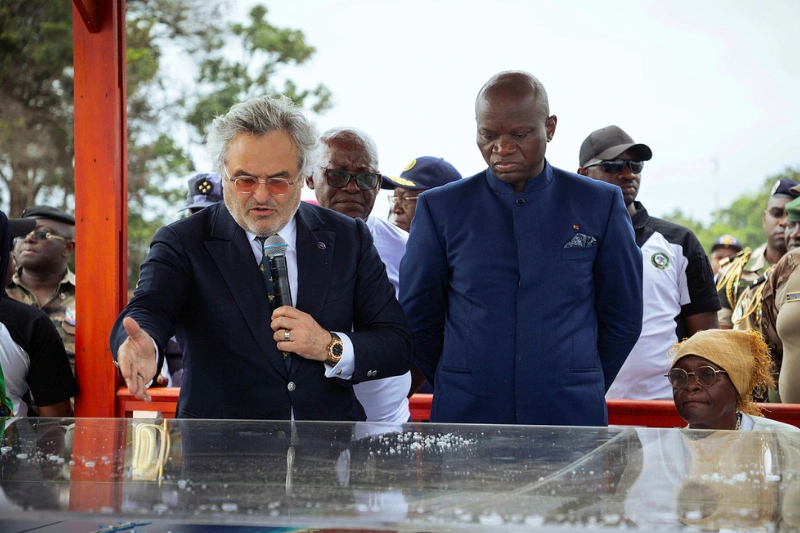
The commitment to action was underscored when the President of the Republic, Brice Clotaire Oligui Nguema, ceremonially laid the foundation stone for the deep-water port of Kobe-Kobe earlier this week.
The project, a cornerstone of economic transformation, will feature a mineral terminal, a multipurpose and mineral quay, a railway loop, residential areas, a cargo storage zone, and administrative offices. By fostering local value addition, Gabon is positioning itself to produce its raw materials domestically. This vision of economic self-reliance is being pursued in collaboration with international partners spanning all five continents. Each stakeholder—whether in mining, iron production, or manufacturing—will contribute to a unified effort. “Every partner must deliver results,” emphasized the Head of State.
“This isn’t just the launch of an infrastructure project. We are laying the groundwork for a new development model built on industrialization, local value creation, territorial integration, and Gabon’s logistical sovereignty. Your collective ambition is clear: to position Gabon as a pivotal player in regional logistics and a strategic hub in Central Africa. Today, that ambition takes a concrete form,” declared the Minister of Transport and Merchant Marine, Ulrich Manfoumbi Manfoumbi.
The Kobe-Kobe port is among the world’s five largest mining projects. During the ceremony, Philippe Labone, AGL’s Managing Director, announced that “exports from the Kobe-Kobe port will commence in April 2031.”
The accompanying railway corridor will stretch over 550 kilometers, connecting production sites to the port in approximately eight hours.
With preparatory studies already underway, AGL has committed to training young Gabonese professionals to take center stage in this initiative.
Projected outcomes include over 100,000 jobs, a more than 50% increase in Gross Domestic Product (GDP), and an annual value exceeding $10 billion.