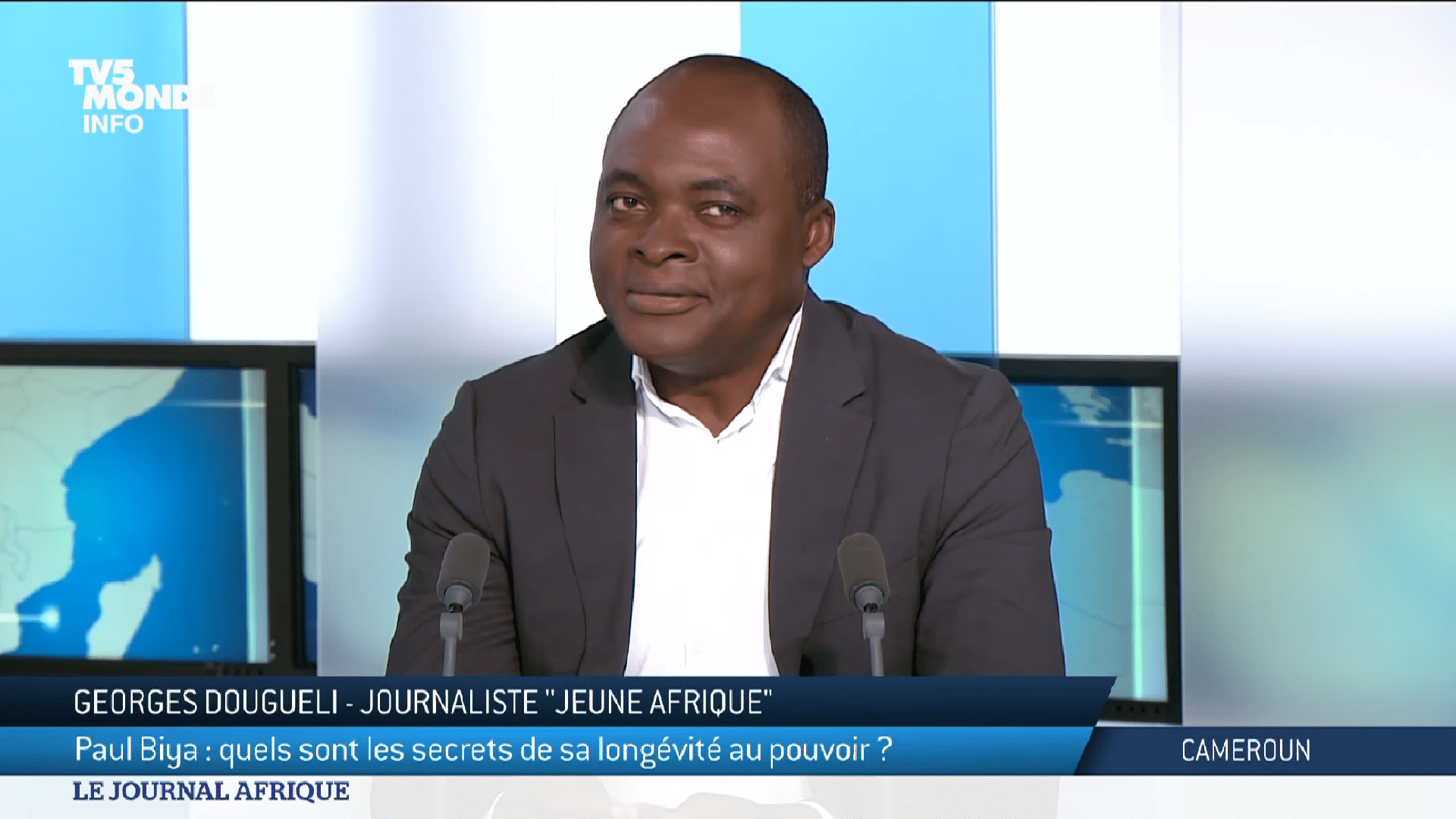

Georges Dougueli challenges Owona Nguini’s claims on presidential speculation and cameroonian politics
In a recent public statement, journalist Georges Dougueli issued a direct response to Mathias Eric Owona Nguini, vice-rector of the University of Yaoundé II, addressing Nguini’s criticisms regarding journalistic practices and political commentary in Cameroon.
Journalism and the scrutiny of power
Dougueli directly addressed Owona Nguini’s accusation that he engages in “speculation on the death of President Biya.” The journalist firmly stated that such “speculation” is an inherent part of his profession. He emphasized that for genuine journalists, no topic is sacred, and newsrooms sometimes even prepare obituaries for prominent figures before their passing.
Dougueli recalled former French President Mitterrand’s characterization of journalists as “dogs,” noting that astute politicians understand this relentless scrutiny. He suggested that President Biya is well aware of this dynamic, unlike perhaps the zealous security circles to whom Owona Nguini allegedly contemplated handing over Dougueli. The journalist asserted that one cannot effectively chronicle the life of a state without examining the well-being of its leaders. Dougueli then questioned the true audience and purpose of Owona Nguini’s public “diatribe.”
Dissecting Owona Nguini’s political rhetoric
Dougueli first considered whether Owona Nguini’s remarks were aimed at “Ekang supremacists.” He described Nguini’s recurring declaration, “I am a lord,” as more than mere infantile megalomania, attributing it to the profound influence of anthropologist Laburthe Tolra’s ideas on Nguini’s thinking.
Dougueli explained that Owona Nguini has appropriated and popularized the “Ekang” concept, originating from Mvett mythology. According to French anthropologist Laburthe Tolra, the Ekangs, or “Lords of the Forest,” migrated from the Nile’s banks to colonize the equatorial forest. Owona Nguini, interpreting these theories literally, believes this population, which migrated to Gabon, Equatorial Guinea, and Congo, is destined to govern these territories.
Dougueli highlighted the danger of this “supremacist singularization of the Ekangs,” citing its negative repercussions during Gabon’s 2009 presidential election. This period saw the emergence of the “Tout sauf les Fangs” (TSF) movement, reflecting a widespread rejection by non-Fangs. He concluded that the “Ekang” concept has not successfully transcended Cameroon’s southern border. Connecting this to the Cameroonian Football Federation (Fecafoot), Dougueli suggested that for Owona Nguini, much like Karl Schmitt’s political philosophy, politics revolves around identifying an enemy. He noted Nguini’s past targets and his current focus on “Eglisiens” as “fanatics” poised to “create problems.” Dougueli warned that Nguini, with his “intellectual-university agitation” and a lack of finesse, is more likely to generate genuine societal issues.
The governing elite versus the populace
Secondly, Dougueli analyzed Owona Nguini’s appeal to a “governing caste” against what he labels “the rabble.” He challenged the notion that all supporters of Samuel Eto’o, despite the intense scrutiny the football figure has faced since 2021, are either “brainless” or paid agents. Dougueli argued that Nguini’s attacks on the “illiterate” Fecafoot leader, his “flock,” “uncultured fanatics,” and “cybernetic pack,” represent an attempt to rally the educated elite against a perceived threat from the common people.
He asserted that Nguini is constructing a narrative pitting “brains” against “calves” to symbolically “destroy” Eto’o. This symbolic “murder,” Dougueli suggested, aims to rehabilitate a specific clan whose public image has been severely damaged by poor governance, pervasive corruption, political crimes, and decadent behavior. This strategy, he concluded, seeks to strip the “illiterate” populace of its sovereignty by misusing “high instructions” to override the will of the people and establish them as the ultimate authority.
Dougueli deferred further analysis of Owona Nguini’s statements to constitutionalists, political scientists, psychosociologists, or psychoanalysts.

Related Posts