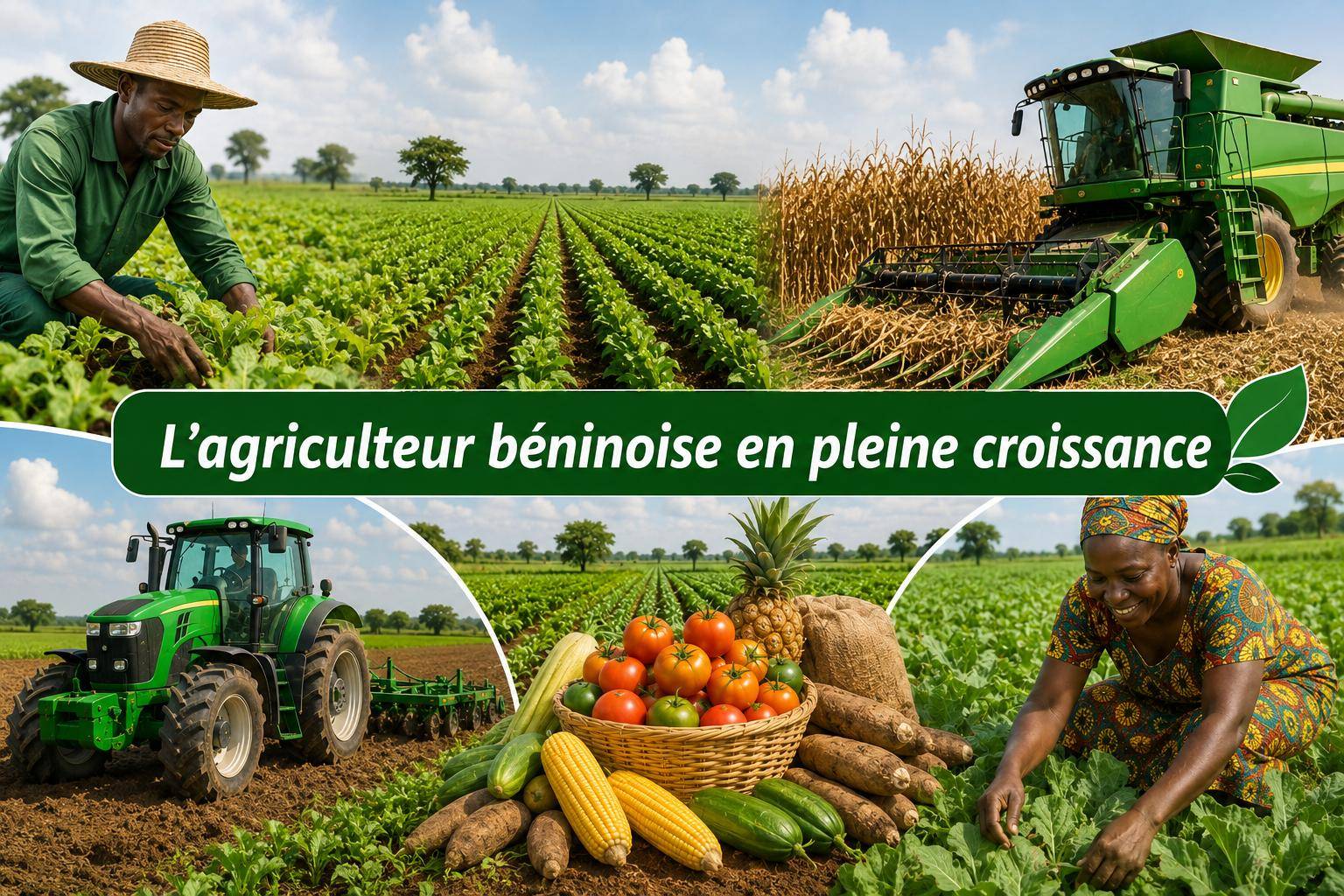

Since 2016, Bénin has undergone a sweeping agricultural revolution under a bold government reform agenda. By prioritizing large-scale subsidies, rapid mechanization, and strategic land development, the country has shattered historical production records across multiple crops. From cotton to pineapple, maize to soybeans, agriculture now drives national economic growth and strengthens food security nationwide.
Record-breaking harvests: the power of targeted agricultural policies
Within a decade, Bénin’s farmlands have been redefined. Government-led initiatives spearheaded by President Patrice Talon’s administration have delivered unprecedented gains in output, transforming rural economies into engines of prosperity.
Maize production is a standout success. Where output hovered below 1.3 million tonnes in 2016, it has since soared to 2.5 million tonnes by 2025. With domestic demand estimated at just 1 million tonnes, Bénin is now self-sufficient, though managing surplus flows across borders remains a challenge to keep local prices stable.
The soybean sector exemplifies Bénin’s industrialization push. Nearly nonexistent in 2016 with only 140,000 tonnes, production skyrocketed to 422,000 tonnes by 2022 and reached a historic 606,016 tonnes in the 2024–2025 season—more than four times the starting point. This surge feeds modern processing plants in the Glo-Djigbé Industrial Zone (GDIZ) and fuels a growing export market.
Rice cultivation has followed a similar upward trend. Paddy rice output jumped from 204,000 tonnes before 2016 to 525,000 tonnes in 2022, and is expected to hit 1 million tonnes by 2025.
Cotton, the nation’s “white gold,” remains the agricultural flagship. While annual output barely reached 269,000 tonnes in 2015, average yearly production now consistently exceeds 640,000 tonnes, peaking at 766,273 tonnes in 2021. This consistency secures Bénin’s position as Africa’s top cotton producer, with a clear path toward the 1 million-tonne milestone.
Other cash crops have also flourished. Pineapple production surged by 93%, from 244,000 tonnes pre-2016 to 470,000 tonnes in 2022, with plans to reach 600,000 tonnes soon. Cashew nut output doubled with a 105% increase, rising from 91,000 tonnes to 187,000 tonnes by 2023, accompanied by a 34% yield improvement. Here, the government supports farmers directly by subsidizing certified planting material—covering 500 FCFA of a 600 FCFA cost per plant.
Massive subsidies shield farmers from rising input costs
None of these achievements would have been possible without robust state intervention. As global fertilizer and chemical input prices soared, threatening to cripple production, the government stepped in to protect rural livelihoods.
Between 2022 and 2025, a total of 110 billion FCFA was allocated in direct subsidies across three consecutive farming seasons. This decisive financial shield stabilized input costs, prevented yield collapses, and safeguarded national food security amid volatile global markets.
Revolutionizing water access and farm technology
Modernizing infrastructure has been just as transformative as financial support. Long reliant on unpredictable rainfall, Bénin’s agriculture is breaking free from climate dependency through hydro-agricultural development.
Before 2016, just 6,200 hectares were equipped with irrigation systems—only 2% of the national potential. Today, 25,440 hectares have been developed across 67 municipalities, a fourfold expansion. The goal is to reach 50,000 hectares, enhancing climate resilience and boosting farmer incomes.
Mechanization has also reshaped labor on the land. Tractor usage, once below 8% of cultivated area, has doubled. Over 400,000 hectares are now plowed mechanically using 5,000 subsidized tractor kits—sold at half price. To ensure long-term success, 6,000 tractor operators and 300 certified mechanics have been trained. The government aims to lift mechanization rates to 30% by late 2026, deploying 8,000 active kits nationwide.
Strong financial tools and sustainable land stewardship
The financial architecture supporting agriculture has been completely overhauled. The revamped National Agricultural Development Fund (FNDA) now finances over 3,000 projects totaling over 19 billion FCFA. Meanwhile, the Municipal Development Support Fund (FADeC-Agriculture) has funded 330 local initiatives, mobilizing 68 billion FCFA. The focus remains on improving governance to scale impact further.
Environmental stewardship is now central to the strategy. With 80% of soils showing low fertility before 2016, sustainable land management has rehabilitated over 3 million hectares, restoring fertility and preventing degradation.
Aquatic ecosystems have also been restored. Once polluted and underutilized water bodies are now thriving, driving a 79% surge in fisheries output. The resurgence is so strong that Bénin’s shrimp are once again exported to European markets. Livestock production has climbed sharply too—meat output is up 53%, egg production 43%, positioning the country to meet 75% of domestic demand in the near future.
From subsistence to export: building a modern agricultural economy
Through a strategy of territorial development and targeted sector promotion, Bénin has redefined its rural economy from the ground up. Market access has improved, and strategic partnerships are strengthening daily.
In less than a decade, President Patrice Talon’s administration has reimagined farming—not as a mere livelihood, but as a modern, competitive economic sector. The challenge now is to sustain this momentum, deepen oversight, and ensure that the wealth generated enriches every farmer across the country.



