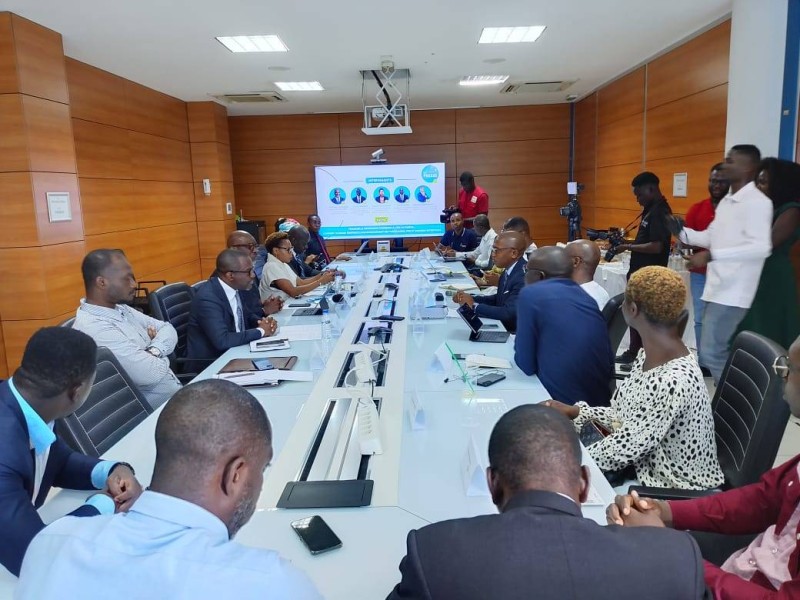

During a press event held in Abidjan-Plateau, the strategic importance of industrialising Côte d’Ivoire took centre stage. Paul-Harry Aithnard, the Director for the UEMOA Region and General Manager of Ecobank Côte d’Ivoire, shared his insights on the nation’s economic trajectory. He emphasised that for the country to achieve full emerging market status, embracing a robust industrial framework is an absolute necessity, drawing parallels with successful global examples like Malaysia.
Lessons from the Malaysian economic model
According to Paul-Harry Aithnard, industrialisation is the primary engine required for the country to truly scale its operations. He pointed out that the current GDP of Côte d’Ivoire stands at approximately 100 billion dollars—a figure identical to where Malaysia stood 25 years ago. By shifting its focus, Malaysia managed to grow its economy from 100 billion to over 400 billion dollars between 2000 and 2025.
The role of financial inclusion and technology
To replicate such success and potentially quadruple the national economy over the next quarter-century, Aithnard advocates for a significant expansion of financial inclusion. He believes it is vital to provide the population with the tools to manage accounts, execute payments, safeguard savings, and access investment opportunities even for those with modest capital.
The key to achieving this widespread inclusion lies in digitalisation. By leveraging modern technology, the country can improve productivity and scale its economic activities while maintaining lower operational costs. This digital shift is seen as a cornerstone for modernising the financial landscape.
Synergy between the private sector and the State
The transformation requires a collaborative effort. The private sector, particularly the banking industry, is expected to support this vision by providing the necessary capital for major infrastructure projects. Ecobank has already made a conscious decision to prioritise the financing of such essential developments.
Simultaneously, the State must fulfill its responsibilities in two critical areas:
- Energy: Strengthening the electricity sector is fundamental, as industrial growth cannot exist without reliable power.
- Education: Reforming the academic system to focus on STEM (Science, Technology, Engineering, and Mathematics) and management is crucial for preparing a qualified workforce.
In his concluding remarks, the General Manager acknowledged the impressive progress made in Côte d’Ivoire‘s energy production capacity in recent years. Furthermore, he noted positive indicators in the education sector, suggesting that the strategic choices being made are moving the nation in the right direction.