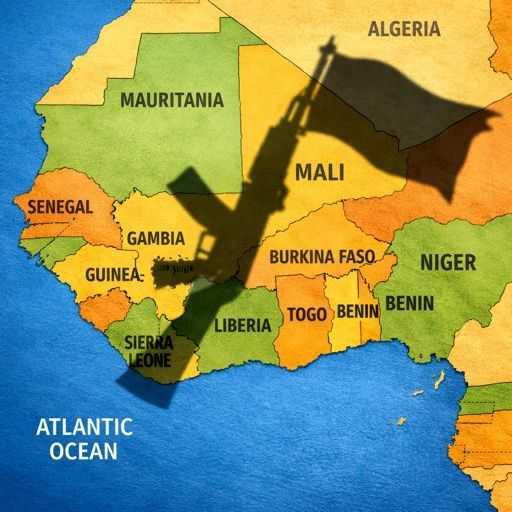

The JNIM’s strategic puzzle: expanding jihadist influence beyond the Sahel
An analysis of how the Jama’at Nusrat al-Islam wal-Muslimin (JNIM)—Al-Qaeda’s affiliate in the Sahel—navigates the challenges of territorial expansion beyond its traditional strongholds in Mali, Niger, and Burkina Faso.
The JNIM has emerged as one of the most powerful armed groups in the central Sahel, establishing a significant presence through multiple katibas (military units) that compete with state authorities for control over local governance. However, recent years have seen the group shift its focus southward, toward the Gulf of Guinea and specifically the northern regions of Benin, Togo, and Côte d’Ivoire. While these movements appear to be a deliberate strategy, their execution reveals unexpected inconsistencies: Ghana remains untouched, Côte d’Ivoire saw attacks between 2020 and 2022 but none since, and Benin has faced a sharp deterioration in security since 2025.
Inside the JNIM’s expansion: a calculated risk or a strategic dilemma?
A recent report by Crisis Group delves into the JNIM’s unconventional expansion strategy, challenging the assumption that territorial growth is always a priority. The findings suggest that expansion is not as straightforward as it seems—it presents internal dilemmas for the group’s leadership. Failing to expand risks losing ground to rival factions or disappointing its own fighters. Yet, growing too quickly could strain resources, dilute cohesion, and increase the likelihood of fragmentation.
Geopolitical context: how regional shifts influence the JNIM’s moves
The current geopolitical landscape in West Africa adds another layer of complexity. The formation of the Alliance of Sahel States (AES), its withdrawal from ECOWAS, and persistent regional tensions create an environment where understanding the JNIM’s internal decision-making processes is critical for developing effective security policies. Countries bordering the Sahel must grapple with the looming threat of armed jihadist groups expanding their reach.
Key insights from the Crisis Group report
The report highlights several critical observations:
- Selective expansion: The JNIM appears to prioritize certain regions while avoiding others, such as Ghana, despite its proximity to active zones.
- Sudden shifts in activity: After a period of attacks in Côte d’Ivoire, the group has remained silent in the region since 2022.
- Accelerated pressure in Benin: The security situation in northern Benin has worsened significantly in 2025, indicating a possible intensification of JNIM operations.
- Internal divisions: Expansion decisions are not universally supported within the JNIM, leading to potential strategic misalignments.
Why this matters for West African security
Analyzing the JNIM’s expansion is not just an academic exercise—it has real-world implications. For policymakers and security analysts, understanding the group’s motivations, constraints, and internal dynamics is essential to crafting responses that address the root causes of jihadist violence rather than merely reacting to its symptoms.
Expert perspectives on the JNIM’s trajectory
To unpack these issues, the report features insights from leading researchers and analysts:
- Jean-Hervé Jézéquel (International Crisis Group):
Director of the Sahel Project at International Crisis Group, Jézéquel focuses on political and security dynamics in the Sahel and its neighboring regions. With a PhD from the École des Hautes Études en Sciences Sociales (EHESS), he brings deep expertise to the discussion.
- Marte Beldé (Sciences Po Bordeaux):
Postdoctoral researcher at Sciences Po Bordeaux, Beldé contributes to the GOVJIHAD project, examining the political economy and spatial expansion of jihadist movements in West Africa. Her 2025 thesis, Contested Fringes, explores Salafi-jihadist expansion in Sikasso, Mali.
- Beatriz de León Cobo (GEMASS – Sorbonne Université):
Doctoral candidate at GEMASS, Cobo studies radicalization and is an Associate Fellow at RUSI (Royal United Services Institute). She also leads the Europe-Sahel Dialogue Forum at the Universidad Francisco de Vitoria in Madrid.
- Dan Sanaren (CERI–Sciences Po / CNRS):
Moderator of the discussion, Sanaren is a researcher at CERI–Sciences Po and CNRS, specializing in Sahel and West African affairs.
What’s next for the Sahel and beyond?
The JNIM’s expansion strategy is a moving target, shaped by internal debates, regional geopolitics, and the group’s evolving priorities. As countries in West Africa confront this challenge, the insights from reports like Crisis Group’s offer a vital roadmap for anticipating and countering the jihadist threat. The stakes are high, but so is the need for nuanced, informed analysis—on the ground Sahel reporting plays a crucial role in shaping effective security policies.