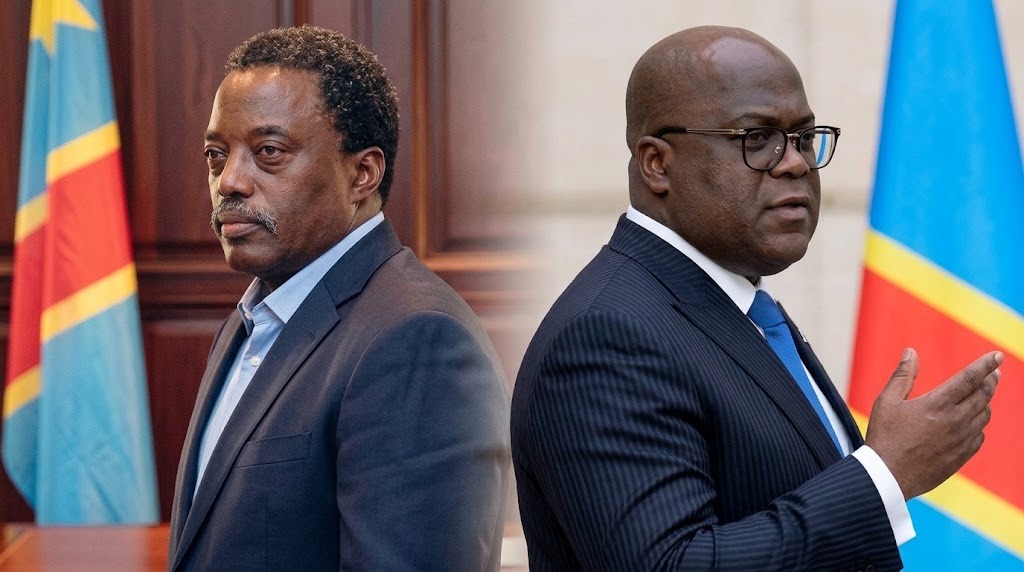

The political and military landscape of eastern Democratic Republic of the Congo has entered a decisive new phase. Former president Joseph Kabila has officially assumed leadership of the Front for the Refoundation of the Nation (FRN), a rebranded politico-military platform unveiled in Goma, the strategic hub of the North Kivu conflict zone.
Rebranding the rebellion: from AFC-M23 to FRN
The transition from the Alliance for the Congo River (AFC) to the FRN represents more than a name change—it signals a strategic overhaul aimed at consolidating rebel factions under a unified command structure. The FRN’s formation brings together key figures from the March 23 Movement (M23) and the AFC, including high-profile leaders such as Corneille Nangaa, Bertrand Bisimwa, and Sultani Makenga.
This merger pools Kabila’s political legacy with the operational strength of armed groups active in the region. The announcement explicitly outlines a confrontational strategy against President Félix Tshisekedi‘s administration, leaving little doubt about the FRN’s intent to escalate both political and military pressure.
Diplomatic rollercoaster: regional tensions escalate
The FRN’s emergence occurs amid escalating diplomatic friction with Rwanda, whose alleged military support for the M23 has long been a flashpoint in regional relations. The inclusion of Kabila—a former head of state with deep political influence—could expand the movement’s appeal beyond its traditional military base, further complicating peace negotiations.
For Kinshasa, the challenge is no longer confined to suppressing armed rebellion; it now faces a multi-pronged opposition that blends political dissent, territorial claims, and cross-border alliances. Kigali, meanwhile, continues to dismiss accusations of involvement while framing its actions as a response to perceived security threats along the DRC border.
Peace talks at a crossroads: new players, old questions
The FRN’s formation coincides with ongoing international mediation efforts to end hostilities in eastern Congo. However, the leadership shift introduces critical uncertainties: Who will represent the rebel factions in negotiations? How will authority structures within the movement be enforced? And can Kabila, currently facing a contumacious death sentence for treason, drive a unified agenda?
The former president has publicly rejected the charges, dismissing them as politically motivated—a stance that could further polarize an already volatile situation. Meanwhile, the international community watches closely, with many questioning whether this restructuring will pave the way for de-escalation or deepen the crisis.
Uncertain future for eastern Congo’s civilians
Behind the political maneuvering, the people of North Kivu and South Kivu bear the brunt of the conflict. Displacement, economic disruption, and persistent insecurity remain daily realities for thousands. The FRN’s formation does little to alleviate these hardships in the short term, leaving residents caught in the balance of shifting power dynamics.
The big question now is whether this new alliance will solidify under Kabila’s leadership or fragment under internal rivalries. One thing is clear: the conflict in eastern Congo has evolved beyond a simple clash between government forces and the M23. With Kabila’s entry, the crisis has taken on a strategic, multi-layered dimension—one that intertwines national politics, military strategy, and regional geopolitics in ways that could redefine the path ahead.