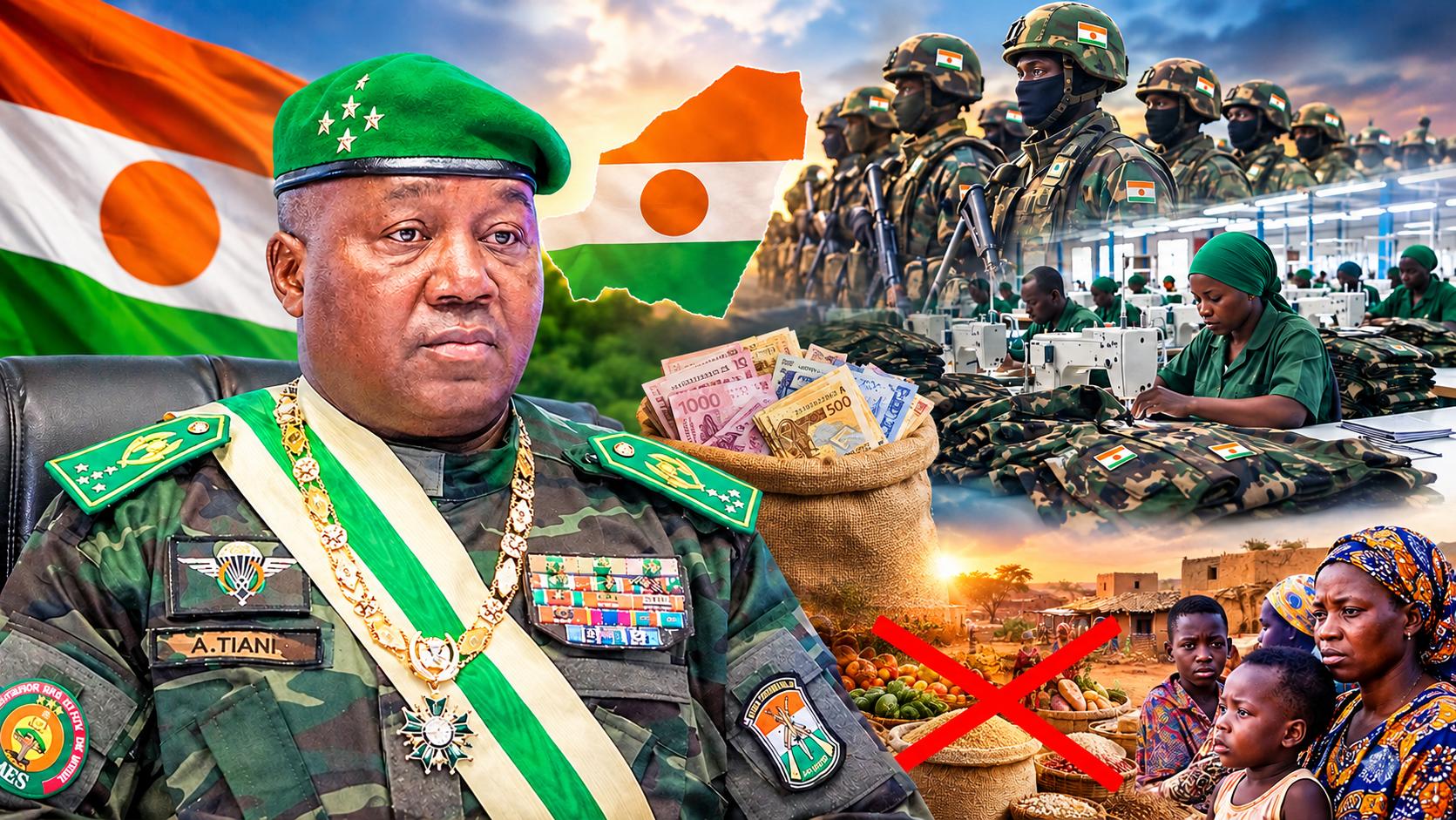

The groundbreaking ceremony for Niger’s newest military uniform production facility, announced as capable of manufacturing 1,000 uniforms daily through domestic funding by the National Solidarity Fund for National Safeguarding (FSSP), has ignited a critical national conversation. With the country navigating persistent security threats and widespread socioeconomic challenges, the central question remains: can this ambitious project deliver the transformative impact Nigeriens desperately need?
From symbolic gesture to tangible impact: redefining military self-sufficiency
At first glance, the facility’s projected annual output of 365,000 uniforms positions it as a potential game-changer in reducing foreign dependence for military attire. However, the true value of this initiative hinges not on production capacity alone, but on tangible outcomes aligned with national priorities. Local manufacturing of military equipment can streamline logistics and reduce supply chain vulnerabilities, but only if the output matches actual operational needs.
Key operational questions persist: How many uniforms do Niger’s armed forces require annually? What criteria govern distribution across military branches and regional units? Without transparent data on demand forecasting, procurement cycles, and inventory management, the facility risks becoming a showcase project with limited operational utility.
Beyond clothing: addressing the multidimensional security crisis
A uniform, while essential, represents only one component of a comprehensive security apparatus. True progress in combating armed groups demands parallel investment in intelligence systems, logistical infrastructure, personnel training, and civil protection programs. The government must demonstrate how uniform production integrates with broader security strategies rather than serving as a standalone initiative.
The FSSP funding dilemma: balancing national solidarity with development priorities
The decision to finance the facility through the FSSP established to pool national resources for urgent needs has intensified public scrutiny. In a nation where families grapple with food insecurity, economic hardship, and disrupted livelihoods, every franc allocated must justify its societal return. Citizens deserve clarity on several fronts: the total project cost, the FSSP’s specific contribution, employment generation, and revenue projections.
Transparency is not negotiable. If the facility relies on public funds, the public has a right to know how its contributions translate into measurable benefits whether through cost savings, job creation, or enhanced security delivery.
Employment and economic spillover: more than just numbers
Proponents argue the facility will create jobs, but how many? Under what conditions? Will these positions support local communities through fair wages and skill development? Equally critical is the project’s long-term financial sustainability. Will the unit operate as a self-financing entity, or will it become a recurring fiscal burden? Without a detailed operational model, the benefits remain speculative.
Regional industrial ambitions: alignment or duplication?
Niger’s initiative reflects a broader trend across the Sahel Alliance (AES), where neighboring states also prioritize local production to reduce external dependencies. While autonomy is a legitimate goal, the risk of uncoordinated industrial projects looms large. Are these initiatives strategically integrated, or do they represent isolated responses to shared challenges?
Sustainable industrialization depends on factors beyond mere output: access to raw materials, supply chain resilience, market demand, and operational efficiency. Without a coordinated regional framework, Niger risks investing in infrastructure that cannot compete with established production centers or that duplicates efforts elsewhere.
The cost-benefit reality: local vs. imported uniforms
Theoretical efficiency gains from local production are meaningless without cost transparency. How does the per-unit cost of domestically manufactured uniforms compare to imported alternatives? What quantities are required to achieve economies of scale? Will the government realize net savings, or will maintenance, utilities, and labor costs outweigh initial benefits? These calculations must be publicly available to assess the project’s economic viability.
Connecting security with citizen welfare: a unified approach
Niger’s security challenges cannot be divorced from its socioeconomic realities. Pervasive food insecurity, strained healthcare systems, and declining purchasing power demand urgent attention. How will the government balance defense spending with investments in social protection, agricultural resilience, and public services?
A prosperous, secure population is better equipped to withstand crises. Rather than viewing industrial projects and social programs as competing priorities, authorities should present a cohesive vision where both sectors reinforce each other. The uniform factory cannot function as a standalone solution; it must be part of a comprehensive strategy addressing immediate needs while building long-term stability.
Accountability through measurable outcomes
For a project of this magnitude, the government bears the burden of proof. It must provide verifiable data on production schedules, distribution logistics, employment terms, and financial sustainability. Citizens and stakeholders alike require concrete benchmarks to evaluate success: reduced uniform procurement costs, improved military operational readiness, and tangible benefits for local communities.
Without these assurances, the facility risks becoming another unfulfilled promise an exercise in symbolism without substance. The true turning point for Niger will not be measured by the number of uniforms produced, but by the improvement in security, employment, and quality of life that follows.
Conclusion: transforming potential into reality
The military uniform facility represents a bold step toward self-reliance, but its success hinges on more than ambitious announcements. It demands rigorous planning, transparent governance, and alignment with the pressing needs of Niger’s people. As the nation charts its path forward, the measure of this initiative’s worth will be the tangible difference it makes in the lives of its citizens.
By Idriss MAMADOU — Journaliste / Rédacteur