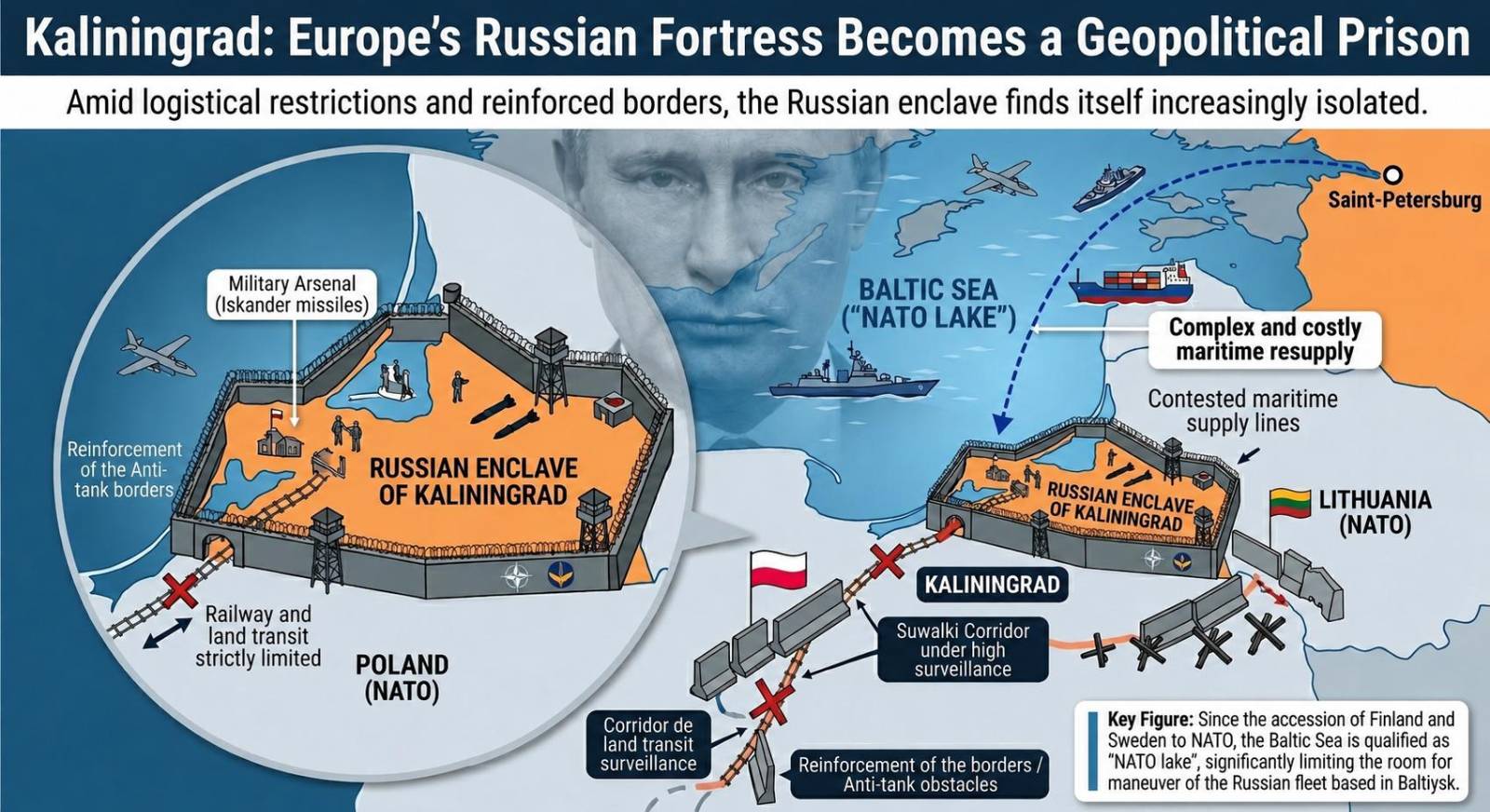

Once a formidable military bastion for Moscow deep within Europe, the Kaliningrad exclave now faces an unprecedented tightening of controls from neighboring NATO states. Between tightened logistics and fortified borders, the Russian territory is slipping into deeper isolation.
This is a pivotal strategic shift unfolding along the eastern edges of the European Union. Kaliningrad, Moscow’s ultra-militarized outpost wedged between Poland and Lithuania, is experiencing an unparalleled connectivity crisis. Long regarded by the Kremlin as a formidable forward position capable of projecting firepower—particularly through its Iskander missile systems—deep into European territory, the enclave now resembles a besieged fortress severed from the outside world.
Logistics under siege: the tightening noose around Kaliningrad
The breakdown has not been abrupt but the result of a deliberate, step-by-step strangulation. Poland, Lithuania, and Latvia have progressively hardened transit conditions into the exclave:
- Rail infrastructure: The Suwałki corridor, the critical land bridge linking Belarus to Kaliningrad, is under heightened scrutiny. Shipments via the Soviet-era rail network have been slashed to the bare minimum permitted under European sanctions.
- Energy transit: Fuel and energy flows overland have plummeted, forcing Moscow into costly and complex resupply operations via the Baltic Sea to prevent paralysis.
- Border fortifications: On the ground, access has been all but sealed by physical barriers. Poland and Lithuania have erected anti-tank obstacles and razor-wire lines, effectively sealing their borders with the Russian territory.
A pivotal statistic: Since Finland and Sweden joined NATO, the Baltic Sea has been redefined as an “NATO lake,” severely narrowing operational space for Russia’s Baltic Fleet based in Baltiysk.
Is Kaliningrad becoming a logistical trap for the Kremlin?
For Vladimir Putin, the situation in Kaliningrad presents a top-tier strategic challenge. Though the enclave remains heavily armed, its resilience in prolonged conflict is increasingly questioned by military analysts. Cut off from smooth overland links to mainland Russia, Russian forces there rely entirely on contested maritime and aerial supply lines.
Some observers warn that what Moscow once viewed as its “sharpest blade” against the West may now be a liability: in any open confrontation, the territory would find itself isolated, encircled by a united and vigilant NATO force.
Diplomatic deadlock looms
In response to this de facto blockade, Moscow repeatedly condemns what it calls a breach of international treaties guaranteeing free transit to its outlying regions, threatening retaliation. Yet Poland, Lithuania, and Latvia—backed by their Western allies—justify the measures as vital security imperatives in light of Russia’s aggressive posture in Ukraine.
The pressing question now is how far this logistical war of attrition can escalate before igniting a military flashpoint in one of the world’s most heavily militarized zones.