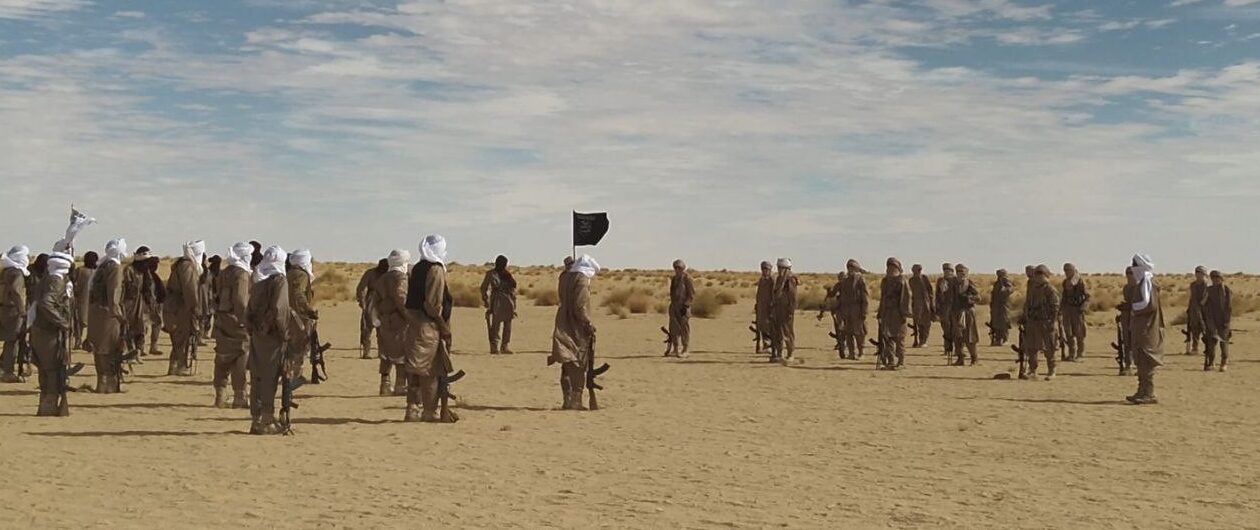

Northern and central Mali are no longer merely enduring the threat of sporadic armed assaults. For several years, these regions have been plunged into a relentless state of permanent warfare, leading to the constant exhaustion of local populations. Recent offensives by the Jama’at Nusrat al-Islam wal Muslimeen (JNIM) and the Front de Libération de l’Azawad (FLA) against military installations, supply convoys, and critical road infrastructure signal a significant strategic evolution in the conflict.
These armed factions are no longer solely focused on seizing specific towns or executing spectacular operations. Their objective has shifted to progressively rendering vast swathes of territory beyond the control of the military junta, effectively cornering the government within its last strongholds in Bamako.
This tactical transformation is crucial because it fundamentally alters the core dynamics of the conflict. The central question is no longer who controls a particular city or military camp. Instead, it has become: who can still ensure the movement of people, goods, fuel, administrative personnel, or public services?
a war against mobility
For months, attacks targeting vital road networks and military convoys have intensified across Mali. In several regions, administrative travel has become increasingly difficult, often requiring heavily armed escorts. This phenomenon profoundly weakens not only the Malian army but also the state’s practical capacity to maintain a presence and exert authority beyond major urban centers.
The JNIM appears to have grasped a fundamental truth: in a state already weakened by years of institutional, economic, and security crises, a sustained campaign of attrition can yield greater political results than direct, frontal confrontations.
This strategy is considerably less costly than traditional territorial conquest. It allows for the dispersal of opposing forces, escalates security expenditures, and perpetuates a pervasive sense of insecurity. Crucially, it fosters collective fatigue—military exhaustion, economic strain, and social weariness.
In numerous rural areas, the primary concern is no longer just the presence of armed groups. It is the gradual and alarming absence of any stable administrative horizon.
the limits of a purely military approach
The Malian military leadership has made security restoration a cornerstone of its political legitimacy since the successive coups. The departure of French forces and the subsequent increase in Russian military cooperation were presented as a powerful return to national sovereignty.
However, sovereignty is not solely measured by the capacity to conduct military operations. It is also defined by the ability to maintain territorial, economic, and administrative continuity.
Herein lies Mali’s paradox: military intensification does not necessarily translate into lasting stabilization. In certain regions, it coexists with an increasing fragmentation of rural spaces.
The prevailing security strategy relies heavily on offensive operations, airstrikes, and military deployments. Yet, it continues to struggle in rebuilding a sustainable administrative presence, including schools, health services, local justice, infrastructure, and economic circulation.
The resulting vacuum generates its own destructive dynamics. As public services disappear, local populations become increasingly reliant on parallel systems for protection, arbitration, or sheer survival.
the Sahel: a zone of armed recomposition
The Malian situation now transcends its national borders. The entire Sahelian belt is experiencing a rapid recomposition of armed actors, local alliances, and clandestine economic networks.
The porous borders between Mali, Burkina Faso, and Niger facilitate the mobility of armed groups. State responses, however, largely remain national, while insurgent dynamics are distinctly regional. More strikingly, the political-military alliance formed by these three nations has proven incapable of providing mutual assistance. The JNIM and FLA offensive starkly exposed the fragility of this alliance and the isolation of the Malian military junta, whose sole external support comes from Africa Corps mercenaries.
This asymmetry favors groups capable of rapid adaptation. The JNIM, in particular, benefits from its territorial flexibility, its ability to establish local roots in certain areas, and its integration into informal economic networks.
This does not imply that it maintains lasting control over all territories it traverses. However, it consistently succeeds in imposing a severe security cost on the states involved.
The Sahelian conflict is thus evolving into a war of political endurance. Armed groups are less interested in fully administering a country than in persistently preventing states from functioning normally.
what the Malian crisis reveals
The Malian crisis also highlights the limitations of a strictly counter-terrorism interpretation of the Sahel. Reducing the crisis to a simple military confrontation obscures the profound social, economic, and territorial dimensions of the conflict.
In numerous rural zones, frustrations stemming from state abandonment, land disputes, communal rivalries, or structural poverty fuel areas of persistent vulnerability. Jihadist armed groups exploit these existing fractures; they do not always create them but are adept at leveraging them.
The central problem, therefore, becomes political: how to reconstruct state legitimacy in territories where the state often appears intermittently, primarily in a military guise?
This is likely where the future of Mali will be determined. Not in a single decisive battle, but in the capacity—or incapacity—to rebuild a stable public presence that extends beyond security operations.
Because a war of attrition does not merely destroy military positions. It erodes roads, the economy, administrations, social bonds, and ultimately, the very concept of a governed territory.