
The Malian junta’s decision to prioritize counterinsurgency operations against Tuareg rebels in the North following the 2021 deployment of Russian mercenaries has backfired, analysts warn. The move allowed jihadist factions like the Group for the Support of Islam and Muslims (GSIM) and Islamic State in the Greater Sahara (ISGS) to expand their influence, tightening economic strangleholds and imposing blockades.
Military escalation and civilian toll
With the backing of Russia’s Africa Corps, Malian forces launched aggressive campaigns in northern regions, leading to thousands of civilian deaths under the guise of targeting rebels or terrorists. Many of these operations involved summary executions, fueling cycles of violence that inadvertently bolstered recruitment for jihadist groups. Analyst Wassim Nasr observed, «While the junta focused its firepower on desert outposts, GSIM’s influence quietly grew around Bamako. Their fixation on reclaiming the North backfired, feeding into the group’s propaganda narrative.»
In January 2024, the junta abandoned the Algiers Accords—a 2015 peace agreement between the then-democratic government and the Azawad Liberation Front (FLA)—launching a renewed offensive. By November 2023, Malian forces, supported by Wagner Group mercenaries, had retaken the Tuareg stronghold of Kidal, exacerbating tensions in the region.
Terrorist expansion and economic strangulation
As the junta diverted resources to crush Tuareg resistance, GSIM and ISGS militants seized control of central Mali, encircling the capital. Their blockade of supply routes from Senegal and Côte d’Ivoire crippled trade, further destabilizing the nation’s economy. The junta’s decision to sever ties with France in 2022—ending decades of counterterrorism cooperation under Barkhane and Serval operations—left a critical security vacuum, which the junta attempted to fill with Russian mercenaries.
By late 2023, the junta expelled the UN’s MINUSMA peacekeeping mission, replacing it with brutal counterterrorism campaigns led by Wagner fighters. The most notorious of these was the three-day assault on Moura in central Mali, where hundreds of Fulani civilians were executed. These atrocities not only alienated local populations but also drove more recruits into the arms of GSIM, ISGS, and the FLA.
Nasr criticized the junta’s failure to address civilian needs, stating, «Their only project is: “We hate France. We hate the West.” They’ve built no schools, no roads—just destruction.»
Mercenary retreat and strategic collapse
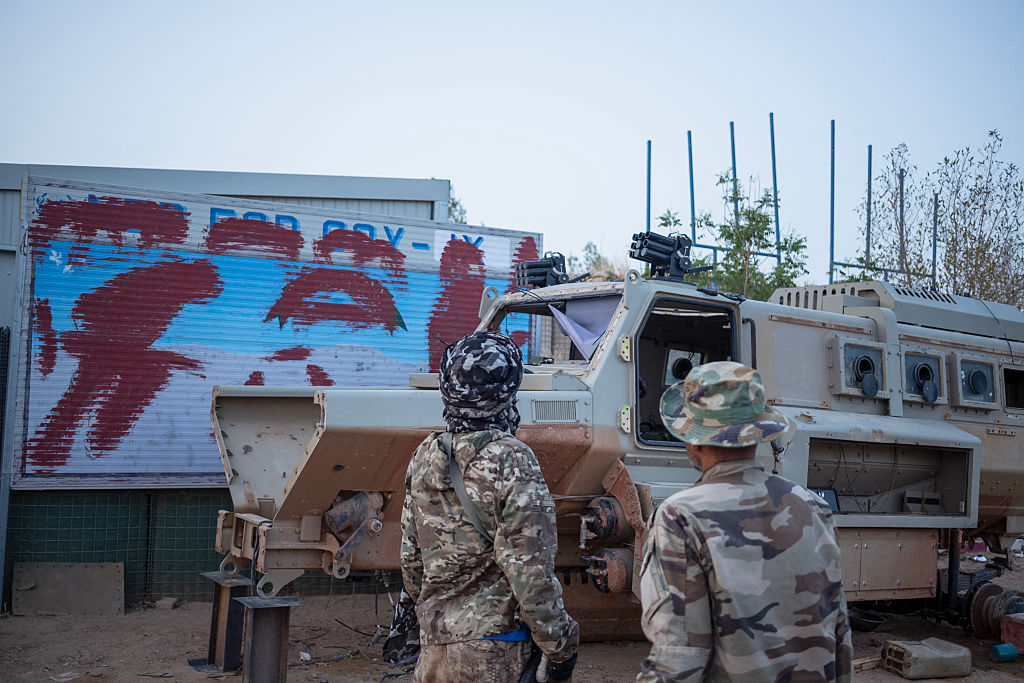
The Wagner Group’s brutal campaign ended abruptly in July 2024 near Tin Zaouatine in northern Mali. Tuareg fighters ambushed a joint Malian-Wagner force, driving them back into GSIM-held territory. The ambush resulted in nearly 50 Malian soldiers and over 80 mercenaries killed. Nasr described the defeat as a turning point: «Wagner ceased to be Wagner—their label changed, and within weeks, they announced their withdrawal from Mali.» The Africa Corps, staffed by Wagner veterans, took over, but its operations grew increasingly limited.
Instead of frontline combat, the Africa Corps now relies on drone surveillance and refrains from risky engagements. Nasr noted, «They still venture out, but with far less confidence.» In late April, during a joint operation to defend Kidal from a GSIM-FLA assault, the Africa Corps fled, allowing the FLA to seize the city. Hours later, the Malian Defense Minister was killed in a separate attack.
Desperate reliance on mercenaries
Facing battlefield defeats, the Africa Corps now prioritizes protecting the junta rather than combating insurgents. Nasr explained, «Their goal is to shield Bamako’s international airport and safeguard fuel and supply routes from GSIM blockades.» The junta shows no signs of negotiating with GSIM or the FLA, clinging instead to mercenary support as its lifeline.
Nasr concluded, «They have no choice. Isolated internationally, they’re trapped. They keep paying because the Africa Corps is their lifeline.»