
The already fragile security situation in Mali took a sharp turn for the worse in late April 2026, when coordinated attacks struck multiple cities and claimed the lives of Defense Minister Sadio Camara and several Malian soldiers.
These incidents are part of a rising wave of violence against the army and state institutions that has intensified over recent years. Through over a decade of research on insecurity and politics in West Africa and the Sahel, it has become clear that the roots of these attacks lie in unaddressed grievances from the Touareg communities—nomadic Berber groups in northern Mali.
Why the touareg crisis persists
Three critical factors continue to fuel instability in northern Mali:
Unmet political and cultural demands: The Touareg people have long sought greater autonomy, cultural recognition, and a voice in national governance. These demands have consistently been ignored or suppressed, deepening their alienation from the Malian state.
Militarized responses with heavy civilian tolls: Repeated military crackdowns in the north have resulted in significant collateral damage, including civilian casualties, forced displacements, and collective punishments such as arbitrary arrests. Such actions have eroded trust in the state and fueled resentment among the Touareg population.
Economic marginalization and resource inequality: The northern regions of Mali, rich in gold deposits, salt mines, grazing lands, and strategic trade routes, remain economically neglected. Revenue from these resources flows mainly to the southern-central parts of the country, leaving northern communities in poverty and disenfranchisement.
Escalation and historical parallels
In April 2026, the Group for the Support of Islam and Muslims (JNIM) joined forces with the Front for the Liberation of Azawad (FLA), a Touareg rebel group, to launch coordinated attacks across the country. This mirrors a similar pattern from 2012, when Touareg separatists—backed by Al-Qaeda affiliates—launched an offensive against the Malian state.
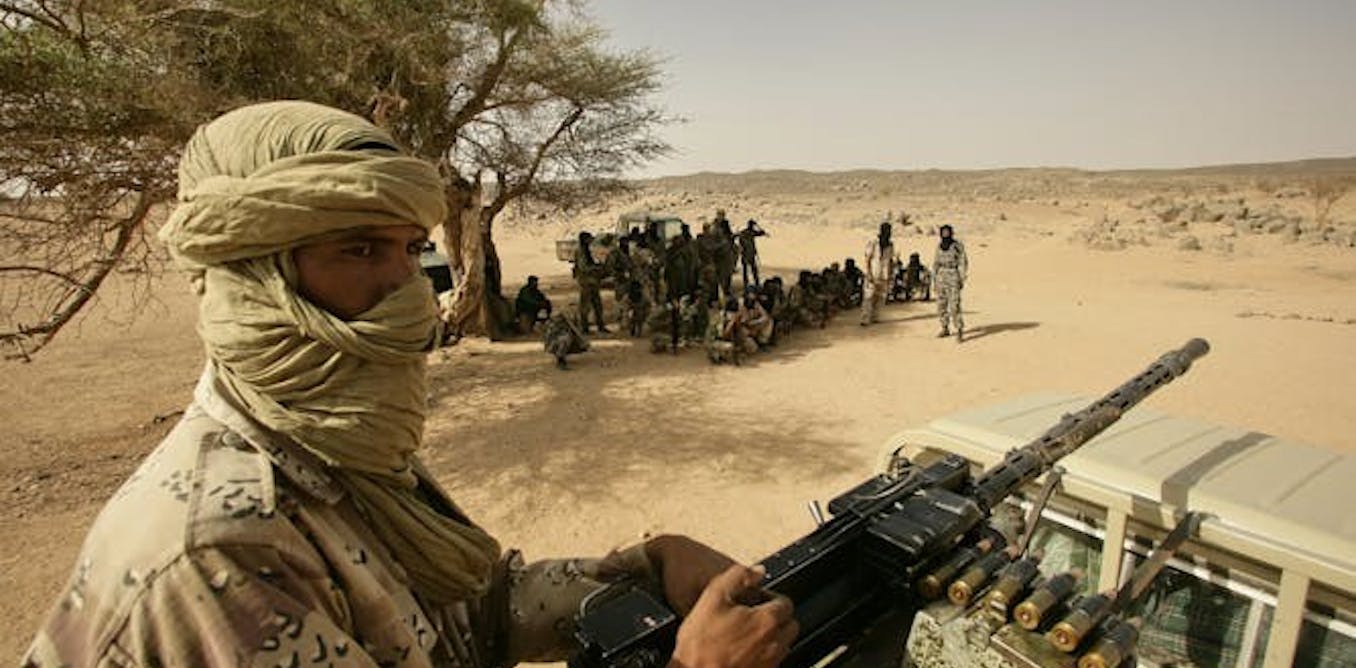
The National Movement for the Liberation of Azawad (MNLA), a predominantly Touareg separatist movement founded in 2011, initially sought to secede. At its peak in 2012, it fielded around 10,000 fighters, many former combatants returning from Libya. However, lacking the military strength to hold territory, the MNLA formed alliances with Islamist groups like Ansar Dine, Al-Qaeda in the Islamic Maghreb (AQIM), and the Movement for Oneness and Jihad in West Africa (MUJAO).
After briefly capturing major cities such as Gao, Timbuktu, and Kidal, the alliance collapsed as the better-armed Islamists turned on their former allies. The French military intervention in 2013 helped the Malian government regain control, but Islamist forces retreated into remote mountain and desert strongholds, adopting guerrilla tactics including suicide bombings and landmines.
The withdrawal of French forces in 2022 removed a key counterterrorism pressure point, creating a security vacuum that allowed Islamist groups to regain influence, expand operations, and recruit locally by exploiting local grievances—especially among marginalized communities like the Touareg.
Forgotten lessons and structural failures
The current military regime under Assimi Goïta has failed to address the core demands of the Touareg people. Since independence in 1960, successive governments have marginalized northern populations, ignoring their calls for autonomy and equitable representation. Structural inequality persists, with public investment, infrastructure, and social services concentrated in the south.
Climate change has worsened the crisis, with drought, desertification, and erratic rainfall devastating pastoral livelihoods—the backbone of the Touareg economy. These environmental pressures, combined with political exclusion and economic neglect, have made the region fertile ground for recruitment by Islamist groups.
Previous peace agreements promised decentralization, financial support, and integration of former combatants, but implementation has been slow or nonexistent. This failure has perpetuated a cycle of violence, with civilians bearing the brunt of military operations and Islamist retaliation alike.
A path forward: lessons from Niger
To break this cycle, the Malian government could draw inspiration from Mahamadou Issoufou, former President of Niger. During his presidency from 2011 to 2021, Issoufou:
Integrated Touareg leaders and former rebels into state institutions, giving them representation and political legitimacy.
Decentralized governance by devolving administrative and budgetary control to regional authorities, empowering local communities.
Launched disarmament, demobilization, and reintegration (DDR) programs to reintegrate former fighters into civilian life.
Invested in critical infrastructure tailored to Touareg needs: water access, rural roads, pastoral support, and education.
By addressing the underlying grievances of marginalized groups—such as the Touareg—Mali could reduce support for armed groups, restore state legitimacy, and pave the way for sustainable peace.