
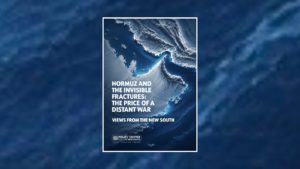
— A comprehensive collective work examines the global repercussions of conflict
A recent collective publication, “Hormuz and the Invisible Fractures: the Price of a Distant War,” released by the Policy Center for the New South (PCNS), delves into the far-reaching geopolitical, economic, and security consequences of the ongoing conflict involving Iran, the United States, and Israel, along with the escalating tensions surrounding the Strait of Hormuz.
This significant volume brings together insights from a diverse group of international experts, including Abdelhak Bassou, Ferid Belhaj, Ian Lesser, Hafez Ghanem, Hinh T. Dinh, and Rida Lyammouri. Their contributions collectively explore the conflict’s ripple effects across various global regions, with a particular emphasis on its implications for Morocco, the broader African continent, and the nations of the Global South.
The authors unanimously conclude that the crisis in Hormuz transcends a mere regional dispute. It starkly exposes the inherent fragilities within a globalized economy that remains heavily reliant on the uninterrupted flow of energy, commerce, and logistics through this crucial maritime chokepoint. A substantial portion of the world’s oil, natural gas, fertilizers, and international trade navigates these strategic waters.
One pivotal chapter within the book, authored by economist Hinh T. Dinh, specifically analyzes the potential impact of a 20% surge in oil prices on the economies of Morocco, Tunisia, and Egypt.
Utilizing a sophisticated input-output economic model, the study’s findings indicate that Morocco stands out as the North African nation most susceptible to the fallout from an oil price shock triggered by a crisis in Hormuz. The analysis pinpoints significant vulnerabilities across several key Moroccan sectors, notably agriculture, construction, transport, and various other activities deeply dependent on energy products.
Conversely, Egypt is projected to experience a partial benefit from elevated oil prices, primarily due to increased state revenues from its petroleum sector. Tunisia, while showing a generally balanced overall outcome, would still contend with considerable disparities in impact across its different economic sectors.
+ Questioning the international order +
Beyond the immediate economic ramifications, several contributors to the volume argue that the 2026 conflict represents a pivotal moment in the evolution of the international order.
Ferid Belhaj suggests that the conflict underscores the increasing fragmentation of the global system and the erosion of traditional mechanisms for international cooperation and deterrence. Marcus Vinicius de Freitas, for his part, interprets these events as signaling the emergence of a more multipolar world, where conflicts are often managed rather than definitively resolved.
In another insightful contribution, Ian Lesser examines the war’s repercussions on transatlantic relations. He posits that the conflict has exacerbated existing divergences between the United States and several European nations regarding the appropriate use of force and the management of international crises.
The collective work also highlights the significant risks to African energy security, the delicate balances within the Sahel region, and the economies of South America. Furthermore, it emphasizes the growing strategic importance of critical minerals in shaping new global geopolitical dynamics.
According to the PCNS, this collaborative effort serves as a vital contribution to the ongoing discourse surrounding the transformations of the international order. It aims to inform strategies that states must consider adopting in the face of potential crises capable of profoundly disrupting global supply chains, energy markets, and geopolitical equilibrium.