
The hidden drivers behind Niger’s sweeping exclusion of the Mohamid people
Recent directives from Niger’s Interior Ministry have thrust the Mohamid community into the spotlight, raising urgent questions about the motivations and systemic factors behind state-imposed sanctions. While officials cite security concerns, the measures—ranging from school closures to revoked identity documents—extend punishment far beyond individual wrongdoing, exposing a deeper crisis in governance.
What the October 7 directive reveals about state power and collective punishment
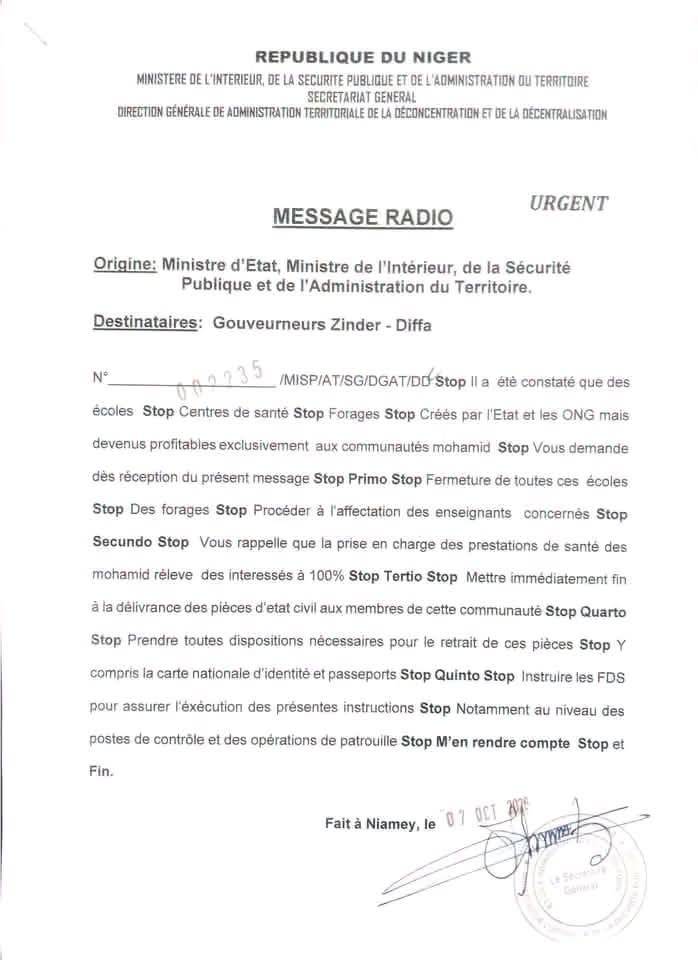
On October 7, 2026, an official radio announcement from Niger’s Interior Ministry sent shockwaves through the regions of Zinder and Diffa. Notarized instructions ordered the immediate shuttering of schools and water pumps serving the Mohamid population, the reassignment of teachers in those facilities, and the suspension of public healthcare support for the group. Even more concerning was the directive to cease issuing or withdraw civil documents, including national ID cards and passports, effectively rendering thousands of citizens stateless in administrative limbo.
The order also tasked security forces with enforcing these punitive measures, blurring the line between public safety and collective retribution. Observers note that such broad strokes contradict constitutional principles, which guarantee equal access to education, water, healthcare, and legal documentation for all Nigerien citizens.
Essential rights weaponized: how state policies erode human dignity
At the heart of this controversy lies a disturbing trend: the transformation of fundamental rights into tools of control. Schools, water sources, and healthcare systems are not favors bestowed by authorities; they are lifelines that sustain communities. In Niger’s arid Sahelian zones, where water scarcity is a daily struggle, cutting off access to vital resources like boreholes could devastate livelihoods reliant on agriculture and livestock.
Similarly, disrupting education disrupts futures. Children in these communities face an uncertain path forward, their education abruptly halted. The suspension of healthcare coverage exposes vulnerable households to the harsh reality of inaccessible medical services, while the withdrawal of identification documents strips individuals of their basic legal identity—necessary for everything from travel to land ownership.
Critics argue that proportionality and due process are conspicuously absent in these measures. Instead of investigating specific cases of abuse and applying targeted punishments, the directives blanket an entire ethnic group with penalties, raising grave concerns about discrimination under the guise of national security.
Security versus civil liberties: can Niger balance both?
Niger faces real security threats, particularly in the east where armed groups and trafficking networks operate. Authorities defend their actions as necessary to curb instability, insisting the measures target communities perceived as harboring threats. Yet, this logic assumes guilt by association—a principle incompatible with the rule of law.
National security cannot justify collective punishment. The presumption of innocence and the principle of individual responsibility are cornerstones of any democratic society. If criminal acts are suspected, investigations must follow legal procedures, not sweeping administrative edicts. The absence of transparent evidence linking the entire Mohamid community to security breaches undermines the legitimacy of these policies.
This dilemma is not unique to the Mohamid case. Since the July 2023 military takeover, Niger’s transitional government has faced criticism for narrowing civic freedoms. Political parties have been dissolved, civil society organizations restricted, and journalists targeted. These actions, combined with recent moves like the revocation of nationality from opposition figures, paint a picture of a regime increasingly willing to wield administrative power to suppress dissent and marginalize perceived threats.
Economic ripple effects: how exclusion harms more than just the targeted group
The Mohamid community contributes to Niger’s economy through trade, transportation, and livestock rearing. When entire populations are isolated, the impact reverberates beyond the community itself. Local markets feel the strain as commerce slows, transport networks face disruptions, and agricultural production declines due to reduced labor and trade activity.
For example, the closure of schools and water sources disrupts daily life for Mohamid families, but it also affects neighboring communities who rely on the same infrastructure or whose economies depend on interactions with the Mohamid people. The withdrawal of civil documents further complicates economic participation, as legal identity is essential for conducting business or accessing financial services.
These measures, therefore, do not just target one group—they risk destabilizing the social and economic fabric of the regions where they are enforced.
Accountability and remedies: what the state owes the Mohamid people
For a government sworn to uphold the rights of all citizens, the current approach raises critical questions: On what legal or evidentiary basis were these measures justified? What avenues exist for appeal or redress for those affected? And how can the state ensure that punitive actions do not inflict disproportionate harm on innocent civilians?
Transparency must be the first step. Authorities should publicly disclose the reasoning behind the October directive, the evidence supporting its necessity, and the legal framework underpinning it. An independent investigation into the implementation of these measures could also shed light on unintended consequences and identify those responsible for oversight failures.
Moreover, the government must guarantee the continuity of essential services like education and healthcare for all Nigeriens, regardless of ethnic or tribal affiliation. Any revocation of civil documents should be conducted on an individual basis, following due process and with full opportunity for affected persons to contest the decisions.
Beyond Mohamid: a test of Niger’s democratic foundations
The treatment of the Mohamid community is not merely an internal matter—it is a litmus test for Niger’s commitment to equality before the law. When the state resorts to collective punishment, it undermines the very institutions meant to protect its people. It sends a message that citizenship is conditional, that rights are privileges to be granted or revoked at will.
Niger’s future stability depends on more than military strength or administrative control. It hinges on the ability to uphold the rights and dignity of every citizen, even in the face of security challenges. The Mohamid case forces the nation to confront a fundamental question: Can a state protect itself without sacrificing the principles of justice and equality that define its legitimacy?