Ousmane Sonko’s semantic shift: from firebrand to peacemaker
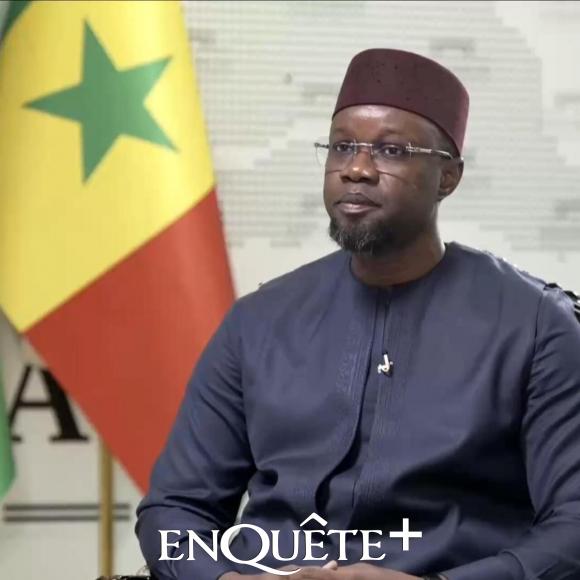
Since leaving the prime minister’s office, Ousmane Sonko has noticeably softened his rhetoric. More measured, more nuanced, less combative, the Pastef leader now wears the cloak of a peacemaker, attempting to erase his earlier warlike image.
“Pastef has become a mature party.” Ousmane Sonko declared this a few days ago in Diamniadio during the party congress. He urged his often aggressive and confrontational supporters to reconsider their public behaviour. “We must change how we speak, because we are watched by everyone, including religious leaders, family fathers… Insults, jeers, abuse — none of that elevates us,” he told a crowd fully behind him. Aware that he must set an example, the former prime minister has grown much more restrained in his public appearances recently. Observers wonder whether the Pastef president has undergone a transformation. His recent interview seemed to signal a metamorphosis.
According to analysts, Sonko not only defended his record or commented on the break with President Bassirou Diomaye Faye. He especially outlined the contours of a new political persona — a man who now intends to exercise power differently, from the speaker’s chair of the National Assembly, turning a dismissal into a new launchpad.
Typically bellicose, Sonko has considerably revised his discourse since leaving the executive branch. The man of rallies appears to be becoming a man of balances. The tribune may gradually be turning into an arbiter. Whether this transformation represents political maturation or merely a step on the road to 2029 remains to be seen.
One thing is certain: the Pastef leader is far from consistent in his messaging. He can make a statement in the morning and contradict it by evening, depending on the objective and the audience. Recently, in a media appearance, he was notably composed, measured, weighing every word. On issues where he was previously unequivocal — such as debt restructuring — he now showed much more nuance. When asked whether he would oppose restructuring, he replied: “We are not in absolute, fixed positions. We will examine the situation lucidly.”
Contradictions and nuances in the discourse
What matters most, he said, is what is put on the table. “A wild restructuring — we never wanted that. As prime minister, I always opposed it because conditions did not require it… As outgoing prime minister, I know we are living through a rather tense period. We will assess; we are not here to obstruct. But if solutions are not in Sénégal’s interest, we will not accept them.” When reminded of his earlier calls for debt cancellation, Sonko first backpedaled, then got lost in explanations. “You talk about odious debt. I used that term once or twice. It is a whole procedure.” He continued more confusingly: “I did not have all the levers. When I spoke on certain occasions, it was as party leader giving an opinion. Do not forget that I was merely prime minister. And the powers of the prime minister in this country are extremely limited.” Asked if he had discussed this with the president, he retorted: “We never discussed it. We have always been on the same page regarding the debt. Up to our last discussion. He reaffirmed that the position has not changed.” Then he backtracked to assume his position on odious debt.
“That debt is indeed partly odious. It takes political courage to bring this debate. As a politician, I have said it many times. I hope the current executive will take its responsibility and go in that direction to negotiate cancellation of part of the debt…” The journalist cut him off, asking why he did not do it when he was prime minister. Sonko laconically and unconvincingly replied: “It was proposed, it was proposed.” Notably, the last time Sonko spoke about odious debt was during his appearance at the National Assembly on 22 May during question time, when he was prime minister, not party leader.
Also, for a rare, perhaps first time, the National Assembly president spoke of “wild restructuring.” He had previously categorically rejected any idea of restructuring. So what changed? Is the leader hiding his true intentions? The question is legitimate.
On the issue of homosexuality, Sonko was more precise. He stands by his positions but recalled some truths he often seemed to forget. He noted that the criminalisation of homosexuality dates back to the Senghor era, and that there had been arrests before Pastef. However, his justifications seemed contradictory to his earlier communication. Reacting to journalists, he said: “The arrests occurred before the vote on the law to toughen penalties. It stemmed from two things: the practice of homosexuality linked to the deliberate transmission of HIV. The Western press seems to want to ignore this second, extremely important aspect.” Yet a few days earlier in the hemicycle, he recounted discussions with one of his ministers, appearing to fully embrace the crackdown. “The other day, I talked to one of my ministers. He said, yes, the goal is to break the HIV transmission chain. I told him no. The main objective is to stop the proliferation of the phenomenon,” he fumed. Those remarks were widely picked up by his opposition rivals.
The apostle of peace
On another front, speaking about President Bassirou Diomaye Faye, Sonko avoids incendiary statements, as he has done for some time. He even rejects the word “betrayal”, saying it belongs to the realm of affection and morality. Sonko now wants to embody political correctness. He does not believe there is a quarrel between him and the head of state — only political differences, he says.
This change in trajectory and communication strategy was already laid out by Sonko in Diamniadio. For him, Pastef, now a mature party, must be exemplary in all aspects. “Pastef is a party of ideas, a party of science, a party of programme… Show that you are a well-educated youth, an intellectual youth, an intelligent youth, a civic youth. Do not give in to provocation. The only strategy left for the other side is to make what happened in 2021-2024 happen again…” According to Sonko, the opposing camp, lacking legitimacy, simply wants to push them onto the streets, then portray Pastef as a belligerent, conflict-driven party. “Do not fall into that trap,” he warned.