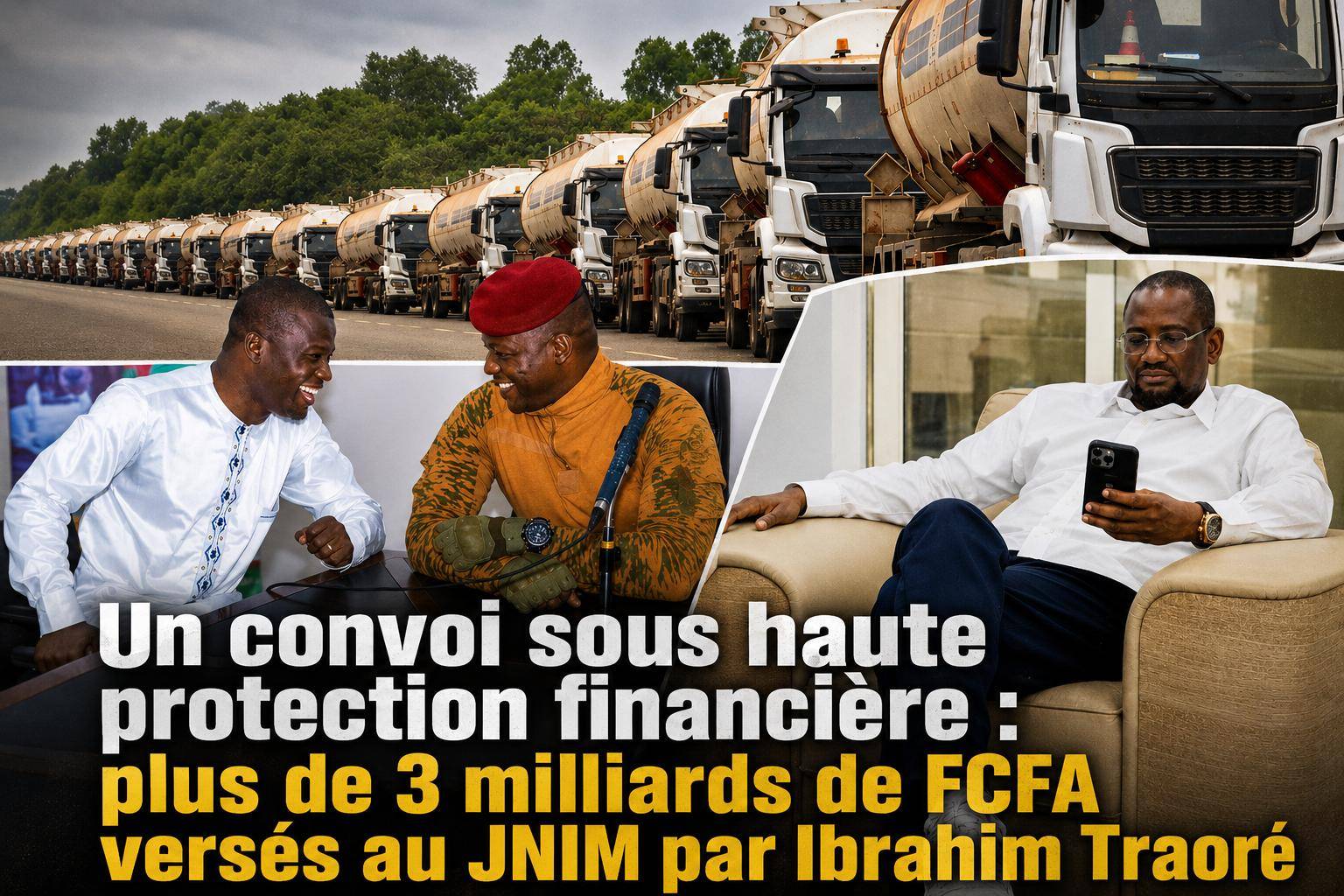

In the heart of the Sahel, a scandal is rocking the Alliance of Sahel States (AES), where official narratives champion sovereignty and a relentless war on armed groups. Yet, beneath the surface, a covert operation of staggering proportions has come to light: a massive convoy of 710 fuel tankers traversed the most volatile regions of the Sahel-Saharan belt to reach Bamako, bypassing all state security protocols. At the center of this operation? A staggering 3 billion FCFA payment to the Group for the Support of Islam and Muslims (JNIM), allegedly orchestrated by high-ranking Burkinabè officials to protect the commercial interests of Kangala Transport.
a convoi shielded by shadowy financial deals
The sight of 710 fuel tankers snaking through Sahelian roads should have drawn military escorts—whether Burkinabè special forces, Russian drones, or Malian elite units. Instead, an eerie silence prevailed. The reason? A clandestine agreement worth billions. To ensure the safe passage of these critical fuel shipments, 3 billion FCFA was allegedly transferred to JNIM. What began as a routine logistical operation has now snowballed into a full-blown state scandal, with whispers of Ibrahim Traoré financing JNIM to safeguard private assets.
kangala transport’s web of influence and private interests
At the epicenter of this controversy lies Kangala Transport, the entity managing this gargantuan fuel flow. Officially a logistics provider, it operates as the economic arm of a powerful trio within Burkina Faso’s transitional government: Ibrahim Traoré, Oumarou Yabré, and Ali Konaté. This blending of state leadership with private commercial ventures raises serious ethical questions. When those tasked with national security become economic operators on enemy-controlled routes, priorities shift dramatically. For Captain Traoré, the goal is no longer neutralizing armed groups but ensuring the unhindered movement of goods belonging to his inner circle.
the paradox of fuel money fueling terror
The irony cuts deep for Malian civilians and frontline soldiers. While Bamako and Ouagadougou broadcast unity under the AES banner, money from Kangala Transport’s owners is allegedly flowing directly into the coffers of Iyad Ag Ghali’s organization. The 3 billion FCFA meant to secure fuel tankers has, in effect, bankrolled the purchase of ammunition targeting Malian security posts and the logistical support for improvised mine layers. Worse, this same money has likely been used to recruit new fighters, further depleting the ranks of the Malian Armed Forces (FAMa). The fuel burning in Bamako’s engines may have first powered the very terror machine striking Mali.
the collapse of sovereign security models
The most damning aspect of this affair is the deliberate exclusion of regional strategic partners from the convoy’s protection. Neither Russian Wagner instructors nor Africa Corps operatives nor elite national units were involved in overseeing this 710-truck procession. This deliberate sidestepping of regular forces exposes a disturbing truth: personal profit demanded an unholy alliance with the enemy. By striking covert financial deals with terrorists, the convoy’s owners avoided scrutiny from patriotic military personnel and guaranteed the safe arrival of their cargo without incident.
The revelation threatens the very cohesion of the AES and casts a long shadow over Burkina Faso’s commitment to the alliance. How can Mali trust a neighboring leader who allows private interests to fund the very group attacking its territory on such a massive scale? Domestically, this scandal erodes all credibility from Burkina Faso’s anti-terrorism efforts. The facts now paint a picture of cynical pragmatism, where the personal gains of a ruling trio outweigh the sacrifices of soldiers. In politics and war alike, actions eventually catch up with words—and seeing a convoy traverse the Sahel with a terror group’s permission is a betrayal to terrorism’s victims. If security can now be purchased from JNIM using Kangala Transport’s funds, then Sahelian solidarity is nothing more than an empty slogan.