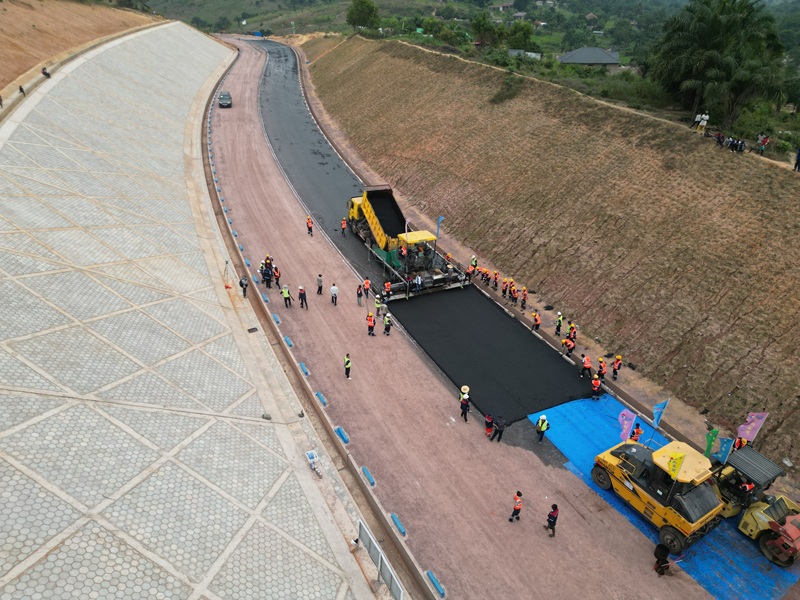

The ambitious Sino-Congolese cooperation project, a cornerstone of the Democratic Republic of Congo’s infrastructure development agenda, is facing severe setbacks due to prolonged customs clearance delays. Despite coordinated efforts from technical, financial, and institutional stakeholders, critical construction materials remain stranded at entry points, directly impeding progress across multiple project sites.
bitumen stuck at matadi port threatens road construction timelines
Nico Nzau Nzau, Director-General of the Congolese Agency for Major Works (ACGT), recently briefed Infrastructure Minister John Banza during an infrastructure caravan inspection. He highlighted that multiple road surfacing projects, including key segments in Kinshasa and surrounding provinces, have stalled due to more than six months of delayed customs clearance for bitumen imported by SISC SA. This delay persists despite the project’s eligibility for full tax exemptions under Law No. 14/005 of February 11, 2014, and the Fifth Amendment to the 2024 Collaboration Agreement.
The blockade at Matadi Port has trapped approximately 1,477 tons of bitumen earmarked for Kinshasa’s ring roads, the Matadi-Tshela-Singini highway, and the Kananga-Kalamba Mbuji route. An additional 1,650 tons of bitumen intended for the rehabilitation of National Road 1, specifically the Mbujimayi-Nguba section, remains held up in Katanga. Heavy machinery, including concrete plant components for the Idiofa Stadium project, along with spare parts and other essential materials, are similarly immobilized at customs checkpoints, preventing their deployment to active construction sites.
government inspection reveals partial progress amid systemic obstacles
Since June 19, the Minister of Infrastructure and Public Works has led a province-wide inspection tour to assess the progress of Sino-Congolese funded projects. While certain initiatives have shown positive development—such as the construction of 17 new buildings and the modernization of 11 existing ones at the Kikwit General Referral Hospital, expanding capacity from 150 to 650 beds and increasing morgue capacity from 9 to 90—the overall pace remains compromised by logistical and administrative bottlenecks.
Without immediate intervention from the Coordination, Oversight, and Monitoring Agency (APCSC), which serves as the dedicated customs clearance body for infrastructure projects under this program, the risk of significant project slowdowns or even complete halts escalates. Several pending requests for tax waivers and indirect fiscal fee coverage have gone unaddressed for months, despite the legal frameworks supporting these exemptions.
seasonal challenges compound infrastructure delays
June typically marks a period of accelerated construction activity due to favorable dry-season conditions. This year, however, the dry season is having the opposite effect. Despite recent milestones—such as the completion of the substructure for the Southeast Kinshasa ring road and land clearance along the same corridor—the persistent customs blockade threatens to derail other high-priority projects valued by local communities. These include:
- The Southeast and Southwest ring roads in Kinshasa
- The Manterne–Tshela–Singini road
- The Kananga–Kalamba Mbuji route
- National Road 1 between Mbujimayi and Nguba
- The Idiofa Stadium
- The Kikwit General Referral Hospital
Each of these projects plays a vital role in enhancing regional connectivity, healthcare access, and economic development. Their delayed completion represents a tangible loss for the Congolese people, who stand to benefit from modern infrastructure that supports growth and improves quality of life.
urgent call for customs intervention
To restore momentum, urgent action is required at the highest levels of government. The APCSC must prioritize the resolution of outstanding customs clearance requests and ensure the swift release of all stranded materials. Time-sensitive construction windows cannot be wasted while critical inputs remain in limbo.
The current impasse underscores the need for stronger inter-agency coordination and accountability. Only through decisive leadership and adherence to existing legal provisions can the Sino-Congolese initiative fulfill its promise of transforming the Democratic Republic of Congo’s infrastructure landscape.