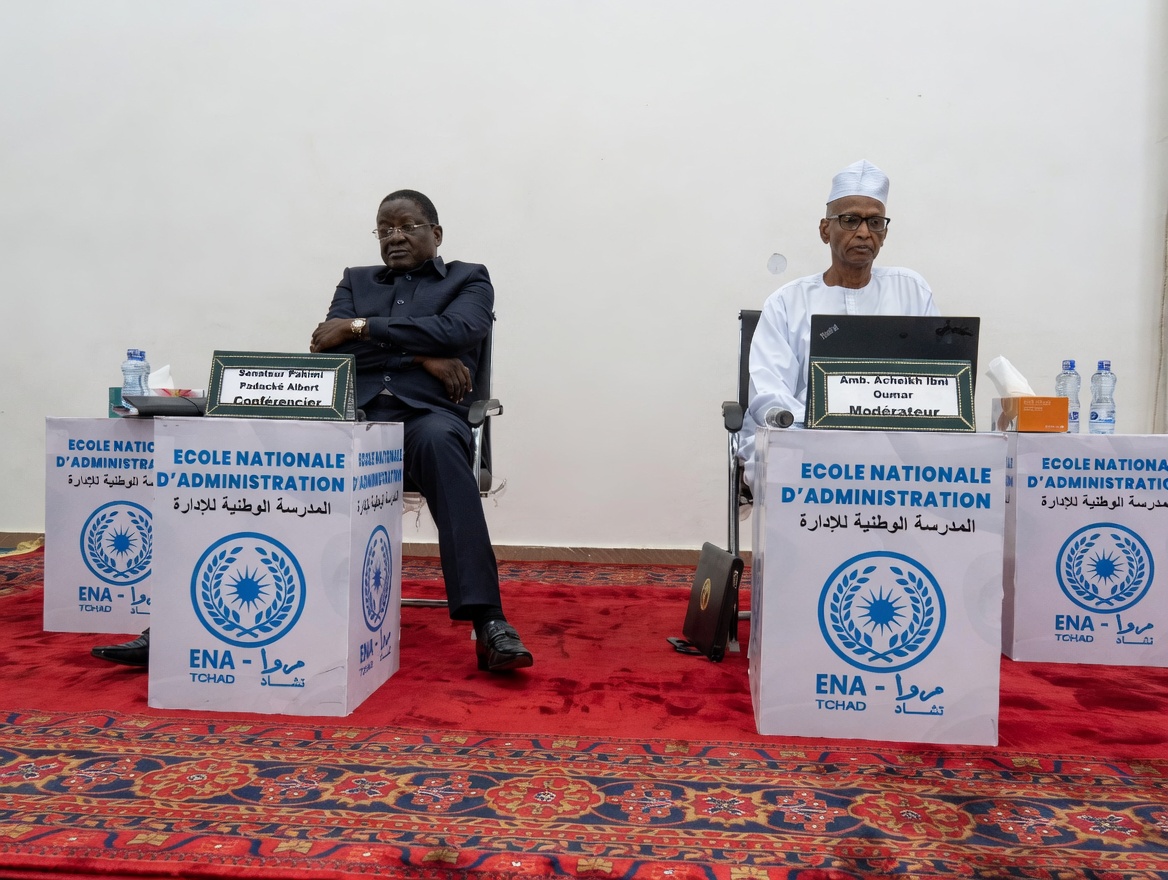

The École Nationale d’Administration (ENA) in N’Djamena played host this Friday afternoon to a high-level conference-debate centered on a pressing national issue: decentralization and the evolving role of provincial councils in fostering local development. The event, part of the ENA’s Grandes Rencontres series, drew a packed audience of civil servants in training, administrative officials, political figures, and students eager to engage with the topic.
Leading the discussion was Albert Pahimi Padacké, a seasoned politician, former Prime Minister, and current senator with deep roots in civil administration. His address was both pragmatic and visionary, blending historical context with actionable insights. He opened by emphasizing the timeliness of the discussion, framing decentralization as a cornerstone of modern governance and a catalyst for equitable progress across Tchad’s provinces.
The conference traced the origins of Tchad’s decentralization journey, which gained momentum in the 1990s amid sweeping democratic transitions across Africa, international donor pressure, and a global shift toward people-centered governance models. The process found formal grounding in the 1996 Constitution, later reinforced by the 2023 constitutional reforms of the Fifth Republic. Key legal milestones included the 2024 Organic Law No. 14, which outlines the status of autonomous local entities, and Organic Law No. 28, which delineates the distribution of competencies between the central government and provincial councils.
Pahimi Padacké structured his remarks around three critical pillars:
- Legal and political foundations: The constitutional principle of subsidiarity (Article 271), which mandates that decisions be made at the most local level feasible, was highlighted as a guiding framework for decentralization.
- Current challenges: Despite legal progress, real-world implementation lags. Financial and human resource transfers to provincial councils remain incomplete, while technical and administrative capacities struggle to keep pace. Governance bottlenecks, weak coordination between decentralized administrations, and elected local bodies further complicate progress.
- Strategic solutions: Pahimi Padacké proposed accelerating the transfer of critical resources—particularly oil and tax revenue shares—to provincial councils, bolstering the skills of elected officials and civil servants, and establishing robust monitoring and evaluation systems. He also underscored the need for active civil society participation and strict adherence to the subsidiarity principle to prevent decentralization from becoming a hollow promise.
Looking ahead, Pahimi Padacké urged the next generation of administrators to embrace these challenges. He argued that the success of decentralization is intrinsically linked to Tchad’s ability to achieve balanced development and bridge the gap between citizens and their government. « The future of our nation depends on how effectively we decentralize power—making it tangible, accountable, and responsive to the people it serves, » he concluded.