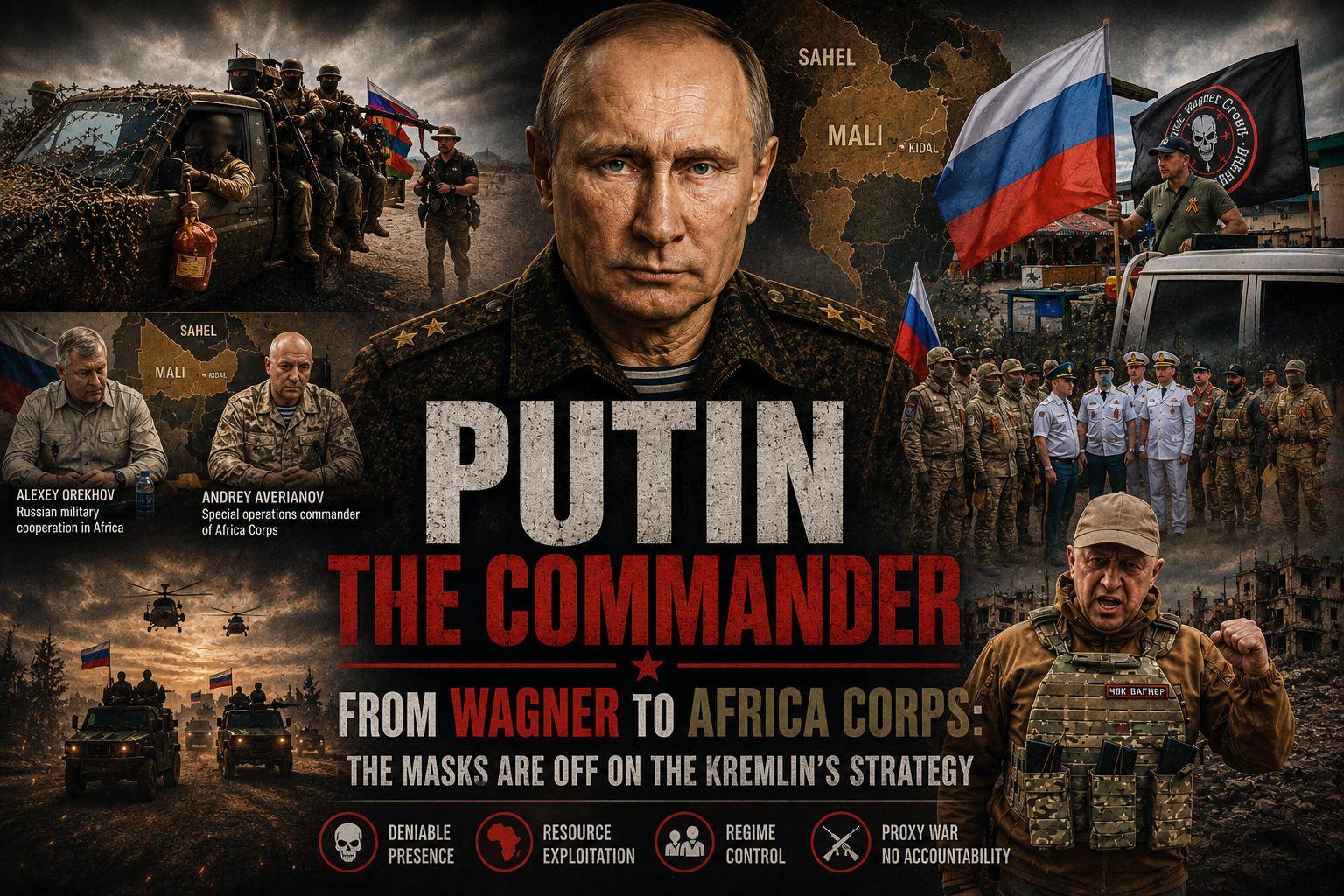

Following a decade of rapid expansion under the guise of mercenary operations, disinformation campaigns, and anti-Western populism, Russia’s African strategy now faces an insurmountable reality. Promises of enhanced security remain unfulfilled, military engagements have stalled, and growing public opposition signals that the notion of a waning Russian imperialism on the continent is no longer speculative—it is an unfolding reality.
The illusion of a security alternative
In the mid-2010s, Russia exploited the strategic void left by declining Western influence, particularly that of France. From Bamako to Bangui, Ouagadougou to Niamey, Moscow marketed a ready-made solution: unconditional security assistance, personified by the Wagner Group (now rebranded as Africa Corps), free from human rights constraints.
Yet, a few years later, the balance sheet reveals a stark contrast. In the Sahel, security conditions have not merely stagnated—they have deteriorated dramatically. The turning point came with the devastating losses suffered by Russian mercenaries and Malian soldiers in the Battle of Tinzawatane, near the Algerian border, shattering the myth of Russian invincibility.
The extractive agenda exposed
Far from fostering peace, Moscow’s interventions have prioritized propping up regimes in exchange for access to mineral resources—gold, diamonds, and uranium. This purely extractive logic, the hallmark of imperial ambition, is increasingly apparent to local populations, who recognize that the colonizer has merely exchanged one uniform and one language for another.
The three pillars of Russia’s decline
Current trends reveal that Russia’s receding influence in Africa stems from three fundamental weaknesses:
- The financial and military strain of the Ukraine war. The prolonged conflict has drained resources, forcing Moscow to withdraw elite troops from African operations and ration heavy weaponry once exported to the continent.
- The absence of a viable economic model. Russia’s economy, comparable in scale to Spain’s, lacks the capacity to match either the European Union’s development aid or China’s infrastructure investments. Once the initial political honeymoon fades, African juntas and governments realize that emergency wheat shipments and social media disinformation campaigns do not feed populations.
- The rise of African nationalism. Russia’s rhetoric of a “second decolonization” has fallen flat. A digitally connected and vigilant public now rejects Moscow’s tutelage with the same fervor once reserved for Paris. The replacement of one foreign flag with another is no longer seen as liberation, but as a self-defeating subjugation.
A shifting geopolitical landscape
The decline of Russian imperialism does not automatically herald a Western resurgence in former spheres of influence. Instead, the continent is witnessing a rebalancing in favor of actors who prioritize pragmatism over ideology.
China is steadily consolidating its economic foothold, favoring contractual stability over the boisterous tactics of Moscow. Meanwhile, Turkey and the United Arab Emirates are emerging as key alternative partners, offering advanced drone technology and financial investments without the geopolitical baggage that accompanies Kremlin-backed initiatives.
The end of the geopolitical shortcut
Russia’s imperial venture in Africa, though intense, has proven historically short-lived. It has underscored a critical truth: influence cannot be sustained through military force and information warfare alone.
For African leaders, the lesson is unequivocal: there are no geopolitical shortcuts. Security and development cannot be outsourced to foreign mercenaries, whether from the East or the West. The erosion of Russian dominance may signal the dawn of an Africa that seeks not masters, but genuine partners.