World Bank’s $5.3 billion in Ivory Coast: the debate, the reactions, and what happens next
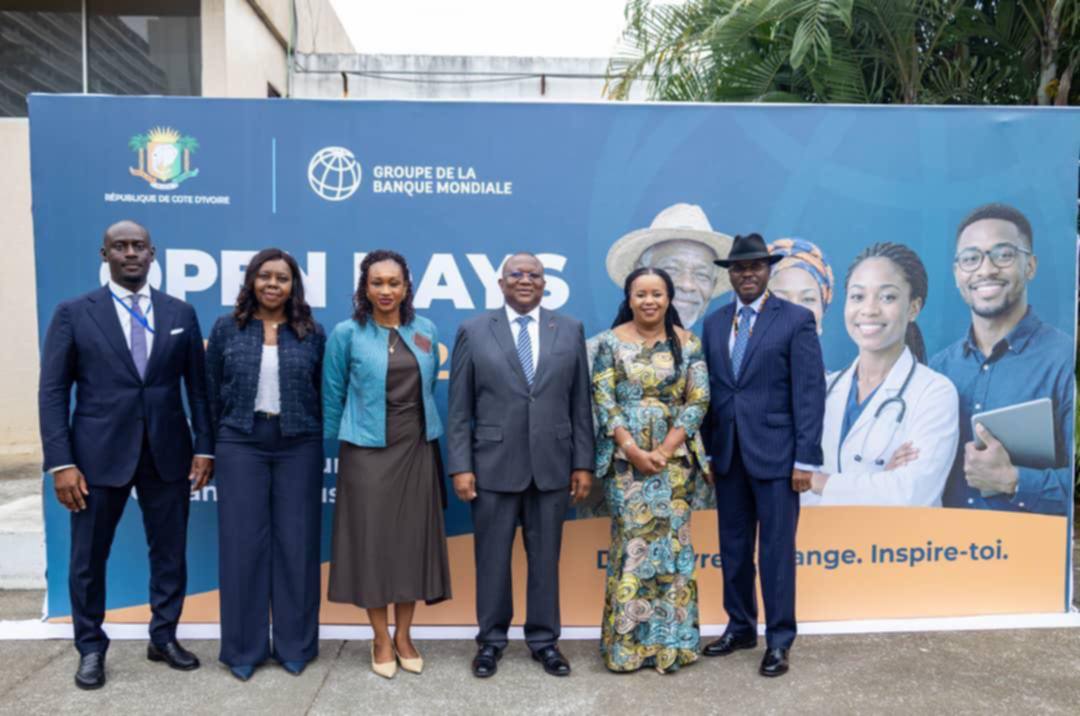
The World Bank Group’s active portfolio in Ivory Coast now stands at 25 projects worth a combined $5.3 billion. That figure was put back in the spotlight in Abidjan on Monday, September 21, 2026, as the institution opened its first-ever Open Days in the country. The number was cited by Amadou Coulibaly, Minister of Communication and Government Spokesperson, who represented Dr Souleymane Diarrassouba, Minister of Planning and Development and the World Bank Group’s Governor for Ivory Coast.
The two-day event, held on September 21 and 22 under the theme “Jobs and Opportunities: Building Together for Inclusive Growth,” brought together several government members alongside Marie-Chantal Uwanyiligira, the World Bank’s Division Director for Ivory Coast, Benin, Guinea and Togo. For two days, students, recent graduates and project leaders met the teams behind the institution’s financed projects in education, employment, entrepreneurship and infrastructure. Jobs ran through every discussion: the 2026-2030 National Development Plan aims to create three million jobs, with young people and women first in line.
What the open days revealed about the portfolio
The Group’s funding covers infrastructure, agriculture, energy, education, health and human capital development. The International Finance Corporation (IFC) has invested close to $2.7 billion in Ivory Coast over the past five years, while the Multilateral Investment Guarantee Agency (MIGA) works to shore up investor confidence.
This current portfolio is distinct from the commitment announced for the years ahead. At the Consultative Group meeting on financing the 2026-2030 National Development Plan, held in Abidjan on July 8 and 9, 2026, the World Bank Group announced an engagement of more than $17 billion: $10 billion from the World Bank, $5 billion from the IFC and $2 billion from MIGA.
Reactions: a partnership under scrutiny and in demand
The scale of the sums has fuelled public debate in Abidjan. For many young attendees, the open days were a rare chance to put faces to the projects and to ask directly how the money reaches them. The question on everyone’s lips was less about the headline figure than about delivery: how many of the three million promised jobs will actually materialise, and how quickly.
Government representatives framed the event as proof of a maturing relationship, pointing to the PND’s targets as the yardstick by which the partnership should be judged. World Bank officials, for their part, stressed that the portfolio is active and disbursing, not merely pledged.
Financial firsts that changed the conversation
The partnership has also produced financial operations that were unprecedented in the region. In December 2024, Ivory Coast carried out a debt-for-development swap with the Group’s support, the first of its kind backed by the institution. Covering nearly €400 million in commercial debt, it improves the debt profile and frees up resources for education. In 2025, the country concluded West Africa’s first sustainability-linked sovereign loan, worth €433.3 million, backed by a dual guarantee from the International Bank for Reconstruction and Development (IBRD) and MIGA.
Outlook: a new country framework on the horizon
The sequence points to a closely tracked partnership. On September 10, Dr Souleymane Diarrassouba received Harold Tavares, Director of the Africa Group II at the World Bank Group’s Board of Executive Directors, in Abidjan. Their talks covered the Ivorian portfolio and preparations for the next Country Partnership Framework, which is expected to align with the priorities of the 2026-2030 National Development Plan.
What comes next will be watched closely. The open days have set a benchmark: the government, the institution and the public now have a shared reference point against which the promised jobs, infrastructure and reforms can be measured in the months and years ahead.