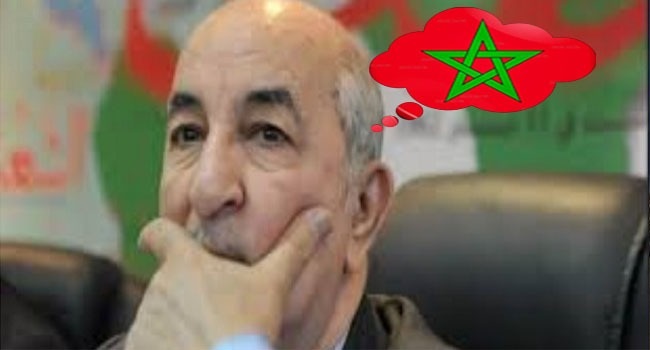

A relentless competition in diplomatic aggression and a surge in hostile rhetoric appear to have been unleashed from within the inner circles of the Algerian government, whose singular focus remains fixed on Morocco. Many Algerian observers critical of this trend suggest that this openly embraced and sustained posture of animosity, championed by President Abdelmadjid Tebboune’s administration, is a relatively recent development.
Conversely, others argue that this underlying hostility towards Morocco was always present, but the perception of its current eruptive manifestation is amplified by social media. However, this magnifying effect overlooks a crucial point: the Tebboune government established a television channel, AL24 News, whose editorial line primarily appears dedicated to glorifying President Tebboune while simultaneously unleashing torrents of vitriol against Morocco.
Viewers following its programs, whether live or on social media, cannot help but notice the level of morbid glee displayed by some of its propagandist “journalists” when discussing Morocco. Each individual strives to formulate the most devastating phrase, the most impactful “punchline” to tarnish the Kingdom’s image, without restraint, without oversight, and with an overflowing excess of zeal. The factual basis of these attacks seems irrelevant; the primary goal is for the insult to achieve its intended effect.
Regarding Morocco, the official Algerian media’s communication has reached ludicrous extremes. It has gone so far as to avoid pronouncing the Kingdom’s name in certain sports summaries, presumably to prevent “glorifying the country.” This peculiar situation first emerged during the Qatar World Cup when the Moroccan national team reached the semi-finals—a feat celebrated globally, yet conspicuously ignored by Algerian television. Today, a similar grim scenario unfolds with the 2026 World Cup, where Morocco’s name and achievements have once again become unmentionable.
“One commentator recently spiraled into an acute delusion, asserting that Lionel Messi, who scored three goals against the Algerian national team, was manipulated by ‘the Jewish lobby’ and that this entity would do everything to make Algeria pay for its ‘support for Western Sahara and the Palestinian cause’.”
If shame could induce deafness, Algerian leaders would struggle to hear themselves breathe. How can such depths of pettiness and blind hatred be reached, to the point of banning a country’s name from broadcasts simply to avoid acknowledging its significant sporting accomplishments?
These outlandish excerpts, widely circulated after translation into French and English, highlight a particularly troubling phenomenon with potential international repercussions. The Algerian regime not only appears to be fostering animosity towards its neighbors but also seems to be promoting state-sponsored antisemitism, given that public television broadcasts and propagates such extreme rhetoric. In the current global climate, this can be perceived as exceptionally serious on the international stage.
Evidently, Tebboune has unleashed a wave of hostile discourse in Algeria. He seems to have contributed to shaping a new, neurotic identity founded on the logic: “Tell me who you hate, and I will tell you who you are.” This evolution is also reflected in the emergence on social media of numerous influencers, reportedly close to the regime, who echo this narrative with barely concealed glee.
Hatred directed at Morocco has transformed into a lucrative political commodity in Algeria. It is a trade so profitable that, to climb the ranks of power or secure positions of responsibility, one apparently needs to demonstrate neither expertise nor skill, but merely an unquenchable animosity towards Morocco. This, it seems, has become the ultimate qualification for rapid ascent within the corridors of power, with countless examples illustrating this trend.