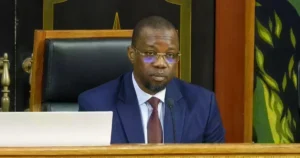

The National Assembly of Bénin has approved a landmark legislative reform that reshapes the role of the Mediator of the Republic, assigning these critical duties to the first vice-president of the Economic and Social Council (CES). This decision, adopted during a plenary session at the Governor’s Palace, marks a significant shift in the governance of conflict resolution and administrative oversight in the country.
New structure of the Mediator’s office
Under the revised Law No. 2009-22 dated January 3, 2014, the position of Mediator of the Republic is no longer filled through a separate appointment process. Instead, the responsibilities are now integrated into the portfolio of the first vice-president of the CES, streamlining institutional operations and reducing administrative redundancies. This reform aims to enhance efficiency and responsiveness in addressing public grievances and institutional disputes.
A seasoned jurist at the helm
The newly designated Mediator is Razacki Amouda Issifou, a distinguished legal expert whose career reflects deep engagement with the judiciary and public administration. With a strong background in constitutional law, Issifou brings unparalleled expertise to this newly configured role. His journey through key institutions has equipped him with a comprehensive understanding of Bénin’s legal and administrative frameworks.
Before assuming his current position, Issifou served as vice-president and later president of the Constitutional Court, where he played a pivotal role in shaping the country’s legal landscape. His leadership extended to the National Assembly, where he chaired the Commission on Laws, and to the first-ever autonomous National Electoral Commission (CENA) in 1996, where he held the position of Secretary-General. His executive experience also includes serving as mayor from 2010 to 2015 and holding strategic leadership roles within the Ministry of Justice.
Challenges and opportunities ahead
The integration of the Mediator’s functions into the CES presents both challenges and opportunities. On one hand, it consolidates oversight mechanisms under a single leadership structure, potentially improving coordination and accountability. On the other hand, the new Mediator will need to navigate the complexities of a dual role, balancing his existing duties with the expanded responsibilities of mediating disputes between citizens and public authorities.
The reform signals a commitment to modernizing Bénin’s governance structures, emphasizing efficiency, transparency, and responsiveness. As the country continues to evolve its institutional framework, the appointment of Issifou underscores the importance of legal expertise and administrative experience in fostering public trust and institutional integrity.