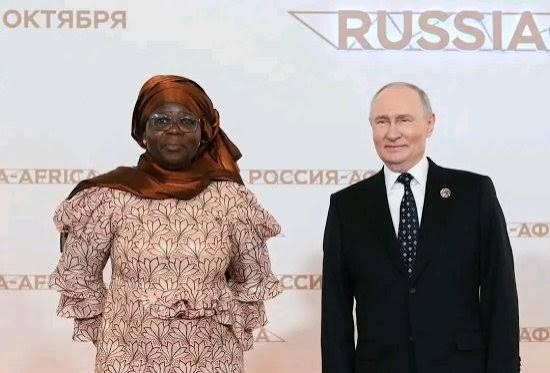

The Vice-President of Benin, Mariam Chabi Talata, arrived in Moscow not merely as a diplomat, but as a strategic architect of her nation’s economic future. Her mission at the 2026 Russia-Africa Summit was to transform historical alliances into actionable opportunities—without sacrificing Benin’s core interests. In a world where global power dynamics are rapidly evolving, her approach demonstrates how smaller economies can leverage diplomatic engagement to secure real, long-term benefits for their populations.
From Cold War collaborations to modern economic strategy: the evolution of Benin-Russia relations
Benin’s diplomatic ties with Russia trace back to January 9, 1962, when the newly independent Republic of Dahomey officially recognized the Soviet Union. Over the following decades, particularly during the People’s Republic of Benin era from the 1970s to the 1980s, collaboration flourished across education, healthcare, and defense. Tens of thousands of Beninese professionals and students received training in Soviet institutions, creating enduring people-to-people connections that transcended political boundaries.
Today, as Mariam Chabi Talata engages with Russian leaders in Moscow, she isn’t merely maintaining these historical ties—she’s redefining them. The focus is no longer on whether Benin should engage with Moscow, but on how to craft partnerships that drive economic transformation while safeguarding the nation’s sovereignty.
The Moscow summit’s hidden agenda: practical outcomes over empty promises
The 2026 Russia-Africa Summit in Moscow stood apart from typical diplomatic events. It served as a critical juncture for African nations to navigate complex international relationships while prioritizing balanced, mutually advantageous collaborations. Benin’s delegation adopted a distinctive stance—pragmatic, citizen-focused, and unambiguously committed to creating sustainable value.
The meetings between Mariam Chabi Talata and Russian President Vladimir Putin and other senior officials went beyond symbolic gestures. These were strategic discussions aimed at shifting from outdated aid-based models to investment-driven partnerships. The Beninese delegation advocated for agreements that deliver concrete results, whether in agriculture, energy infrastructure, or digital innovation, ensuring strong local involvement and long-term gains.
Bridging dialogue and execution: Benin’s blueprint for economic transformation
Previous Russia-Africa summits in Sochi (2019) and St. Petersburg (2023) often emphasized discussions over tangible outcomes. In contrast, the 2026 event placed unprecedented emphasis on implementation. The 2023–2026 Russia-Africa action plan underwent rigorous evaluation, while a new roadmap for 2027–2029 is currently being developed. For Benin, the challenge lies in capitalizing on this momentum to fund critical sectors without falling into cycles of dependency.
The solution lies in precision. Benin is not pursuing broad, non-specific commitments. Instead, it is negotiating strategic alliances—such as vocational training exchanges, joint renewable energy ventures, and investments in local supply chains. By focusing on sectors where Benin holds a natural advantage—like cotton production, cashew processing, or tech innovation—the country is converting diplomacy into a catalyst for sustainable growth.
Empowering communities: education and healthcare as pillars of progress
Amid shifting geopolitical landscapes, Benin’s delegation reaffirmed a fundamental principle: durable partnerships are built on human capital. Education remains a cornerstone of this strategy. From the Soviet-trained physicians of the 1980s to the next generation of engineers and innovators, knowledge exchange remains a quiet yet powerful engine of progress. Mariam Chabi Talata underscored the need for future collaborations to prioritize upskilling and technological advancement, ensuring that Benin’s youth are not passive recipients of support but active contributors to their nation’s development.
Future prospects: the roadmap for Benin-Russia collaboration
The summit concluded with a forward-looking declaration and a detailed action plan. Yet for Benin, the critical phase is just beginning. Success hinges not on signing agreements, but on executing them, measuring outcomes, and ensuring accountability. The country’s strategy rests on three foundational pillars:
- Expanding diplomatic and economic partnerships to avoid over-reliance on any single global player
- Designing deals that incorporate technology transfer and local value addition
- Establishing clear, measurable benchmarks to track progress in education, infrastructure, and trade
Mariam Chabi Talata’s mission in Moscow was never about generating headlines. It was about laying the foundation for economic resilience in an unpredictable global environment. And with a history of strategic foresight, Benin appears to be charting the right course.