
- Sécurité
Burundi, currently holding the African Union presidency and a key witness to the Washington Peace Accord between Félix Tshisekedi of the Democratic Republic of Congo and Paul Kagame of Rwanda, with former United States President Donald Trump in attendance, has expressed deep concern. The nation laments the agreement’s failure to bring about tangible peace on the ground, as hostilities persist between government forces and the AFC/M23 rebellion, reportedly supported by Rwanda, in the eastern Democratic Republic of Congo.
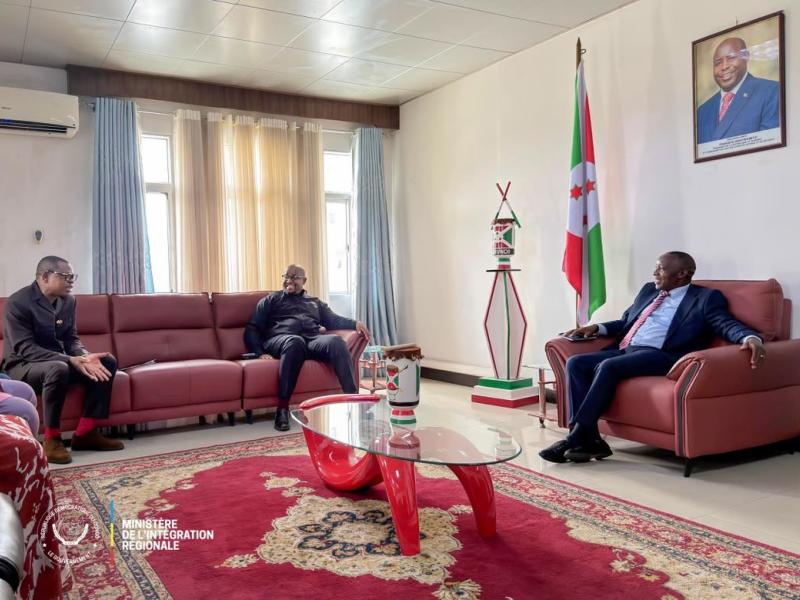
This sentiment was conveyed by Ambassador Édouard Bizimana, Burundi’s Minister of Foreign Affairs, Regional Integration, and Development Cooperation, during his meeting with Floribert Anzuluni, the Congolese Minister of Regional Integration. The discussions, held on Monday, June 1st, in Bujumbura, saw the Burundian official underscore that despite some Congolese citizens returning to their homes, numerous regions remain gripped by insecurity, prompting renewed displacement. He urgently called for robust international involvement to address the escalating crisis.
“Regarding peace and security in the region, Minister Édouard Bizimana voiced regret that the agreements signed between the Democratic Republic of Congo and Rwanda, facilitated by Washington, have not been fully honored. He highlighted that while certain improvements have allowed refugees to return, other areas are experiencing a resurgence of insecurity, leading to new waves of displacement towards neighboring countries. He emphasized the critical need for increased international community engagement to bolster existing regional initiatives,” the Burundian Ministry of Foreign Affairs reported on X.
The same meeting also saw both dignitaries commend the strong bilateral and diplomatic ties between Burundi and the Democratic Republic of Congo, signaling their mutual desire for further strengthening these relations. Beyond the security situation in eastern Democratic Republic of Congo, several other matters of shared interest were discussed. These included the allocation of land for the future Burundian embassy in Kinshasa, the management of the Executive Secretariat of the International Conference on the Great Lakes Region (CIRGL), and preparations for the upcoming ordinary summit of CIRGL Heads of State and Government, an organization currently chaired by the Democratic Republic of Congo.
For his part, Congolese Minister Floribert Anzuluni extended his sincere appreciation for Burundi’s diplomatic efforts, particularly its role in mobilizing humanitarian assistance for Congolese refugees residing in camps within Burundi. Concerning CIRGL, he informed his counterpart about the ongoing preparations for a Troika meeting, intended to review the regional security landscape and assess the statutory contributions of member states.
Ambassador Édouard Bizimana, the Burundian Minister of Foreign Affairs, Regional Integration, and Development Cooperation, reiterated Burundi’s unwavering commitment to silencing all weapons on the African continent. This objective was a key priority outlined by Burundian President Évariste Ndayishimiye in his acceptance speech upon assuming the presidency of the African Union, succeeding his Angolan counterpart, João Lourenço.
In the Great Lakes region, Burundi and the Democratic Republic of Congo stand as strategic allies, bound by a bilateral defense agreement inked in March 2023. In response to the persistent insecurity in eastern Democratic Republic of Congo and what Kinshasa describes as Rwandan aggression through the AFC/M23 rebellion and its associated groups active in Sud-Kivu, Bujumbura has deployed thousands of soldiers to support the Congolese army (FARDC) and secure their shared border. This military alliance encompasses various cooperation frameworks.
Since the signing of the joint communiqué in Montreux, Switzerland, from April 13th to 17th, 2026, between representatives of the Democratic Republic of Congo government and the Alliance Fleuve Congo/Mouvement du 23 mars (AFC/M23), with representatives from the United States of America, the State of Qatar, and the Republic of Togo (acting as African Union mediator) present, the situation remains fraught. Similar to previous discussion rounds held in Doha, mutual accusations of ceasefire violations and non-compliance with commitments continue. The Washington process faces comparable challenges; despite meetings, the situation shows no improvement, with each party interpreting the Accord’s terms differently, thus impeding its implementation.
This diplomatic stalemate, unfolding under the watchful eyes of mediators like the United States and Qatar, continues to detrimentally affect the security landscape, with fighting persisting across eastern Democratic Republic of Congo.

Related Posts