
Over the past two decades, the landscape of major public contracts in Senegal has undergone a dramatic shift. While French conglomerates once held a near-monopoly on infrastructure, energy, and banking projects, their presence has dwindled to a mere 5% of public tenders today. Meanwhile, Chinese enterprises have surged ahead, commanding over 30% of these lucrative contracts, reshaping the country’s economic partnerships.
chinese-backed mega-projects redefine Senegal’s future
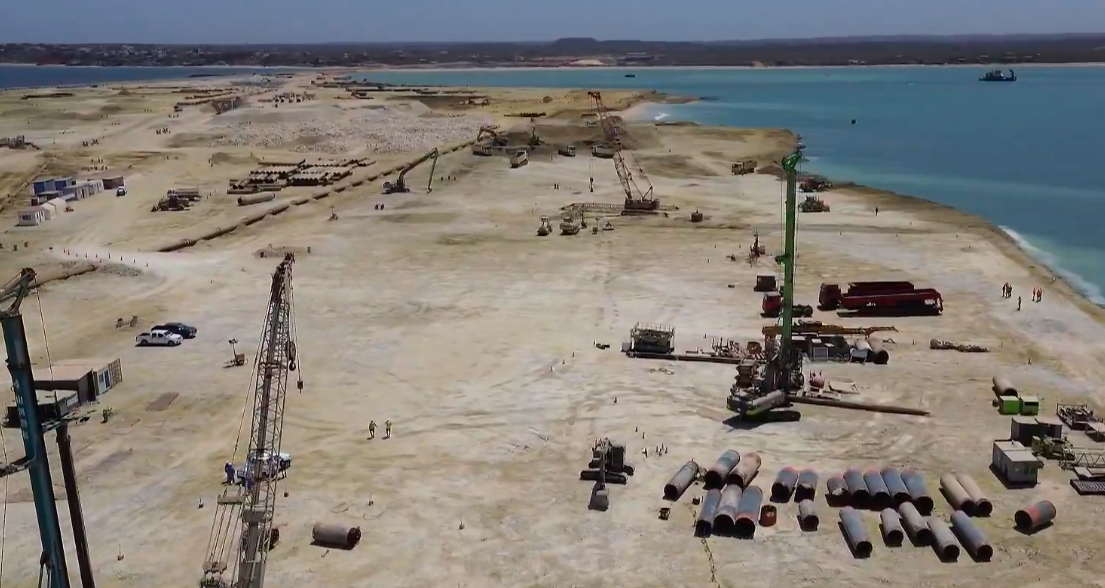
The most striking example is the Ndayane deep-water port, a $2 billion+ project hailed as a game-changer for Senegal. Designed to accommodate the largest container ships in the Atlantic, this facility is expected to revolutionize the country’s logistics, job market, and global connectivity. Though led by the Emirati firm DP World, the construction consortium is dominated by Chinese contractors. “We had global firms competing, including several from France, but in the end, none of them secured the deal,” admits David Gruar, DP World’s Dakar project director. According to reports, the French-led consortium, including Eiffage, was priced nearly 20% higher than the winning bid, leaving them out of the running.
Just a short distance away, the Diamniadio new city project—a sprawling urban development aimed at easing congestion in Dakar—tells a similar story. Turkish firms have secured the majority of contracts here, from the stadium and railway station to hotels and residential buildings. The industrial zone, designed to attract foreign investors, features prominent participation from Tunisian and Chinese companies. “You’ll find a Tunisian firm here, a Chinese one there—we don’t see any French companies at all,” notes Bohoum Sow, Secretary-General of APROSI, the platform’s management body.
why chinese firms are winning Senegal’s trust
Experts argue that Chinese firms have a better grasp of Senegal’s evolving priorities. For instance, in a recent cardboard packaging plant project, Chinese technicians trained local employees, demonstrating adaptability to local needs. “This is exactly what we need—industries that didn’t exist before, tailored to our market,” says Sow. “The Chinese aren’t just building infrastructure; they’re investing in real, flexible solutions.”
China’s strategic push into Africa has made it a key player in the continent’s development. “Their flag is flying high in Senegal today,” observers note. While French firms once dominated, their share has plummeted, with Chinese companies now leading the charge. Other nations, including Turkey, the UAE, and Tunisia, have also gained ground, further diversifying the country’s economic alliances.
For decades, French groups like Bouygues, Vinci, and TotalEnergies secured the lion’s share of Senegal’s major contracts. Today, their influence has waned, leaving them to adapt to a new reality where cost efficiency, local partnerships, and rapid execution are critical to winning bids.
can french firms regain ground in Senegal?
Despite the decline, some French companies are finding success by embracing change. Take Ragni Group, a family-run enterprise from France specializing in solar-powered street lighting. By establishing a local subsidiary in Senegal and transferring expertise, they secured a 70 million euro contract to deploy 36,000 next-gen solar lamps—partially funded by France’s Development Bank. “Success came from flexibility, quality, and cost, but above all, local job creation,” explains Birama Diop, head of Ragni’s Senegalese subsidiary.
Caroline Richard, a representative of Proparco in Senegal, believes French firms still have opportunities—if they evolve. “The bar is higher now, but French companies excel when demands are stringent. There’s real potential in workforce training and long-term partnerships,” she states.
From solar-powered streetlights illuminating Dakar’s neighborhoods to the rising skyline of Diamniadio, French firms are being forced to reinvent themselves. To compete, they must adopt leaner, more collaborative models—proving their competitiveness against Chinese, Turkish, and Emirati rivals who have already staked their claim in Senegal’s future.