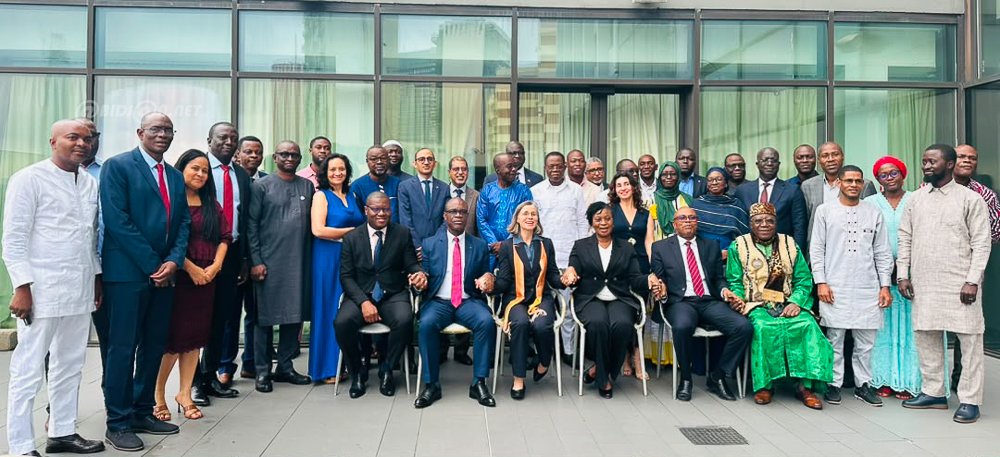

The inaugural 2026 meeting of the WACA ResIP Regional Steering Committee (CRP) convened on Wednesday, July 8, in Plateau. This significant gathering brought together delegates from member states, regional organizations, and various technical and financial partners dedicated to the sustainable management of the West African coastline.
During the opening remarks, Bérangère Prince, the World Bank’s Senior Natural Resources Specialist, highlighted the institution’s longstanding commitment to the WACA program, which it has championed since 2018 alongside numerous technical and financial collaborators.
Prince emphasized the program’s unique strength, stating, “We are very fortunate, as this program truly unites many partners, fostering a strong sense of regional solidarity.” She specifically acknowledged contributions from the French Development Agency, the Netherlands, Spain, Germany, and key regional organizations.
She further underscored the economic importance of coastal areas, which generate over 50% of the region’s Gross Domestic Product (GDP). This vital contribution necessitates integrated management strategies that actively address the escalating impacts of climate change.
Reviewing the achievements of the program’s initial phase, Bérangère Prince reported impressive results: more than 500,000 individuals have become more resilient to climate change impacts, between 300,000 and 400,000 jobs have been either created or strengthened, and over 32,000 hectares of crucial coastal ecosystems have undergone restoration.
Looking ahead, she announced the continuation of the initiative through WACA+, with upcoming phases set to benefit nations including Côte d’Ivoire, Senegal, Cameroon, Togo, and Guinea-Bissau.
Kouadio Parfait, representing the Minister of Environment, officially inaugurated the proceedings. He commended the attendance of delegations from beneficiary countries and lauded the unwavering commitment of technical and financial partners in the collective effort to combat the adverse effects of climate change on coastal zones.
Parfait underscored the shared heritage of West African nations: “Our countries share a common legacy—a coastline teeming with biodiversity, economic resources, and development opportunities. Regrettably, this vital coastline also faces escalating threats, particularly coastal erosion, severe flooding, marine submersion, and ecosystem degradation, all intensified by climate change.”
He described the WACA program as an “exemplary framework for cooperation,” enabling states to pool their experiences and forge unified responses to pressing environmental challenges.
The Minister’s representative outlined the key objectives for this Regional Steering Committee meeting: to assess progress, finalize preparations for WACA ResIP’s conclusion, expedite the implementation of WACA ResIP 2, and bolster regional coordination.
Focusing on the project’s successes within Côte d’Ivoire, he highlighted that infrastructure developments in Grand-Lahou have effectively stabilized nearly seven kilometers of coastline, facilitated mangrove restoration, and significantly improved living conditions for over 150,000 beneficiaries. He proudly declared, “We can confidently state that the challenge of coastal erosion has been effectively addressed in Lahou-Kpanda, the primary intervention zone for this project.”
This inaugural 2026 meeting of the WACA ResIP Regional Steering Committee brought together representatives from beneficiary nations, UEMOA, the World Bank, ECOWAS, CEEAC, and various regional implementing institutions. Their collective aim is to strengthen cooperation, ensuring sustainable and resilient management of the crucial West African coastline.