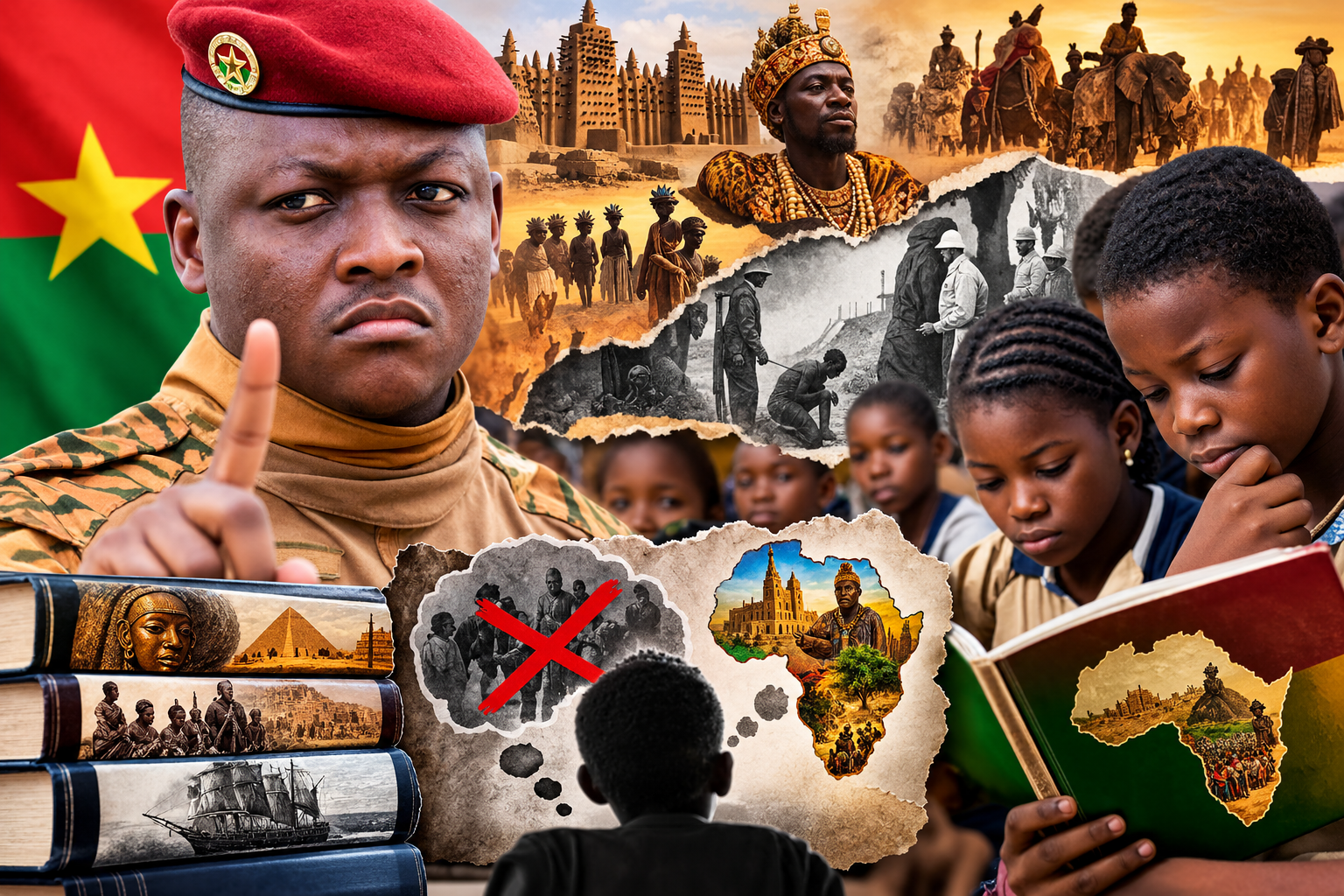

The reform of history and geography curricula in Burkina Faso aims to “decolonize” school textbooks, sparking a critical debate about the representation of Africa’s past in education. However, this endeavor raises a fundamental question: can educational reform truly address historical injustices by reshaping the narrative presented to students, or does it risk substituting one partial account for another?
Beyond the shadows of colonialism: the complexity of restoring historical truth
While there is merit in challenging the dominance of colonial perspectives in African history education, the effort must not inadvertently limit the scope of learning. A curriculum that solely emphasizes the hardships of colonization or the conflicts between Africa and the West risks oversimplifying the continent’s rich and diverse heritage. True historical education should acknowledge these injustices without reducing the entire narrative to them.
Burkina Faso’s history is not a monolithic tale of suffering or resistance; it is woven with civilizations, empires, trade networks, scientific advancements, and cultural exchanges. To present a well-rounded education to future generations, schools must integrate these dimensions, ensuring students grasp the full spectrum of their heritage. This approach does not negate the importance of addressing colonial-era injustices it complements them by providing a more nuanced foundation for understanding the past.
Ideological reform vs. comprehensive historical understanding
The risk inherent in this curriculum reform is the potential to substitute a new ideological framework for the old. If the goal is merely to correct historical wrongs by recrafting the story told to students, the reform may miss its mark. Educational programs can and should highlight the injustices of colonization, celebrate African resistance, and elevate long-overlooked historical figures. Yet, these efforts will fall short if they do not also contextualize the broader dynamics of global history.
Consider the example of Côte d’Ivoire, where history education has sought to balance national narratives with broader global contexts. An effective history curriculum does not isolate one nation’s experience; it situates it within a wider tapestry of human development. By doing so, students gain insight into how historical forces have shaped modern societies, fostering a deeper understanding of interconnectedness rather than perpetuating divisions.
Key principles for an inclusive history curriculum
Comprehensiveness: History must be presented in its entirety, acknowledging both injustices and achievements, conflicts and collaborations.
Critical thinking: Students should be encouraged to analyze events, question narratives, and draw their own conclusions rather than memorize predetermined lessons.
Global perspective: Local history must be framed within broader regional and international contexts to avoid fostering a myopic worldview.
Dialogue over dogma: Education should facilitate debate and discussion, not impose a single, unchallenged perspective.
The dual challenge of memory and progress
At its core, this reform raises a pivotal question for Burkina Faso: what kind of memory does the nation wish to impart to its youth? A memory steeped in perpetual confrontation with the past, or one that equips them with the analytical tools to understand, debate, and build upon that past?
Repairing historical injustices cannot be achieved by concealing parts of history from young minds. Instead, it requires providing them with the tools to critically engage with the entirety of their heritage. This means teaching the crimes of colonization not as isolated tragedies, but as events that occurred within a complex web of global interactions. Similarly, African achievements must be presented with their complexities acknowledging both triumphs and contradictions without sanitization.
Ultimately, a well-designed history curriculum should empower students to use the past as a lens for understanding the present, not as a prism that distorts their vision. By fostering this balanced approach, Burkina Faso can cultivate a generation of informed citizens capable of navigating the future without being shackled by a narrow or ideologically driven understanding of history.
By Moussa Samuel Coulibaly — Journalist