
Gabon: can democracy thrive without a strong media sector?
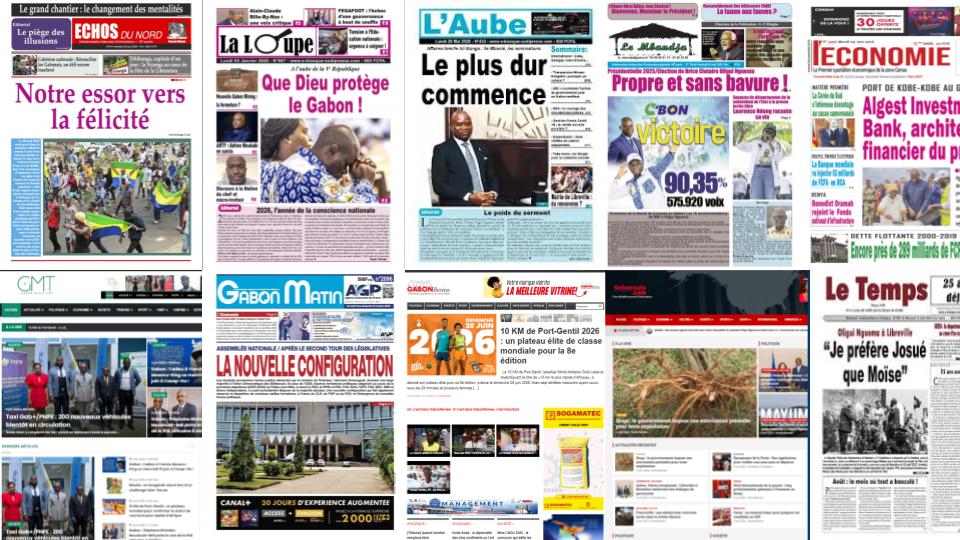
As Gabon pushes forward with its vision of a modern Fifth Republic, the country’s media landscape is grappling with an unprecedented crisis. Print publications are shrinking, online outlets struggle for survival, advertising revenues are dwindling, public access to information is narrowing, and entire titles are disappearing. Beyond the immediate economic threats to press enterprises, the very foundation of Gabon’s democracy is at risk.
There are silences in public discourse that should raise urgent questions. The current neglect surrounding Gabon’s media crisis is one of them. While national attention remains fixated on large-scale projects, infrastructure development, political timelines, and economic ambitions, an essential pillar of democratic life is quietly eroding—largely unnoticed by the public.
A democracy without a thriving media ecosystem is a democracy that speaks only to itself. When a government increasingly hears only its own voice, the gap between official narrative and societal reality grows dangerously wide.
Print media: the quiet unraveling of public debate
The decline of Gabon’s print media reflects a broader erosion of civic engagement. Not long ago, newspaper kiosks were vibrant hubs of national conversation—places where headlines sparked debates, where opinions were formed and shared. Titles like La Loupe, L’Aube, and Échos du Nord once weathered far greater challenges. At the time, their critical coverage sometimes earned them labels like “hostile press” or accusations of systematic opposition. Yet they endured. They were read. They shaped public discourse.
Today, these very newspapers have become rare commodities. In some kiosks, they’re cherished by readers nostalgic for an era when print journalism still played a central role in public life. But this isn’t just an economic downturn—it’s a political concern. When a newspaper folds, it’s not just a business that closes; it’s a voice that is silenced, a perspective that vanishes from the national conversation.
The decline of Gabon Matin: from daily institution to digital ghost
The trajectory of Gabon Matin tells a story of systemic retreat. For decades, this government-affiliated daily stood as a cornerstone of Gabon’s media landscape. It evolved from a daily to a biweekly, then attempted a weekly format during transitional periods. Now, it survives only in digital form—and even that presence is limited. Officially, the shift is framed as technological modernization. But no serious observer can accept that explanation at face value.
What we’re witnessing is the same financial strain affecting every sector of the media industry—even those historically backed by the state. The message is clear: when resources dry up, no outlet is immune.
Where is the promised media restructuring?
For years, officials have spoken of support mechanisms and restructuring plans aimed at revitalizing the media sector. Substantial funds have been pledged. Announcements have been made. Hopes have been raised. Yet on the ground, publishers continue to fight for survival with little visible impact from these initiatives.The true test of any public policy lies not in its rhetoric, but in its tangible outcomes. And today, the results are troubling.
Digital media: growth without stability
Gabon’s digital media landscape may be expanding, but quantity does not equal quality. While new websites and online platforms emerge regularly, few operate with a structured newsroom, a verifiable headquarters, or transparent leadership. Even fewer publish the names of their editors or journalists. A select few strive to uphold professional standards despite severe financial constraints. Yet even these outlets face an unsustainable equation: advertising revenue is scarce, digital income remains minimal, costs are rising, and access to major institutional campaigns is concentrated in the hands of a privileged few.
Why a weak media means a fragile democracy
The stakes extend beyond economics. They touch the core of democratic function. How can pluralism exist when media organizations are collapsing? How can diverse voices be heard when publications disappear one by one? How can editorial excellence be maintained when newsrooms operate in perpetual financial uncertainty? A financially weakened press becomes inherently vulnerable—to influence, to pressure, to compromise. But a strong democracy demands the opposite: independent, resilient, credible media that can operate without fearing insolvency each month.
The cost of media collapse: a collective failure
The irony is stark: the regulatory authority tasked with overseeing Gabon’s media sector may soon find itself regulating a landscape stripped of its essence. What purpose does regulation serve when the regulated no longer exist? What value does a legal framework hold when the entities meant to uphold it can no longer function? What meaning does pluralism retain when independent voices fade into silence? These questions demand urgent attention. What’s at stake isn’t just the future of the media—it’s Gabon’s ability to sustain a vibrant, contentious, and democratic public sphere.
Saving the media to save democracy itself
It’s time to confront the truth: the media crisis is not a niche issue. It’s not solely the concern of journalists or publishers. It belongs to all of Gabonese society. A nation that allows its media to vanish inevitably impoverishes its public debate. And an impoverished public debate ultimately undermines the foundations of democracy itself.
Gabon now faces a critical choice: continue watching its media sector wither, or finally implement a transformative reform of its media economy. Such a reform must be rooted in transparency, fairness, pluralism, and long-term economic viability. Because a democracy doesn’t collapse the moment newspapers close—it begins to weaken the day we stop caring whether they stay open.