
Gabon-EU strategic partnership kicks off in Libreville with new focus on investment and ecology
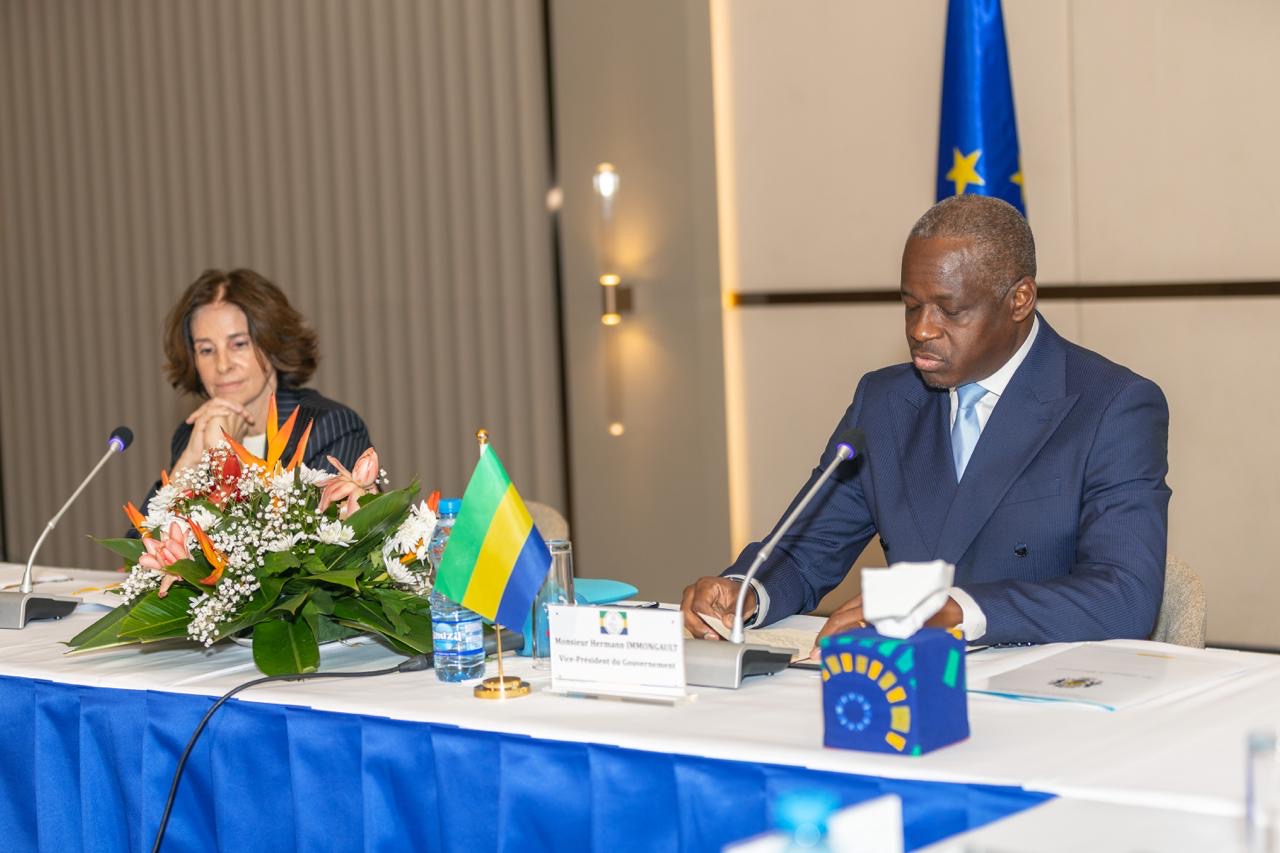
Libreville’s Palais des Congrès Omar Bongo Ondimba hosted a landmark gathering this week as Gabon and the European Union launched the 2026 session of their strategic partnership dialogue. Under the high patronage of Vice-President of the Government Hermann Immongault—standing in for the Head of State—and EU Ambassador to Gabon Cécile Abadie, the event marked a decisive shift in bilateral relations.
Two years after the 2024 talks, and following the April 2025 presidential election that ushered in a new Fifth Republic, Gabon is doubling down on institutional stability while championing a cooperation model built on sustainable co-investment. Discussions brought together EU ambassadors and Gabonese government officials to explore political reforms, economic outlook, governance improvements, environmental commitments, and regional and multilateral collaboration.
Opening the session, Vice-President Immongault declared, « We have definitively concluded the transition phase and, since the 12 April 2025 presidential vote, inaugurated a fresh institutional momentum embodied by the Fifth Republic. » He emphasized that « Gabon is moving away from aid-centric approaches toward a structured economic partnership rooted in investment, local value creation, skills transfer, and human capital development. » The 2023 Samoa Agreement now serves as the guiding framework for this renewed cooperation.
Driving investment while protecting Gabon’s natural heritage
The Vice-President underscored that safeguarding Gabon’s natural capital is a global imperative. « Preserving this wealth is not merely a national policy—it is a worldwide responsibility that deserves fair recognition for countries actively protecting it. » He called for « stronger international financing mechanisms for ecological transition » to harmonize economic growth, industrialization, and environmental stewardship. Gabon reaffirmed its commitment to multilateralism, Central African stability, and security in the Gulf of Guinea.
EU Ambassador Cécile Abadie praised the depth of the exchanges, stressing the need to « adapt cooperation tools between Gabon and the European Union » by prioritizing a « refreshed partnership » aligned with shared priorities. Emphasizing her openness to « candid dialogue », she restated the EU’s readiness to support Gabon through balanced cooperation centered on investments, reforms, and tangible outcomes benefiting both sides.