Gabon food sovereignty: why look abroad for what already exists at home?
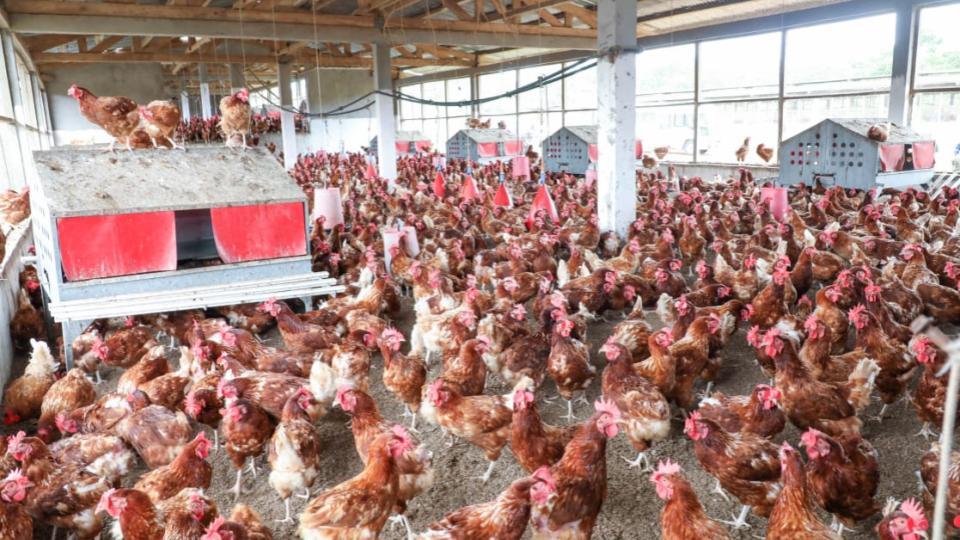
The announcement that Guinean group SONOCO plans to produce 15 million chickens per year in Gabon has reignited the debate on economic sovereignty and the role of local entrepreneurs. While authorities present this project as a major step for food security, several voices—including former deputy Jean-Valentin Leyama—question why the Gabonese company SOGADA, which has invested in poultry farming for over a decade, seems overlooked. This issue goes beyond agriculture, touching the very philosophy of national economic development.
Gabon wants to produce more of what it consumes. The ambition is legitimate. In a country that still imports a large share of its food needs, any initiative to boost local production should be welcomed. This is the logic behind the presidency’s announcement of the Guinean group SONOCO, whose project aims for an annual output of over 15 million broiler chickens.
But behind the official enthusiasm, a question quickly emerged in public debate. Not to challenge foreign investment—Gabon needs that to accelerate development—but to question the coherence of a political discourse that makes economic sovereignty and national entrepreneurship one of its pillars. After all, how can one talk about economic recovery without first supporting those who have already taken the risk of investing in Gabon?
SOGADA: a forgotten national champion?
This is precisely the point raised by Jean-Valentin Leyama. The former Transition deputy recalls the existence of the Société Gabonaise de Développement Agricole (SOGADA), based in Meyang, about 50 kilometers from Libreville. This is not a project or a promise but a tangible economic reality built over more than a decade with Gabonese private capital.
Founded in 2013, SOGADA covers over 160 hectares and represents nearly 16 billion CFA francs in investments. The company does more than just raise chickens. It has developed a full agro-industrial complex integrating poultry farming, egg production, pig farming, processing of local agricultural products, and an industrial unit for manufacturing egg cartons. In other words, an integrated approach to the agricultural value chain—exactly what authorities are now calling for.
Actions rather than announcements
The fundamental difference between SOGADA and recently announced projects lies in a simple fact: the former already produces. For several years, this company has been concretely contributing to import substitution efforts. It employs Gabonese citizens, invests in national territory, pays taxes, and helps ensure the country’s food security.
Thus, the question becomes political. Why do national entrepreneurs who believed in Gabon’s agricultural potential when the sector was neither highly publicized nor considered strategic now seem relegated to the background? Why doesn’t the state highlight these pioneers who invested their own money in a field long regarded as risky? A coherent economic sovereignty policy should naturally start by strengthening those who have already demonstrated their commitment.
Economic sovereignty is not a slogan
The debate goes far beyond chicken production. It touches on the vision Gabon wants to adopt for its development. In every country that has successfully undergone economic transformation, the state played a supporting role for its national entrepreneurs. It didn’t just attract foreign investors; it also created conditions for its own companies to become national champions.
South Korea supported its industrial groups. Morocco actively backs its companies in agriculture, finance, and industry. Rwanda fosters the emergence of local players capable of driving its economic ambition. Why does Gabon still struggle to build this same logic? Why do foreign investors sometimes seem to receive more institutional visibility than national operators who have been investing on the ground for years?
The challenge of the strategic state
Nobody disputes the value of the SONOCO project. If the announced targets are met, Gabon could significantly reduce its poultry imports and create several thousand jobs. But that’s not the main issue. The real issue is whether the state intends to build true economic sovereignty or simply welcome investors capable of producing locally.
Because economic sovereignty is not just about where production originates. It also depends on a country’s ability to foster its own entrepreneurs, finance them, protect them, and support their growth. A nation that does not back those who invest their own resources at home eventually ends up importing both its development and its products.
A question authorities must answer
At its core, the SONOCO announcement raises a question that public debate cannot avoid. If economic sovereignty truly is a national priority, why aren’t Gabonese actors who invested ahead of everyone else in strategic sectors placed at the heart of this ambition?
SOGADA is not just an agricultural company. It demonstrates that Gabon has entrepreneurs capable of investing massively, taking risks, and building entire value chains. So the real question is not why SONOCO is coming to Gabon. It’s why those who have already proven themselves are still waiting for the Republic to recognize them as the national champions they have become. Because credible economic sovereignty is not built against foreign investment. It is built first by trusting one’s own builders.