
Libreville, Saturday, July 11, 2026 (Infos Gabon) – In African capitals and major international decision-making centers, presidential tours are often seen as exercises in political communication. The conduct by Gabonese President Brice Clotaire Oligui Nguema since Thursday in the Woleu-Ntem province seems to follow a broader ambition: to make territories long considered peripheral the true drivers of the country’s next phase of development.
The tour highlights a new doctrine of territorial planning, based on proximity, investment in land, and reducing geographical fractures that have long marked Gabon’s economic history.
Away from inauguration visits and field visits, this region, bordering Cameroon and Equatorial Guinea, is being tested for a vision of national development that seeks to bridge gaps between territories and cities.
The Woleu-Ntem choice has nothing unusual about it. As one of the main land entry points into Gabon from the Central African Republic, this province is an important gateway to regional economic dynamics.
However, it’s another approach to development that sets the tour apart: one that seeks to build a new generation of rural entrepreneurs capable of ensuring food sovereignty and sustainable production.
The partnership between ACM Exploitation, the Local Community Development Fund, and the Agriculture Ministry reveals an evolution in Africa’s public policies where extractive companies are increasingly called upon to play a direct role in developing territories that host their activities.
A visit to an agro-silviculture farm near Oyem confirms this trend towards integrated production models capable of generating durable employment while reducing dependence on imported food.
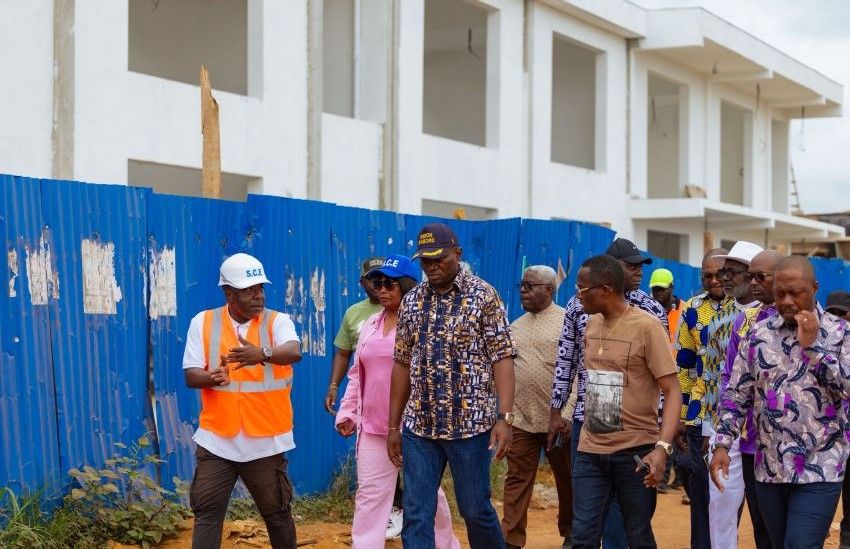
The multiplication of visits to sites, inspections, and arbitration conducted directly on the ground represents a deeper transformation in Gabon’s public governance.
From the hospital in Minvoul to the municipal market in Gouéma, the rehabilitation of the Mvett Palace, village chief housing, teacher training centers, or sports facilities like Nkum Yenguï, these investments aim to link economic growth with social cohesion and human capital development.
The underlying idea is simple: sustainable development cannot be achieved if infrastructure progresses faster than social services or public services.
Centers like Manfred Mendame Ndong dedicated to teacher training or sports facilities equipped with science labs and digital infrastructure demonstrate the government’s commitment to preparing tomorrow’s workforce today.
The choice of remitting village chief housing also reflects a long-overlooked priority in African development policies: strengthening local administrations and community networks.
Transformation rarely starts in metropolitan centers. It often begins in regions capable of becoming balance poles, innovation hubs, and production centers.
Through this Woleu-Ntem tour, the Gabonese government seems to want to demonstrate that another geography of development is possible: one where frontiers become economic opportunities, provinces cease to be peripheries, and public investments strive for both national cohesion and growth.
The real challenge now lies in turning this territorial ambition into measurable, durable results capable of fundamentally altering the trajectory of Gabon’s economy and society in the coming years.