Gabon’s president meets evangelical church leader, signals new governance balance
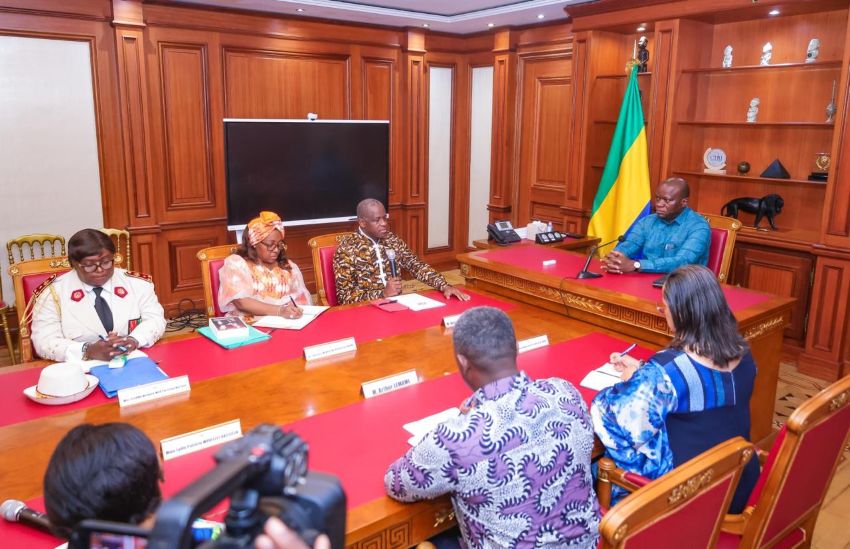
Libreville, Saturday 13 June 2026 – In times of great political transformation, states often seek their balance in institutions. But they also find it in consciences.
In Gabon, the meeting between President Brice Clotaire Oligui Nguema and Reverend Louis Sylvain Allogo Engo, head of the Evangelical Church of Gabon, goes beyond the protocol of an official audience. It reveals a frequently underestimated dimension of modern governance: the strategic role of religious denominations in consolidating national stability, social cohesion, and building the Fifth Republic.
As the country continues its institutional reshaping begun after the political transition, dialogue between the state and spiritual authorities emerges as a governance tool in its own right. In an African context where religious organisations often wield deeper social influence than some public administrations, this Friday’s audience at the presidential palace carries considerable political, social and symbolic weight.
Churches, silent partners for stability
The audience granted to the president of the Evangelical Church of Gabon is part of a broader dynamic of consultation with the nation’s moral forces. For decades, religious denominations have occupied a central place in the daily lives of Gabonese people. They intervene in education, social action, health, youth guidance and community mediation.
For the head of state, these institutions are not merely spiritual structures. They also represent proximity relays capable of promoting values of civic duty, solidarity and collective responsibility.
This reality is not unique to Gabon. Across Africa, religious organisations play a decisive role in preventing social tensions and preserving civil peace. Their ability to mobilise populations gives them considerable influence over citizen behaviour.
The presence of the government’s vice-president at this meeting further underlines the strategic importance attached to these exchanges. The state now openly acknowledges that building institutions does not rest solely on legislative texts, but also on maintaining permanent dialogue with the forces that shape society.
Secularism as a framework for renewed cooperation
One of the most significant aspects of this meeting lies in the message delivered by the president. Brice Clotaire Oligui Nguema reaffirmed his commitment to a balanced collaboration between the republic and religious denominations, strictly respecting the principles of secularism.
This clarification carries special weight. It reflects a desire to preserve the reciprocal autonomy of public institutions and religious organisations while fostering their cooperation on matters of general interest.
In modern democracies, secularism does not imply an absence of dialogue between the state and faith communities. On the contrary, it guarantees a framework where each acts within its area of competence while contributing to the common good.
The Evangelical Church of Gabon is a major actor in the national religious landscape. Established across the entire territory, it has accompanied the country’s social evolutions for generations. Its president, Reverend Louis Sylvain Allogo Engo, recalled during the audience the institution’s role in spiritually guiding the nation during landmark moments of its recent history.
This mutual recognition testifies to a relationship built on trust and a shared understanding of the challenges facing the country.
Human development at the heart of the partnership
Beyond institutional questions, the talks also covered the organisation of the upcoming national synod of the Evangelical Church of Gabon, scheduled from 20 to 26 July 2026 at Baraka Mission.
The request for support made by religious leaders and the agreement in principle given by the head of state illustrate a broader conception of development. This is not limited to infrastructure, the economy or investments. It also includes moral guidance, civic education and community cohesion.
This vision aligns with contemporary human development orientations promoted by many international organisations. The most resilient societies are often those that manage to combine economic performance, institutional stability and social capital.
By paying special attention to spiritual actors, the Gabonese authorities send a strong signal: one of governance that recognises a country’s modernisation is built not only in administrations, but also in communities where collective values are forged.
This audience ultimately appears as a symbol of the method adopted by the Fifth Republic. A method that favours dialogue, consultation and the search for a lasting national consensus. In a world marked by identity fractures and social tensions, Gabon’s choice to strengthen bridges between public institutions and spiritual forces may well prove to be one of the most solid foundations for its future stability.