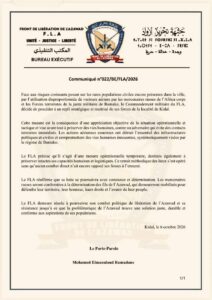

The legal saga surrounding Kemi Seba has reached a decisive turning point in South Africa. During the hearing on October 6, 2026, the South African judiciary dismissed the defense’s appeal based on the activist’s Nigerien diplomatic status. Official records reportedly provided no grounds to recognize Seba as an accredited Nigerien diplomat in South Africa. With extradition proceedings pending from Benin gaining momentum, Seba remains in custody ahead of the critical November 20 hearing.
Diplomatic immunity claim collapses under South African scrutiny
The October 6 hearing marked a pivotal moment in Kemi Seba’s case. Since his arrest in South Africa, his legal team had vigorously argued for his release by emphasizing his alleged role as a special advisor to Nigerien authorities and the diplomatic passport issued to him in 2024.
Officially identified as Stellio Gilles Robert Capo Chichi, Seba’s defense portrayed him as a key figure in Nigerien diplomatic circles. However, South African judges ruled that the evidence presented failed to substantiate his claim of diplomatic immunity within the country’s jurisdiction.
The distinction is crucial: possessing a diplomatic passport does not automatically confer immunity in foreign jurisdictions. The South African court’s refusal to recognize Seba’s diplomatic status underscores this legal principle, reshaping the trajectory of his defense strategy.
Legal limbo: extradition looms as diplomatic defense fails
The immediate consequence of the October 6 ruling is the continuation of Kemi Seba’s detention in South Africa. Arrested in Pretoria on April 13, 2026, Seba has been entangled in overlapping legal proceedings, including immigration challenges and Benin’s extradition request.
It is essential to clarify: the rejection of his diplomatic defense does not equate to a final extradition order. As of now, the South African judiciary has neither approved nor denied Benin’s extradition request. The next phase of this legal confrontation is scheduled for November 20, 2026, when the court will evaluate the merits of the extradition demand.
Why Benin pursues extradition: the charges behind the demand
The extradition request stems from allegations tied to a failed coup attempt in Cotonou in December 2025. Beninese authorities accuse Seba of inciting rebellion, citing a video where he publicly endorsed the coup plotters, labeling them as patriots and the uprising as a liberation movement.
Additional accusations, including apologia for crimes against state security, money laundering, and terrorism financing, have been reported in various accounts. However, these remain unproven claims within the judicial framework. The court’s role is to assess their validity, not to prejudge Seba’s guilt or innocence.
A case with regional repercussions: beyond the courtroom
The implications of this case extend far beyond legal technicalities. Kemi Seba, a prominent panafricanist figure, has built a reputation for his vocal criticism of Western influence in Africa and his support for military regimes emerging from recent coups in West Africa.
His alliance with Nigerien authorities, culminating in the acquisition of a diplomatic passport and a claimed advisory role, introduced a diplomatic dimension to an otherwise judicial matter. Seba’s legal team had hoped this status would provide leverage to challenge his detention, but the October 6 ruling has significantly weakened that argument.
The road ahead: November 20 will shape the case’s future
As the legal battle intensifies, three key facts remain undisputed:
- Kemi Seba remains in detention in South Africa;
- The diplomatic immunity argument was unsuccessful in securing his release;
- No definitive extradition ruling has been issued.
The next hearing on November 20 will be pivotal. The court will scrutinize Benin’s extradition request, evaluate its legal foundations, and weigh the arguments presented by both sides. Until then, the case remains suspended in a precarious legal limbo, with regional and geopolitical stakes hanging in the balance.
The outcome of this hearing could set a precedent, not only for Seba’s future but also for the broader dynamics of judicial cooperation and diplomatic immunity in Southern Africa.