
What happens when profits eclipse safety in the Sahara?
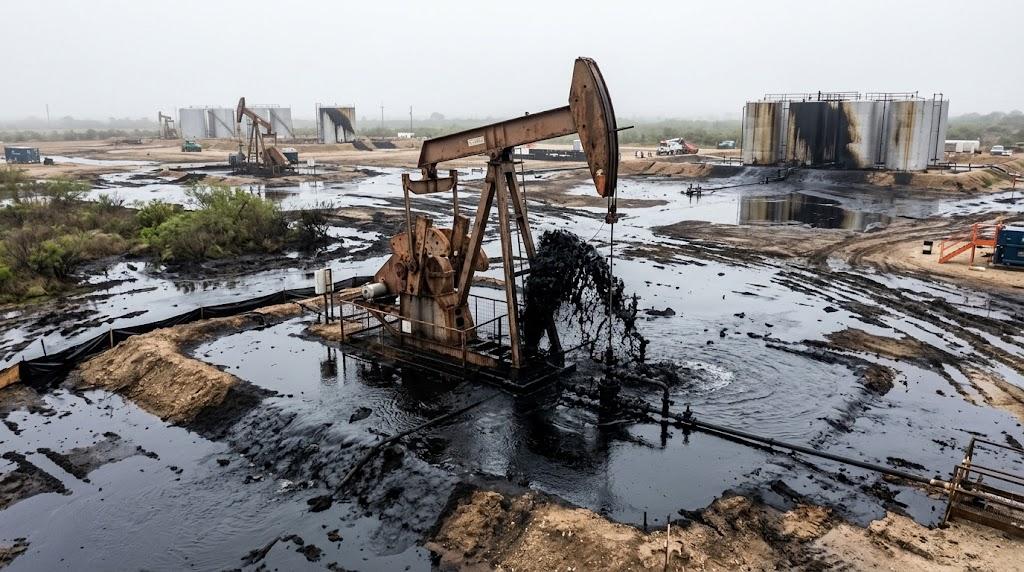
On September 25, 2026, a technical failure at the Goumeri W8 well in Agadem — one of Niger’s most important petroleum sites — spiraled into an environmental nightmare. What began as a routine breakdown became a 17-day nightmare of unchecked hydrocarbon and toxic gas spewing into the desert air. The disaster wasn’t caused only by a malfunction; it was made worse by a toxic mix of industrial recklessness, corporate silence, and government inaction.
This tragedy in the Sahara is not just about a well on fire — it’s about a system that treats Africa’s soil as a sacrifice zone. Behind the dramatic visuals of crude oil flooding the desert lies a deeper story of policy failure, environmental racism, and the long shadow of extractive greed.
The 17-day silence that turned a leak into a climate bomb
For 17 days, the skies over the Agadem block were poisoned while authorities and the operator remained silent. Despite residents noticing the black liquid spewing over 10 meters high and the threat to neighboring wells (W3 and W4), no official statement was made. It wasn’t until October 12 — weeks after the first signs — that the government finally acknowledged a “serious environmental incident,” using cautious language that downplayed the scale of the disaster.
The operator, China National Petroleum Corporation (CNPC), a Chinese state-owned giant, stayed completely silent. No public statements, no data on the volume of oil or gas released, no emergency protocols announced. This corporate opacity reveals a disturbing pattern: when working in Africa, some global energy firms adopt a double standard, prioritizing output over safety, transparency, and the well-being of local communities.
Satellites uncover the truth: a methane leak with global consequences
The government’s cautious tone hid a far greater threat. Thanks to data from the European Space Agency’s Sentinel-5P satellite (part of the Copernicus program), the scale of the methane leak was exposed. Methane, invisible and odorless, is 80 times more potent than carbon dioxide in trapping heat over 20 years. The satellite data told a grim story:
- An unstoppable flow: Over 40 tonnes of methane per hour were being released — a continuous, devastating stream.
- A climate time bomb: In just three weeks, more than 17,000 tonnes of methane escaped into the atmosphere, making this one of the worst methane leaks recorded in Africa.
- A lie of control: Authorities claimed to have “partially contained” the situation, but satellite data showed the gas plume never weakened.
This wasn’t just a spill — it was a silent climate crime, invisible to the eye but detectable from space, with consequences that will linger for decades.
Why methane leaks are worse than we think
Methane (CH₄) is the second most important greenhouse gas after CO₂. While it doesn’t stay in the atmosphere as long, its warming potential in the short term is devastating. A single leak of this magnitude could undo years of climate progress in the Sahel. Yet, unlike oil spills that stain the land, methane disperses invisibly, making it easier to ignore — until the climate data forces the truth into the open.
From profit motive to peril: how Niger’s oil rush backfired
This disaster wasn’t an unpredictable act of nature. It was the direct result of a dangerous race to increase oil production. Driven by ambitions to reach 90,000 barrels per day and supply the pipeline to Benin, Niger’s government prioritized output over safety, maintenance, and environmental protection. Basic safeguards were bypassed. Routine inspections were delayed. Emergency contingency plans were nonexistent.
The human cost became clear when two workers were severely injured in the initial blast. In a desperate move, the government had to call in emergency drilling experts from Algeria’s Sonatrach — a stark admission of technical incompetence. The irony: a landlocked nation relying on foreign expertise to fix a crisis caused by overconfidence in its own oil expansion plans.
The illusion of control in high-risk oil operations
Pumping oil in the Sahara is not like drilling in the North Sea or the Gulf of Mexico. The desert’s extreme conditions, remote location, and fragile ecosystems demand the highest safety standards. Yet, Niger’s oil sector has been marked by:
- Undermaintenance of aging infrastructure — equipment pushed beyond safe limits to meet quotas.
- Lack of local technical capacity — forcing reliance on foreign contractors in emergencies.
- Policy prioritization of revenue over resilience — ignoring long-term environmental and social risks.
When the well failed, the system failed with it — not because of one technical error, but because of a culture that treats safety as a cost, not a priority.
Who bears responsibility in the Sahara’s silent poisoning?
The desert is not a waste dump for hydrocarbons. The absence of immediate casualties does not absolve CNPC of its duty of care, nor does it excuse the state for turning a blind eye to industrial negligence. This is a collective failure — one that reveals a disturbing truth: in Africa’s oil fields, profit margins often come before people and the planet.
As the methane plume continues to rise unseen, the real question is whether this crisis will finally force a reckoning — or whether the world will continue to tolerate an extractive model that treats the Sahara as a sacrifice zone.