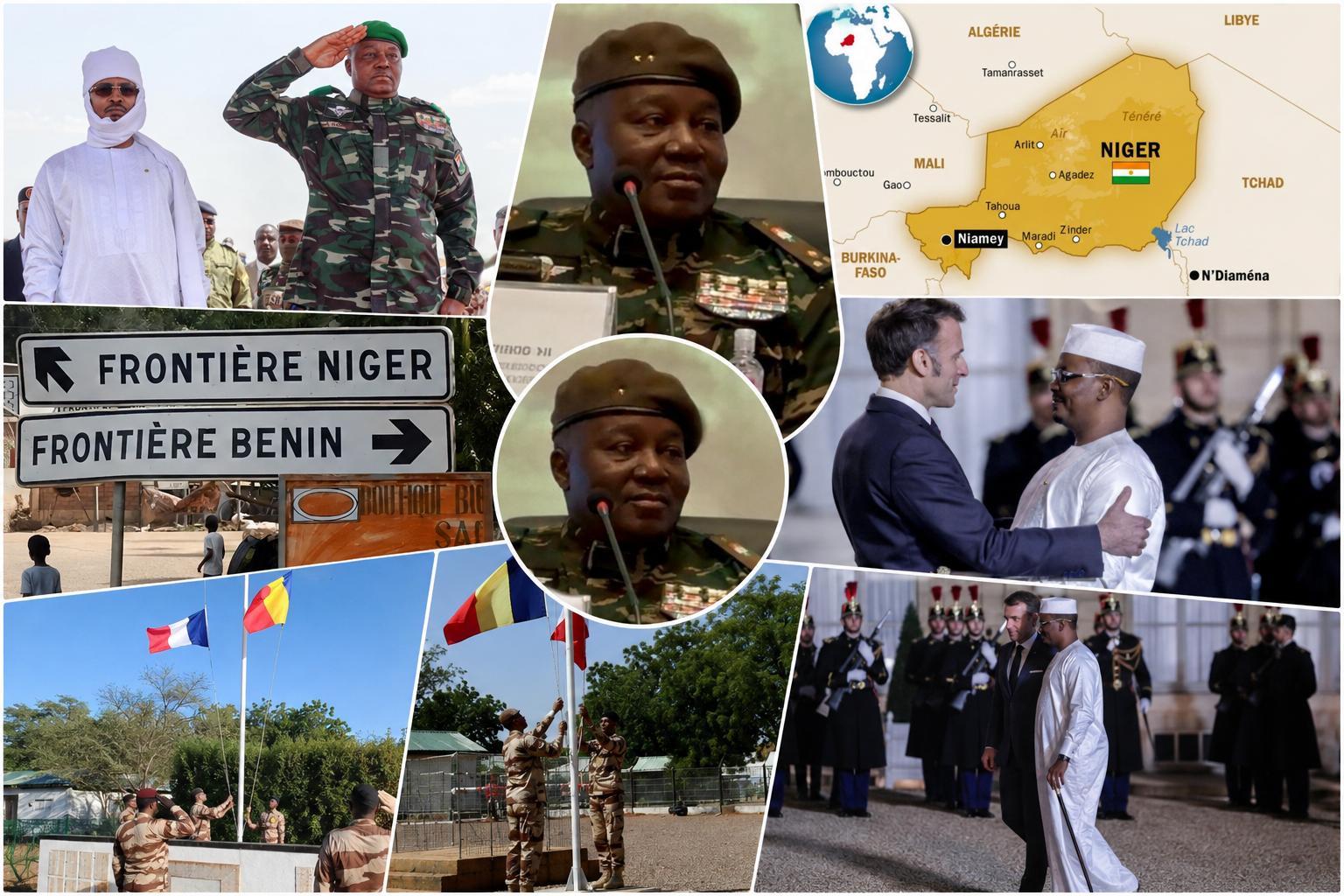

Niamey’s continued closure of its border with Bénin, citing demands for security assurances, brings into sharp focus a delicate question for Niger: if a French military presence in a neighboring state constitutes a threat justifying such a closure, should this same logic not extend to Chad, where France is now re-establishing its military presence?
Despite initial hopes for normalization between Niamey and Cotonou, the crucial border between Niger and Bénin remains sealed, nearly three years following the July 2023 coup d’état. The anticipated reopening of this vital communication route has yet to materialize.
Recent months have, however, seen numerous indications of easing tensions. Both nations have re-engaged in dialogue, establishing a technical framework tasked with assessing the conditions necessary for reopening the frontier. Discussions have also advanced on critical security, economic, and legal aspects.
Nevertheless, Niamey steadfastly upholds its stringent requirements.
During a recent public address, General Abdourahamane Tiani articulated that the border’s reopening hinges on receiving guarantees, particularly concerning security and the absence of any forces deemed hostile near the frontier. This position aligns with the long-standing stance of Nigerien authorities: Cotonou’s territory, according to Niamey, must not serve as a staging ground for operations perceived as threatening to Niger.
This serious accusation, however, is unequivocally refuted by Cotonou.
Cotonou and Paris issue denials
Since the onset of the crisis, Béninese authorities have consistently dismissed claims that France operates military bases within Bénin, particularly in the country’s northern regions.
The Béninese government maintains it has never hosted any foreign military base on its soil. This assertion was reiterated by Bénin’s Minister of Foreign Affairs, Olushegun Adjadi Bakari, as recently as January 2025.
Paris has similarly denied the existence of a French military base in northern Bénin. In March 2026, General Fabien Mandon, Chief of Staff of the French Armed Forces, unequivocally rejected these accusations, confirming no French base operates in that part of the nation.
Yet, a crucial distinction warrants attention.
France does indeed offer a form of security assistance to Bénin. French military personnel have been involved in training and providing support to Béninese forces combating armed groups in the country’s north. For instance, reports from April 2026 indicated a discreet presence of French special forces operating alongside Béninese troops, though French authorities officially refer to them as trainers.
Therefore, it is essential to differentiate between Franco-Béninese military cooperation, which is acknowledged, and the existence of a French military base or a permanent French deployment near the Nigerien border, which both Cotonou and Paris deny.
This very distinction lies at the heart of the ongoing debate.
Niamey’s demands: a new equation
As Niger continues to press Bénin for security assurances, a significant development unfolds with another of its neighbors, which is now rekindling its ties with Paris.
In November 2024, Chad had previously terminated its military cooperation with France, asserting its commitment to full sovereignty and the diversification of its security partnerships.
This French withdrawal was widely perceived as a pivotal moment in the relationship between N’Djamena and Paris.
However, over recent months, the two capitals have been drawing closer once more. French military personnel are gradually returning to Chad, albeit within a significantly more discreet and scaled-down framework than their previous presence.
This evolving situation addresses pressing security realities: Chad grapples with the fallout from the war in Sudan, the persistent threat of Boko Haram in the Lake Chad basin, and substantial requirements for intelligence, surveillance, and logistical capabilities.
Consequently, N’Djamena may view France’s return as a sovereign and pragmatic decision.
Yet, for Niamey, this strategic choice presents a profound question.
Chad, too, shares a border with Niger.
Therefore, if Niamey deems a French military presence near its territory a sufficiently grave threat to prevent the reopening of its frontier with Bénin, how does Niger intend to respond to the burgeoning Franco-Chadian rapprochement?
Why is Chad different from Bénin?
Herein lies the true paradox.
Niamey could reasonably argue that every sovereign state is entitled to select its military partners. Under this rationale, Bénin would possess the right to cooperate with France, and Chad would similarly be justified in re-engaging with Paris.
However, if this logic holds true, it should then logically lead Niger to refrain from making Franco-Béninese cooperation a decisive condition for the reopening of its border.
Conversely, if Niamey genuinely believes that French military cooperation with a neighboring state constitutes a threat to its national security, then the same reasoning should, by all accounts, be applicable to Chad.
The core issue, therefore, is not whether Niger should close its border with Chad. Rather, it is about scrutinizing the consistency of Niamey’s own rationale.
Why would military cooperation with France be deemed unacceptable for Niger’s western neighbor, yet acceptable for its eastern counterpart?
Geography further complicates this sensitive issue. Niger shares extensive borders with both Bénin and Chad. Consequently, a foreign military presence in Chad could, theoretically, be considered an integral part of Niamey’s immediate strategic environment. This is a key point for Sahel current affairs.
France’s return to Chad: a test for sovereign doctrine
The developments in Chad unfold within a profoundly transformed regional landscape.
Mali, Burkina Faso, and Niger have elevated sovereignty and a decisive break from former partner powers as foundational pillars of their new foreign policy. These three nations have withdrawn from ECOWAS (CEDEAO) and solidified their cooperation within the Alliance of Sahel States, a significant aspect of Mali Niger Burkina reporting.
Chad, however, has opted for a distinct trajectory.
Following its rupture with Paris in 2024, N’Djamena now appears inclined to resume military cooperation with France, all while maintaining its other existing partnerships.
This is undoubtedly a sovereign choice.
Yet, such a decision could prove difficult to reconcile with a concept of sovereignty that disputes a neighbor’s right to select its own partners.
Thus, the core of the current debate shifts from the specifics of French presence in Chad to the fundamental principle of consistency.
Towards a resolution between Niamey and Cotonou?
Nevertheless, the situation has the potential to evolve. Ongoing discussions between Niger and Bénin indicate both nations recognize the substantial economic and security costs associated with the border closure. For nearly three years, populations, traders, and transporters in the border zone have borne the brunt of a political crisis far exceeding their local interests.
Furthermore, violence has significantly escalated in the border region shared by Bénin, Niger, and Nigeria, underscoring the compelling need for enhanced security cooperation between the two countries.
Consequently, reopening the border could emerge as a shared, mutual interest.
To achieve this, however, Niamey and Cotonou will likely need to transcend the contentious issue of France’s role.
The discussion cannot indefinitely remain confined to an opposition between « French presence » and « African sovereignty ».
Should Niger genuinely seek security guarantees from Bénin, it is entirely legitimate to request them. However, these assurances must be grounded in verifiable facts, transparent mechanisms, and reciprocal commitments.
Crucially, these principles must be applied consistently to all neighboring states.
The gradual resumption of French military cooperation in Chad thus introduces a new dimension to this ongoing crisis.
Niamey now confronts a critical choice: either acknowledge that every sovereign state is free to choose its partners, or maintain a doctrine asserting that French military cooperation with a neighbor constitutes a threat warranting retaliatory measures.
In the former scenario, the reopening of the border with Bénin could be significantly facilitated.
In the latter, the rapprochement between N’Djamena and Paris risks presenting Niger with a question that will be difficult to sidestep: if France poses a threat in Bénin, why would it not in Chad?
It is perhaps within this apparent contradiction that one of the primary challenges for Sahelian diplomacy currently resides: ensuring sovereignty is upheld as a universally applicable principle, rather than merely an instrument wielded in the shifting power dynamics between neighboring states.



