
Niger’s strategic arms acquisition from Turkey: unmasking the deferred payment framework
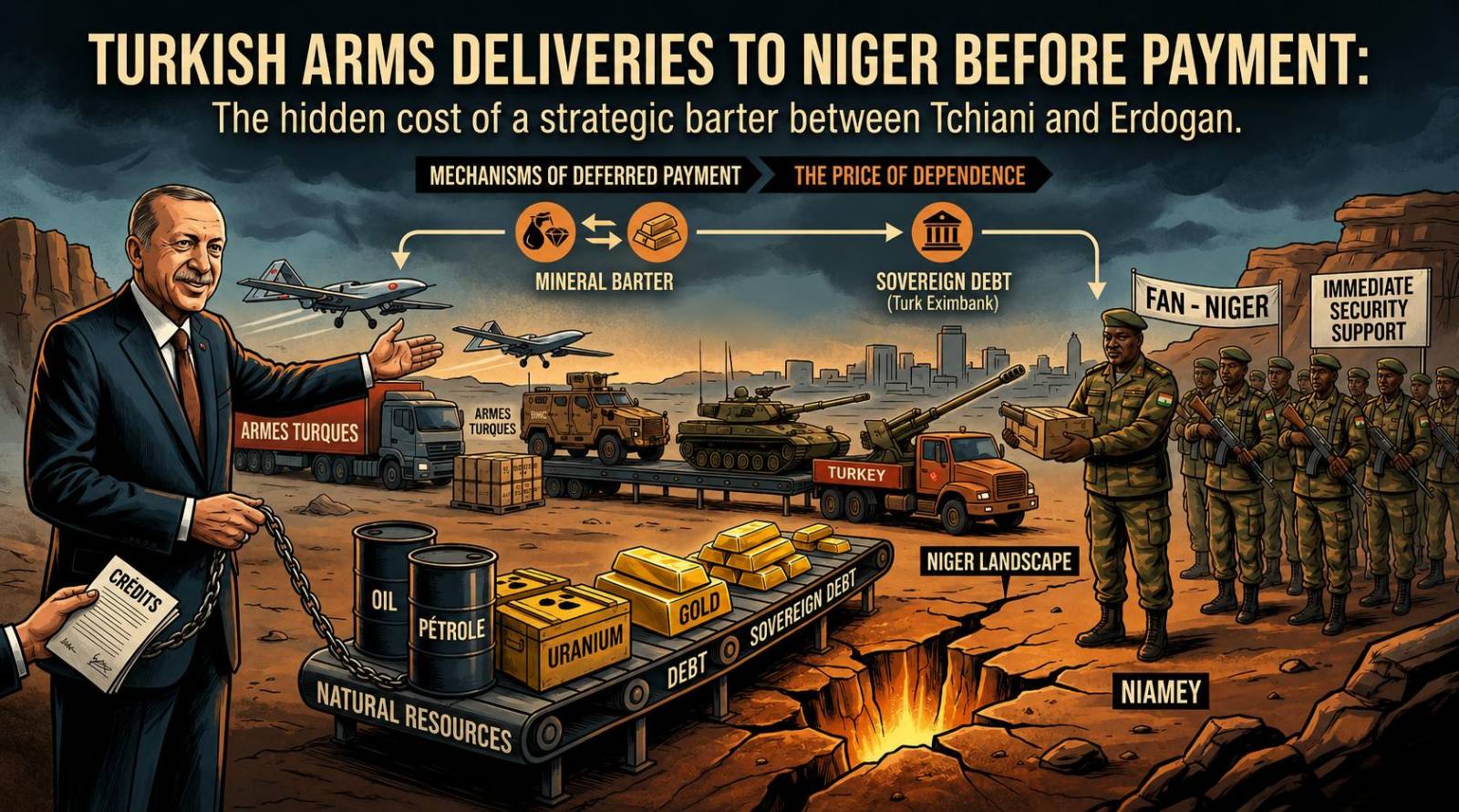
During his official visit to Ankara, General Abdourahamane Tchiani made a significant disclosure, revealing that President Recep Tayyip Erdogan had authorized the provision of military hardware to Niger without requiring immediate financial settlement. While presented as a gesture of solidarity by the Niamey administration, this deviation from conventional international arms trade protocols unveils the intricate mechanics of a partnership that could potentially compromise a segment of Nigerien sovereignty.
In the realm of defense equipment procurement, a ‘total credit’ arrangement devoid of prior guarantees is largely unprecedented. Defense industries typically mandate substantial upfront deposits before commencing any equipment delivery. Consequently, the announcement made by the Nigerien transitional president on June 4, 2026, likely conceals a nuanced economic and geopolitical reality, where the concept of outright gratuity holds no place.
The unstated financial terms: mechanisms of delayed remuneration
International commerce adheres to an immutable principle: all delivered goods ultimately necessitate payment, whether directly or indirectly. To circumvent Niamey’s immediate financial constraints, several compensatory mechanisms are subtly activated behind the scenes:
- Natural Resource Barter (The “Arms for Minerals” model): Niger’s subsoil is among West Africa’s richest in uranium, petroleum, and gold. By agreeing to an early delivery of military materiel, Ankara potentially secures exploration rights or exclusive mining concessions for its national enterprises in return.
- Indebtedness through Sovereign Credit Lines: These sophisticated military provisions are not outright gifts. The associated invoices are typically backed by loans extended through financial institutions, such as the Turk Eximbank. This arrangement effectively transforms Niger’s immediate security imperatives into a long-term financial obligation owed to Ankara.
The cost of reliance: mortgaging national sovereignty
For General Tchiani, this alliance is deemed critical for re-equipping the Nigerien Armed Forces (FAN) following the departure of Western contingents. However, this short-term pragmatic choice imposes a substantial burden on the nation’s future trajectory.
The reality of escalating debt: By accepting Bayraktar TB2 drones, armored vehicles, and advanced transmission systems on credit, Niamey potentially exposes itself to direct Turkish oversight concerning its future economic and mining policies.
Potential strategic reciprocations
- Preferential access to Niger’s uranium and petroleum reserves.
- Establishment of Turkish logistical hubs or military installations.
- Automatic diplomatic endorsement from Ankara within the Sahel region.
Erdogan’s strategy: cementing Turkish influence in the Sahel
For President Recep Tayyip Erdogan, extending financial flexibility to military regimes across the Sahel constitutes a highly lucrative geopolitical investment, designed to achieve three primary objectives:
- To decisively diminish the presence of Western powers in the region.
- To counteract Russian influence (Africa Corps) by positioning Turkey as an indispensable technological provider.
- To guarantee robust markets for its burgeoning defense industry, which serves as a prominent showcase of modern Turkish power.
An immediate political triumph, an uncertain economic future
General Tchiani secures an immediate internal political victory by acquiring essential armaments without immediately depleting state coffers. Yet, this perception of independence is confronted by the stark reality of material dependence. Between security arrangements delegated to Moscow and technological indebtedness incurred with Ankara, Niger has not truly severed ties with foreign spheres of influence; rather, it has merely shifted its principal creditors, at a cost to the Nigerien populace that remains to be fully quantified.