Regional security: Abidjan extends hand to Mali and Burkina Faso against terrorist threat
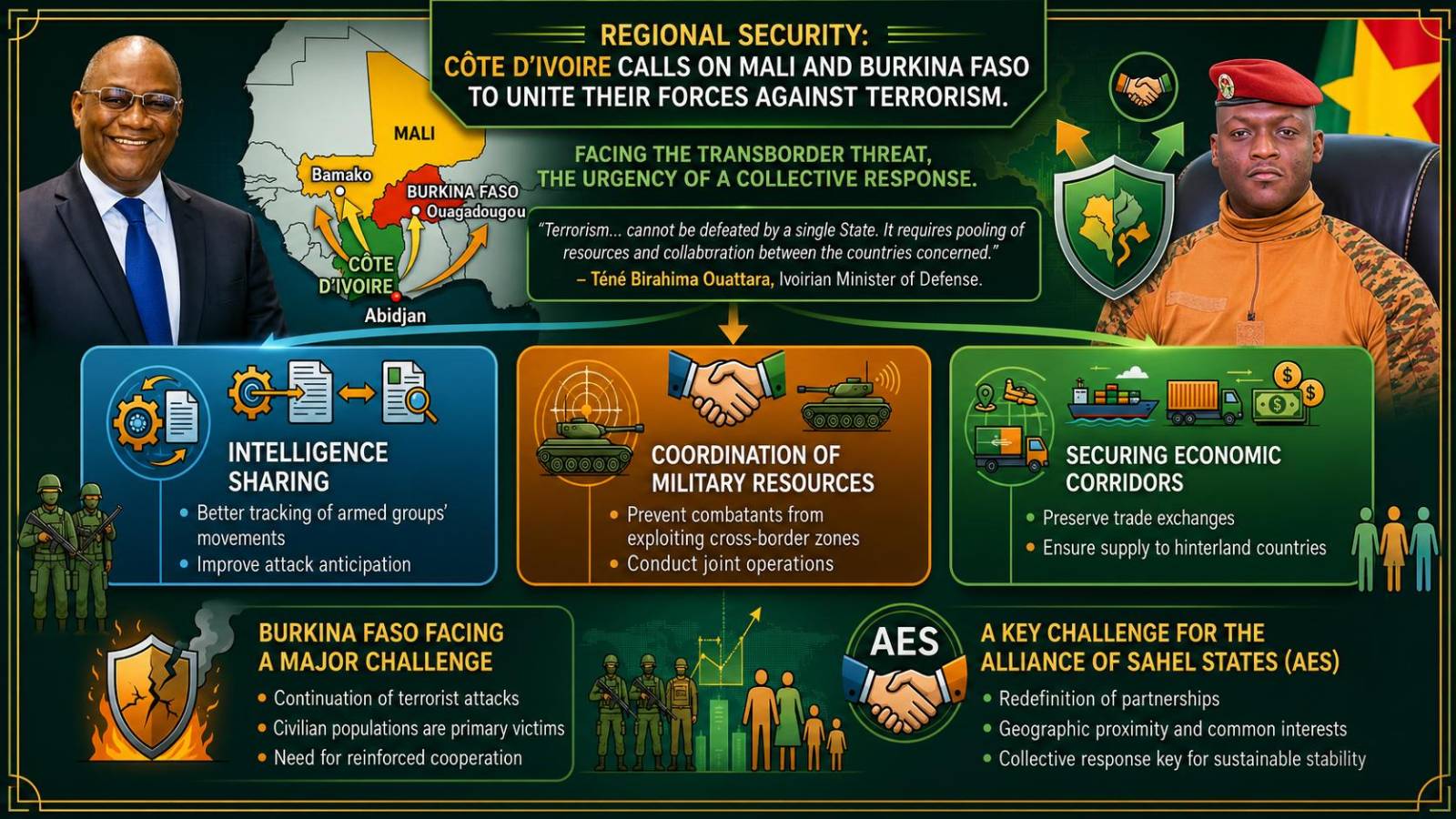
As terrorist attacks intensify across the Sahel, Abidjan is reaffirming the urgent need for a unified front. Faced with this security emergency, Captain Ibrahim Traoré must now choose pragmatism and cooperation with the Ivorian state to stem a threat that knows no borders.
In West Africa, the time for diplomatic quarrels and ideological posturing is over. The imperative of collective survival has taken centre stage. With armed terrorist groups advancing steadily, wreaking havoc in the Sahel and threatening coastal states, Côte d’Ivoire has issued a clear appeal to its Malian and Burkinabe neighbours.
The Ivorian Minister of Defence, Téné Birahima Ouattara, described the situation with cold pragmatism:
“Terrorism, as it currently exists, cannot be defeated by a single state. We need a pooling of resources and collaboration among the affected countries.”
This outstretched hand serves as a reality check for Ouagadougou.
Burkina Faso at a crossroads
Despite a rhetoric of sovereignty and national mobilisation efforts, the fact remains that Burkina Faso is struggling to contain the terrorist hydra. Attacks are multiplying, territorial control remains fragile, and civilian populations are paying the heaviest price. For Captain Ibrahim Traoré, president of the Burkinabe transition, the current situation forces a crucial choice.
According to several analysts in the region, the persistence of the threat should compel the young leader to set aside political tensions and personal pride in order to fully engage in this community-driven dynamic. The security of his people now depends on breaking away from strategic isolation.
The pillars of cooperation proposed by Abidjan
Côte d’Ivoire, which enjoys relative stability and significant logistical capacity, is offering a collaborative framework built on three main axes:
- Intelligence sharing: Tracking the movements of jihadist groups along porous borders.
- Pooling of resources: Coordinating cross-border military operations to prevent terrorists from finding refuge on either side of the border.
- Securing economic corridors: Ensuring the flow of goods essential to the economies of hinterland countries.
A test of political maturity for the AES
This Ivorian gesture represents a major test for the Alliance of Sahel States (AES). While Mali and Burkina Faso have chosen to redefine their international partnerships, geography does not lie. Côte d’Ivoire remains a natural and indispensable partner.
For Captain Ibrahim Traoré, agreeing to collaborate with the Ivorian state would not be an admission of weakness, but rather an act of political maturity and responsibility towards his fellow citizens. Faced with an asymmetric and mobile enemy, division is a death sentence; only a concerted response can restore peace to the sub-region.