
The Kremlin’s playbook: when protection comes with an economic price tag
In the heart of Africa, a silent transaction is reshaping power dynamics. Behind the promise of security lies a far more complex exchange—one where gold flows out, influence flows in, and sovereignty hangs in the balance. After the fall of Yevgeny Prigojine, his son Pavel appears to have inherited a sprawling network in the Central African Republic (CAR), transforming what began as a military partnership into a multimillion-dollar economic empire. This evolution raises a critical question: when security agreements are tied to resource extraction, who really benefits—and at what cost?
The Central African Republic may be a starting point, but the implications ripple across the Sahel. For the Alliance of Sahel States—comprising Burkina Faso, Mali, and Niger—this model offers a cautionary tale of how military cooperation can morph into lasting economic dependence. With jihadist threats and shifting geopolitical alignments, these nations are seeking new partners. But as Moscow tightens its grip on Africa’s security landscape, the question lingers: is gold the new currency of influence?
From mercenaries to businessmen: the Prigojine legacy in CAR
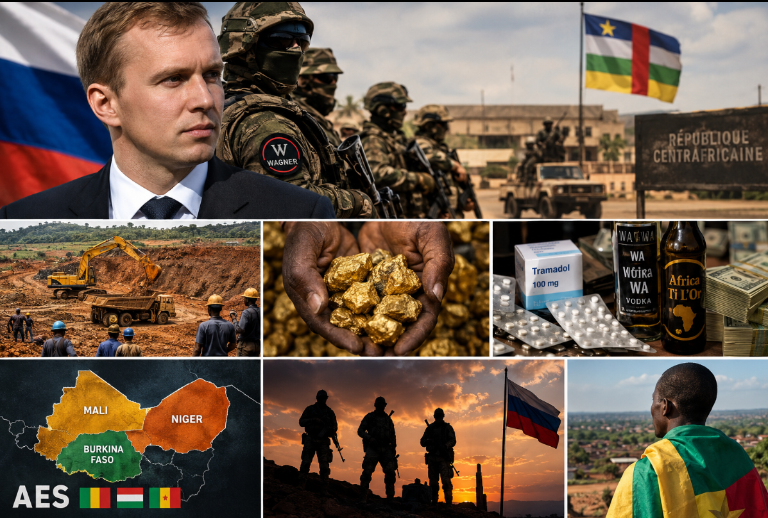
Reports suggest that Pavel Prigojine, now in his late twenties, has not only maintained but expanded the African operations initiated by his father. Estimates place the annual revenue of this network at over $400 million, a figure that underscores the scale of financial stakes involved. While the group’s fighters remain active in protecting President Faustin-Archange Touadéra’s regime, their presence has paved the way for commercial ventures that extend into mining, logistics, and even controlled markets for pharmaceuticals.
The Central African gold sector serves as a prime example. One of the country’s major gold mining operations, allegedly linked to the Prigojine network, generates around $250 million in annual output. Yet behind the glittering figures lies a web of opaque contracts, uncertain revenue flows, and limited transparency regarding how profits are shared—or reinvested. For a nation grappling with instability, this raises concerns: is the gold trade financing stability or merely enriching a parallel power structure?
Security as leverage: the dual role of Russian forces
The Central African model reveals a troubling pattern. Russian-backed security forces, whether labeled as Wagner operatives or members of the recently formed Africa Corps, do more than guard borders—they secure economic footholds. In CAR, their mandate to protect the government has inadvertently cleared the way for mining concessions, trade monopolies, and even illicit commerce. Reports indicate that the network’s activities now span alcohol distribution, arms trafficking, and the tramadol trade, a prescription opioid frequently diverted for non-medical use.
This blending of roles presents a fundamental conflict of interest. While military support may address immediate security gaps, it also creates dependencies that can undermine governance. When a foreign force operates within a nation’s borders—simultaneously as protector, investor, and trader—lines blur between national interest and private gain. Who holds the accountability? Who monitors compliance? Without robust oversight, the line between cooperation and exploitation becomes dangerously thin.
Lessons for the Sahel: what the Mali, Burkina Faso, and Niger debate must consider
The Central African experience is not isolated. Across the Sahel, governments are increasingly turning to Russia for military assistance, citing inefficacy or alienation from Western partners. Yet as these nations renegotiate their alliances, they must ask whether security partnerships risk becoming economic concessions in disguise. In Mali, debates persist over the human and political costs of Russian involvement. In Niger and Burkina Faso, emerging cooperation agreements prompt scrutiny over transparency, accountability, and the long-term implications of resource-sharing deals.
What the Sahel nations must avoid is a repeat of the CAR scenario, where security operations inadvertently serve as Trojan horses for economic control. A healthy partnership is not defined solely by the presence of foreign fighters, but by measurable outcomes: reduced violence, strengthened institutions, and tangible benefits for local communities. The priority should not be simply choosing between Moscow and Western capitals, but ensuring that any alliance preserves national sovereignty—especially when gold and other minerals are at stake.
Moscow’s strategy: control, influence, and the Africa Corps dilemma
The Russian state has not remained passive amid these developments. Following the abortive 2023 rebellion by Yevgeny Prigojine and his subsequent death, Moscow moved to bring Wagner’s African operations under tighter control, often through the Africa Corps—a unit reportedly tied to the Russian Ministry of Defense. Yet even this centralization has not fully dismantled the networks and economic interests built over years.In CAR, Pavel Prigojine’s continued influence suggests that Moscow is still grappling with its dual challenge: asserting state authority over semi-autonomous paramilitary groups while preserving the financial and political dividends these groups generate. This tension reflects a broader reality—Russia’s African strategy is not just about projecting power, but securing long-term economic leverage through resource-rich states.For Sahelian leaders, this dual dynamic presents a choice. Do they seek a partner that offers immediate security solutions, or one whose assistance comes with strings attached? The Central African case demonstrates that when gold and security are intertwined, the cost of protection may far exceed the value of the bullets fired.
The sovereignty equation: gold as currency, not collateral
The ultimate question is not who protects a nation, but who controls its wealth—and who answers for the consequences. When gold becomes the countervalue for security, sovereignty is no longer just a matter of policy; it becomes negotiable in backroom deals. The citizens of CAR and the Sahel deserve more than assurances from foreign powers. They need transparency in contracts, public oversight of mining revenues, and mechanisms to ensure that security operations serve the public good—not the interests of shadowy networks.
The Central African Republic’s story serves as both a warning and a window into a possible future. It shows how military cooperation can evolve into economic domination, and how gold can become a tool of influence rather than development. The Sahel now stands at a crossroads. Will it allow security partnerships to be leveraged for resource extraction? Or will it insist on a model where defense and development march in step?
One thing is clear: the real battle for the Sahel’s future may not be fought on the battlefield, but in the boardrooms where gold deposits are traded and sovereignty is weighed in ounces.