
Sonko urges dialogue to prevent Senegal from plunging into crisis
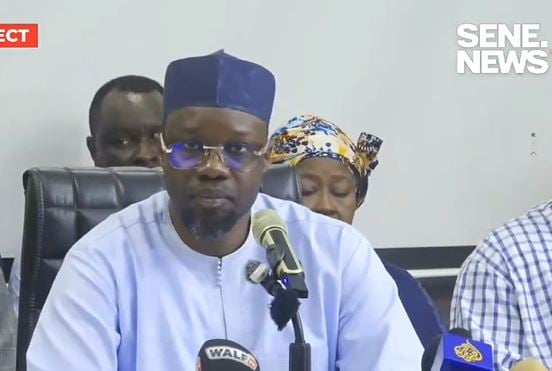
Following his dismissal as Prime Minister, Ousmane Sonko, leader of Senegal’s largest political party, has called for a constructive dialogue to avert a national crisis. His appeal comes as the newly formed government by President Bassirou Diomaye Faye faces growing political tensions.
The president’s decision to replace Sonko, a former ally, has sparked sharp criticism. Speaking publicly for the first time since his removal on May 22, Sonko highlighted irreconcilable differences over economic policies, particularly regarding the management of Senegal’s heavy debt burden.
President Faye acknowledged that Sonko’s recent stances had become “incompatible with government objectives,” leading to his dismissal. In response, Sonko questioned the president’s approach to governance, stating:
“A country is a serious matter. A government is a serious matter! It seems the president does not understand what it takes to form a government. This is not something done lightly.”
Sonko’s remarks underscore the unprecedented nature of the current political situation. He argued that the new administration lacks a solid political foundation, emphasizing:
“Yesterday, a government was formed without any political backing. There is no structured, legitimate political support behind President Bassirou Diomaye Faye.”
With his party, Pastef, holding 130 of the 165 parliamentary seats, Sonko positioned himself as a key player in maintaining stability. While acknowledging the party’s ability to dissolve the government within 72 hours, he stressed a commitment to constructive engagement rather than confrontation.
Sonko urged all stakeholders to prioritize national interests, warning that political instability could deter foreign investment. He also raised concerns over recent provocations against his supporters and called for calm among the youth, declaring:
“Peace requires two sides. We must avoid repeating the mistakes of the past.”
His call for dialogue comes against the backdrop of Senegal’s recent history of violent protests between 2021 and 2024, which resulted in numerous casualties, predominantly young people fatally wounded by gunfire.