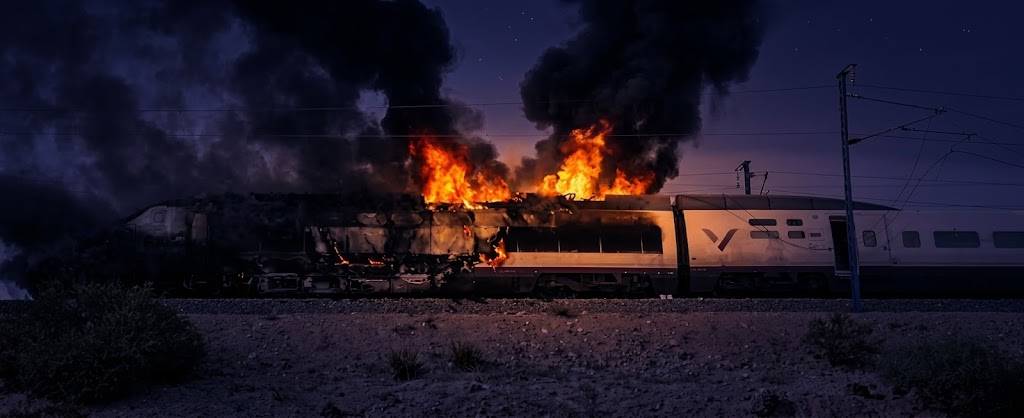

The Spanish high-speed rail network reached a turning point on Monday when a sudden onboard fire forced the emergency evacuation of 283 passengers from a Madrid-to-Figueres AVE train, halting service between the country’s two largest cities. The incident, which occurred near Ricla in Zaragoza province at 4:05 p.m., represents a major shift in how unexpected disruptions are managed in one of Europe’s busiest rail corridors.
Evacuation protocol activated as flames erupt in rear cabin
The fire broke out in the rear cabin of the AVE train, just two hours into its journey from Madrid’s Puerta de Atocha station. Upon detection, safety procedures were immediately triggered, allowing all 283 travelers to exit the train safely under the guidance of onboard staff and emergency responders. No injuries were reported in the initial assessment, underscoring the effectiveness of evacuation protocols.
The blaze, though contained shortly after it began, disrupted high-speed service between Madrid and Barcelona — a key artery of Spain’s rail network. The interruption sent shockwaves through the system, affecting thousands of passengers during a peak travel period coinciding with the national holiday and the end of a long weekend.
Network-wide ripple effect from localized incident
Within minutes, the fire evolved from a procedural event into a full-scale operational crisis. The railway operator suspended all high-speed trains on the Madrid–Barcelona route, leaving scheduled departures stranded in stations and forcing route changes for travelers heading to or from Catalonia and central Spain.
The timing of the incident—during a high-traffic holiday period—amplified the disruption, leaving commuters and holidaymakers facing canceled services, long waits, and uncertain itineraries. The widespread impact highlighted how a single technical failure can trigger a cascade of delays across an interconnected transport system already stretched by seasonal demand.
Renfe takes swift action to restore service and passenger confidence
In response to the emergency, Renfe, Spain’s national rail operator, launched a coordinated effort to minimize disruption and restore service. Affected passengers were offered free ticket modifications or refunds, with additional support available at stations and through customer service channels.
Technical teams worked through the evening to inspect the affected section of the line and assess the integrity of the train and infrastructure. While the fire itself was extinguished quickly, the process of reopening the route required rigorous safety checks to ensure no residual risk remained for subsequent services.
Renfe reported that full restoration of high-speed traffic would proceed gradually, depending on the findings of post-incident inspections. The company emphasized that service resumption was contingent on guaranteeing safe operating conditions—not just for the repaired train, but for the entire corridor.
Unanswered questions after a controlled evacuation
Despite a successful evacuation and the absence of injuries, the fire raises critical questions about its origin. Investigators focused their inquiry on the rear cabin, where the flames first appeared. Early speculation pointed to a potential electrical fault, though no definitive cause was confirmed at the time of reporting.
This incident marks the third major high-speed rail disruption involving fire this year, prompting renewed scrutiny of onboard safety systems, maintenance schedules, and crisis response protocols. The rapid containment of the blazed and orderly evacuation underscore the robustness of Spain’s rail safety frameworks, but the event also serves as a reminder of the volatility of high-speed travel.
As Spain’s rail network approaches a turning point in its modernization efforts, this fire serves as both a test of operational resilience and a call to enhance preventive measures to safeguard the 283 passengers—and millions of travelers who depend on the AVE every day.