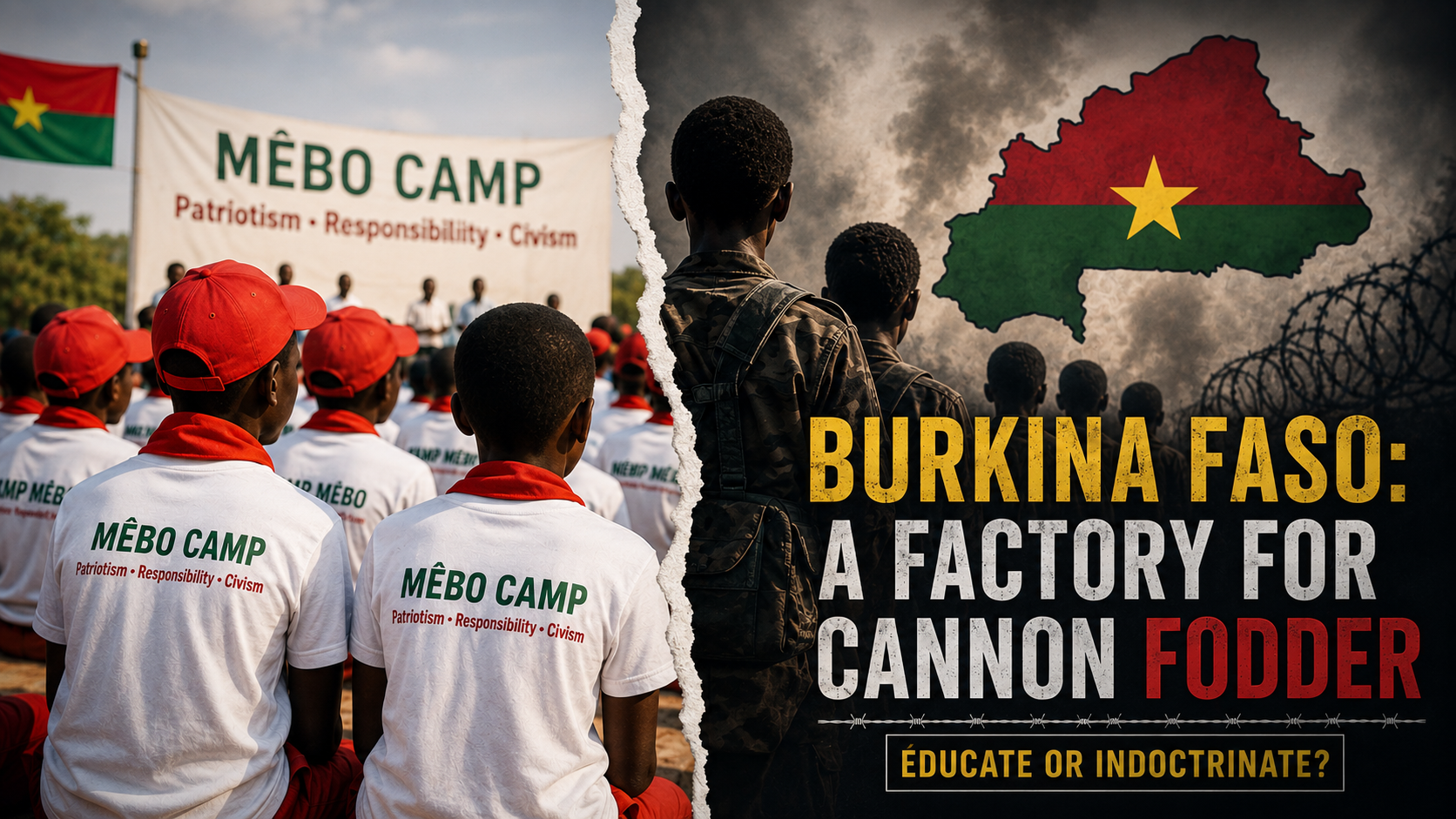

The Mêbo holiday camp in Burkina Faso, designed to bring together young people for cultural, athletic, and civic activities, is officially presented as a community initiative aimed at fostering patriotism and civic responsibility. Yet, beneath this veneer of civic virtue lies a growing skepticism: could such large-scale gatherings represent the early stages of a creeping militarization of the nation’s youth?
Such concerns are not directed at the core principles of civic education teaching responsibility, respect for institutions, solidarity, and the common good remains essential. However, the transition from civic awareness to political mobilization becomes disconcerting when patriotism is weaponized, independent thought is suppressed in favor of blind conformity, and national defense is framed as an everlasting obligation.
This pattern is not isolated to Burkina Faso. Across Africa, historical precedents reveal how early enlistment or ideological indoctrination has often blurred the lines between civic education, political mobilization, and youth recruitment in conflict zones. In regions such as Sierra Leone, Liberia, and the northern Democratic Republic of Congo, the boundaries between fostering national pride, ideological persuasion, and preparing youth for warfare have at times been dangerously indistinct. When state authorities exploit nationalist sentiment among an impressionable and developing youth demographic, there is a tangible risk of transforming civic instruction into a mechanism for mass mobilization.
Examining the rhetoric
The language employed in such programs warrants careful scrutiny. Terms like homeland, sacrifice, adversary, national defense, and commitment, when repeatedly emphasized in youth-focused narratives, can normalize the idea that military service is the natural and only path for a young citizen. Before a child or adolescent is expected to make ultimate sacrifices in the name of a political or military agenda, they must first develop critical thinking, engage in debate, and cultivate creativity.
The Sahel’s security crisis and its implications
Given the escalating instability in the Sahel, the policies implemented under the leadership of Ibrahim Traoré have come under heightened scrutiny. Burkina Faso’s ongoing conflict has shattered communities, displaced thousands, and placed national defense at the forefront of national conversations. In such a climate, patriotic mobilization can quickly take on an intensified even existential dimension. The crux of the debate, therefore, revolves around boundaries: to what extent should the state instill a defense-centric mindset in the youth?
The risks of ideological conformity
By fostering a youth aligned with official narratives, does the government risk, intentionally or otherwise, narrowing the space for dissent and critical inquiry? A robust and engaged citizenry should not be one that passively endorses state policies. Instead, it must be capable of defending the nation while simultaneously holding its leaders accountable, honoring the nation without conflating it with the ruling regime, and contributing to society without becoming a political tool.
There is also the danger of romanticizing sacrifice at an early age. When military service is consistently portrayed as the ultimate act of patriotism, it risks inuring young minds to the gravity of violence. True national devotion, however, should not be measured by a child’s willingness to engage in combat, but rather by their capacity to contribute to education, healthcare, agriculture, innovation, and the broader progress of their society.
The significance of symbols and discourse
Uniforms, military insignia, and forceful rhetoric are not inherently indicative of militarization when viewed in isolation. However, their persistent integration into youth programs particularly within a climate of protracted conflict and continuous national mobilization demands careful examination. It is within these ambiguous intersections that the distinctions between civic education, ideological conditioning, and psychological conditioning for warfare begin to dissolve.
The imperative of age-sensitive engagement
An adult, equipped with the maturity to navigate political and military complexities, may choose to participate in national defense initiatives with a clear understanding of the implications. A child, however, lacks both the experience and the critical faculties to make such choices. Institutions, therefore, bear the responsibility of safeguarding minors from exploitation and ensuring their education empowers rather than indoctrinates, cultivating active citizens rather than subservient recruits.
Mobilization vs. militarization
In the throes of a security crisis, the temptation to militarize young minds is palpable. Yet, addressing military threats by indoctrinating an entire generation risks perpetuating a dangerous cycle. The more a society conditions its youth to perceive adversaries and valorize sacrifice, the greater the likelihood that violence becomes normalized as a response to social or political challenges.
Authentic patriotism should offer an alternative to this trajectory. Devotion to Burkina Faso should not be synonymous with a readiness to die for the nation. It should also encompass the desire for stability, enabling children to live, learn, work, and envision a future free from perpetual conflict. It includes the recognition that citizens can defend their country without blindly supporting its leadership.
Key questions for evaluation
Before accepting statements on patriotism and youth mobilization at face value, critical questions must be asked: What are the intended educational outcomes of these camps? To what extent do they prioritize the development of critical thinking? Are participants encouraged to express dissent? Do activities include paramilitary or military elements? Most importantly, where is the line between fostering responsible citizens and conditioning a generation to accept warfare as an inevitable reality?
Burkina Faso’s aspirations for an engaged, educated, and responsible youth remain commendable. However, the distinction between empowering the next generation to build the nation and grooming them as disposable instruments of conflict must be clearly drawn. The ultimate question remains: are these young individuals being prepared to construct the Burkina Faso of tomorrow, or are they being molded into potential casualties of future wars?