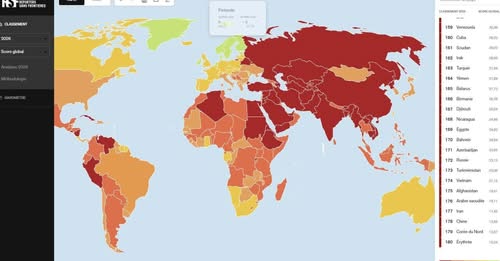

On the occasion of World Press Freedom Day, observed on May 3rd, a concerning reality emerges: across West Africa, the act of reporting has transformed into a perilous, if not heroic, endeavor. Since the ascent of military administrations, Mali, Niger, and Burkina Faso — nations consolidated under the Alliance of Sahel States (AES) — have been experiencing an unparalleled crackdown on information.
An intensifying clampdown on journalistic endeavors
The pressure exerted on journalists is steadily escalating. Whether exemplified by the Malian broadcaster Joliba TV, the Burkinabe newspaper L’Observateur Paalga, or the recent abduction of journalist Serge Oulon in Ouagadougou, the tactics of suppression are becoming increasingly diverse. Authorities are now employing a range of severe actions to silence dissenting voices:
- Abrupt closures of both domestic and international media outlets.
- Unjustified detentions and kidnappings.
- Compulsory expatriation for individuals who decline to disseminate official narratives.
Fear as an instrument of control
The prevailing atmosphere presents information professionals with a stark dichotomy: compliance or silence. Ousmane Diallo, a researcher affiliated with Amnesty International, observes a gradual constriction of the civic sphere. He elucidates, « This environment of intimidation, characterized by enforced disappearances, compels numerous journalists into self-censorship. » Consequently, the apprehension of punitive actions leads reporters to avoid covering contentious issues.
The trajectory towards a ‘thought confinement’
This authoritative grip on information extends beyond journalists, impacting the citizenry at large. By mandating a singular narrative that glorifies the ruling military administrations, the objective is to eradicate critical independent thought among the populace. An indigenous journalist, speaking under the condition of anonymity, draws parallels between the current circumstances and the era of the Soviet Union. The journalist characterizes the Sahel as having evolved into an « informational gulag » — a figurative prison where factual reporting is suppressed.
Observers do not view the diplomatic rapprochement between these nations and Vladimir Poutine’s Russia as coincidental; it appears to coincide with an embrace of information control methodologies characteristic of authoritarian systems. The critical question now revolves around the viability of independent expression within a region where public discourse increasingly appears to be systematically stifled.