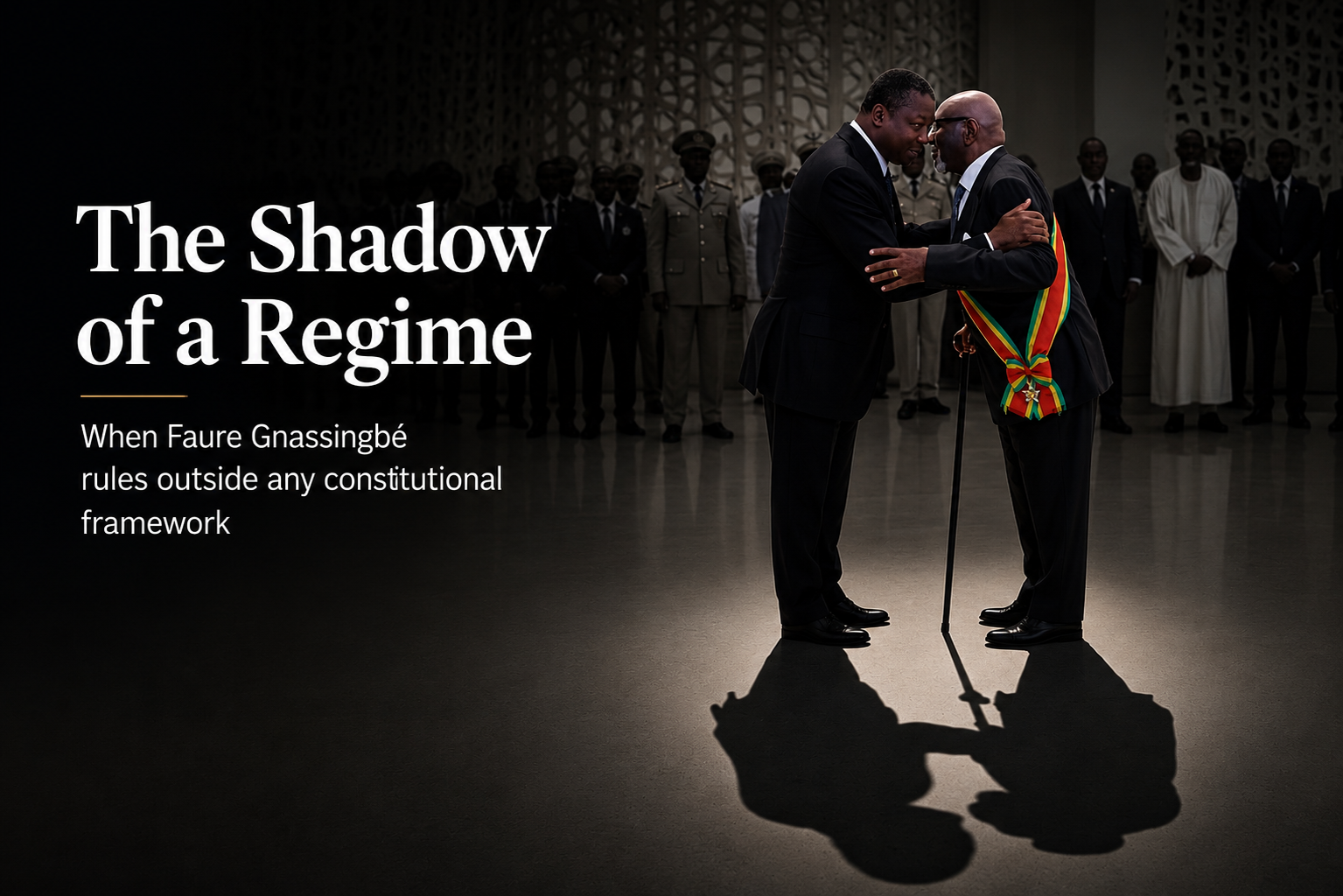

The recent detention of two French nationals in northern Togo has cast a harsh light on the country’s deteriorating governance practices. The suspects, formally charged after several days in the custody of intelligence services, appear to have been processed following direct orders from President Faure Gnassingbé, who reportedly instructed Justice Minister Pacôme Adjourouvi to « resist any external interference » in their case.
Beyond the immediate diplomatic fallout, the incident underscores a far-reaching crisis: the erosion of Togo’s institutional foundations. A critical question now looms over the nation: who truly holds authority, and upon what mandate?
An institutional overhaul devoid of democratic safeguards
The 2024 constitutional reform, passed by a legislature overwhelmingly controlled by the ruling UNIR party, abolished Togo’s presidential system in favor of a parliamentary model. Under the new structure, the ceremonial President (Jean-Lucien Savi de Tové) exerts no meaningful executive power. Instead, all key functions policy formulation, military command, civil service appointments, international representation, and regulatory authority have been transferred to the newly created office of « Council President, » a position currently occupied by Gnassingbé himself since May 3, 2025.
The post carries no term limits, effectively enabling permanent tenure. This structural shift circumvents the prior constitutional cap of two presidential terms, replacing democratic alternation with dynastic continuity. With UNIR holding 108 of 113 parliamentary seats a result achieved after opposition parties largely boycotted the 2024 elections the outcome was predetermined. Governance is no longer subject to electoral validation; it is a hereditary mechanism wrapped in legalistic guise.
A judiciary subordinate to political directives
The detention of journalists Sébastien Perez Pezzani and Gaël Mocaër, arrested while filming for a France Télévisions documentary, exemplifies a pattern of judicial weaponization. Their prosecution, allegedly shielded from external influence by presidential fiat, reveals a command chain that obliterates judicial independence. When the head of state dictates legal proceedings, the principle of separation of powers becomes a hollow formality.
This practice extends across multiple domains: the suppression of June 2025 protests, the prosecution of dissenting voices, and the selective enforcement of laws. Law is no longer an impartial framework but a tactical instrument, deployed or suspended to serve political objectives.
A legitimacy crisis fueled by imposed continuity
Who governs Togo today? The answer rests in the hands of a leader who assumed power in 2005, entrenched his rule over two decades, and then redesigned the state’s architecture to perpetuate his dominance. Crucially, no national referendum was held to endorse these sweeping changes. Legislative elections unfolded amid widespread boycotts and allegations of irregularities. Even the Senate, with one-third of its members appointed by the Council President, reinforces executive dominance.
This is not reform it is the repackaging of personal rule under institutional veneer. Titles shift, procedures multiply, yet decision-making power remains concentrated in a single figure: Gnassingbé, now Council President, parliamentary leader, commander-in-chief, and final arbiter of state affairs.
The precipice of systemic instability
When governance descends into arbitrariness, when institutions exist only as empty vessels, and when justice serves political expediency, the social contract frays irreparably. Togo is no longer grappling with a constitutional dispute. It is confronting a regime that governs beyond the bounds of a stable, predictable republican framework.
The question is no longer merely « who rules? » but rather: how long can a system that defies constitutional norms and public consent endure before internal fractures or mass mobilizations force its collapse?



