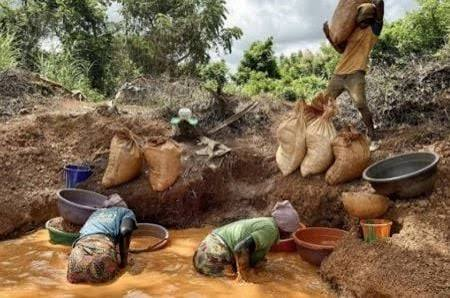

What drives burkinabe miners to flee to Guinea’s goldfields
For many young people in Burkina Faso, the collapse of security and governance has left them with no future—no jobs, no safety, and no hope. Facing a junta unable or unwilling to protect its citizens, thousands have made the perilous journey across borders in search of survival. Guinea’s gold-rich regions, like Siguiri, once promised refuge and opportunity. Yet what began as an escape from political and economic ruin has too often ended in a new kind of danger: the brutal realities of unregulated artisanal mining.
The failed promise of safety and wealth
The allure of gold was meant to be a lifeline for those fleeing violence and repression. But the promise was hollow. Once in Guinea, these migrants—many under 30, with little education or capital—found themselves trapped in a shadow economy where every ounce of gold came at a terrible human cost. The makeshift camps and tunnels of Siguiri’s informal mining sector became prisons of mud, deprivation, and exploitation. Without legal status, without rights, they were at the mercy of local operators, paying exorbitant fees just to dig, sift, and hope for a few grains of fortune.
Guinea’s crackdown: a devastating blow to the desperate
Last week’s military sweep in Siguiri was not aimed at criminals—it was aimed at survival itself. Security forces razed entire makeshift camps, destroyed tools, and displaced hundreds of Burkinabè miners overnight. The operation left families homeless, starving, and stranded, with no clear path forward. The message was clear: there is no place for outsiders here, no tolerance for the chaos of informal mining, no mercy for those who crossed borders just to dig in the dirt for scraps of gold.
Now, without shelter, without food, and with no support from Guinean authorities, many are preparing to return to Burkina Faso—back into the jaws of the same crisis they fled. But there is no going home. The land they left is still scarred by violence. The junta still rules. And the cycle of displacement continues.
Why this crisis reveals deeper failures of governance
This is not just a migration story—it is a failure of leadership. The Burkinabè junta, like other military regimes in the region, has weaponized insecurity to maintain power. Instead of investing in youth, in education, in economic opportunity, it has allowed violence to fester and hope to wither. The result? A generation forced into exile not by choice, but by desperation. And when borders open just enough to let them in, only to slam shut again with brutality, what remains is a trail of broken lives and shattered dreams.
The human cost of unregulated gold mining
- Exploitation without borders: Burkinabè miners in Guinea face extreme exploitation, working long hours in hazardous conditions for wages that barely cover food.
- No legal protection: Operating in legal gray zones, they have no access to labor rights, healthcare, or recourse against abuse.
- Environmental and social collapse: Unregulated mining has poisoned rivers, destroyed farmland, and fueled local resentment—making these migrants targets of both authorities and communities.
- A cycle of despair: Each raid on a mining site, each expulsion, pushes more young people back into the hands of traffickers, smugglers, or deeper into the shadows of the informal economy.
What’s next for Burkina Faso’s forgotten miners
Trapped between a junta that offers no stability and a neighbor that offers no refuge, these young miners face an impossible choice: starve in silence at home, or risk everything in a foreign land that has already turned against them. Without regional cooperation, without transparent governance, and without investment in sustainable alternatives, the story of Siguiri’s displaced miners will repeat itself across West Africa. The gold that was meant to save them has only deepened their suffering—and the world is watching.