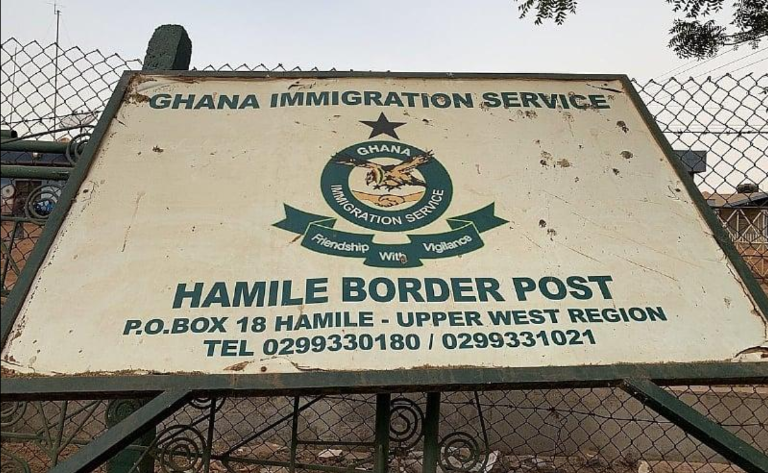

The tranquil border town of Hamile, in Ghana’s Upper West Region, was shattered this month when a pursuit spiraled into tragedy. A Ghana Immigration Service officer lost his life and another security personnel was critically injured when an explosion rocked the area during an interception attempt. Behind this sudden violence lie deeper issues: unregulated routes, porous borders, and the shadow of Sahel unrest.
How a routine check became a fatal confrontation
Local patrols had been monitoring irregular movement on a non-sanctioned path near the Burkina Faso border when they spotted a tricycle carrying suspected explosives. Officials attempted to halt the vehicle, but the occupants did not comply. Instead, they accelerated, triggering a pursuit that ended in disaster.
It was during this chase that the explosion occurred. The blast instantly killed the immigration officer and gravely wounded the other security personnel. The civilians in the tricycle were also killed in the blast. Authorities have yet to release a final casualty list or confirm the exact type of explosives involved.
Why Hamile sits in the crosshairs of regional instability
Hamile is not just another border town—it sits at a flashpoint. The Upper West Region serves as a critical transit hub for cross-border trade and movement between Ghana and Burkina Faso. Yet this very connectivity makes it vulnerable to unauthorized trafficking, including the smuggling of hazardous materials.
The town’s location places it uncomfortably close to the Sahel crisis, where armed groups have destabilized large swathes of Burkina Faso. While no evidence currently links the Hamile explosion to a terrorist network, its timing raises urgent questions about whether regional spillover is creeping into Ghanaian territory.
Local trade meets national security
Border communities like Hamile rely on informal trade for survival. Livestock, grains, and small-scale goods move freely across unmarked paths—routes that are invisible to official surveillance but well known to locals. When security forces attempt to regulate these flows, tensions can escalate rapidly.
In this case, the refusal to stop at a checkpoint suggests a calculated risk by the tricycle occupants. Were they transporting contraband with intent to avoid detection? Or did panic trigger a tragic misstep? Answers remain elusive for now.
A regional powder keg and Ghana’s balancing act
Ghana has long prided itself on stability in a volatile neighborhood. But neighboring Burkina Faso’s descent into jihadist violence has forced Accra to rethink its border strategy. Night patrols, vehicle checks, and intelligence sharing have all been scaled up—but is it enough?
The Hamile incident exposes a glaring gap: how to secure porous borders without strangling the economic lifelines of frontier towns. Unregulated routes facilitate smuggling of not just goods, but also weapons and explosives, turning everyday commerce into a potential threat.
What authorities don’t (yet) know
Investigators are still piecing together the sequence of events. Key unknowns include:
- Whether the explosives were destined for local use, regional trafficking, or further afield
- How the tricycle obtained such sensitive material in the first place
- Whether any external forces were involved or if this was purely a local smuggling operation
Until these facts emerge, speculation about terrorist motives remains premature. For now, the focus is on forensic recovery and intelligence gathering.
From tragedy to action: what must change?
The loss of a life at Hamile demands more than condolences—it demands systemic change. Experts argue for a three-pronged approach:
- Unified border control: Synchronizing patrols across Ghanaian and Burkinabè districts to close gaps in monitoring
- Community intelligence networks: Training locals to report suspicious movements without disrupting their livelihoods
- Alternative trade routes: Formalizing minor cross-border trade paths to bring them under regulated oversight
The challenge lies in balancing security with social realities. Any heavy-handed crackdown risks alienating border residents—ironically pushing them toward the very networks authorities aim to dismantle.
The road ahead: clarity or conjecture?
As investigators reconstruct the moments before the blast, one thing is clear: the Hamile explosion is not an isolated incident. It is a symptom of deeper tensions—unregulated movement, regional instability, and the blurred line between commerce and contraband.
Until comprehensive answers emerge, Ghana must tread carefully. Overreacting risks destabilizing fragile communities; underreacting risks inviting further tragedy. The priority now is forensic truth, not political grandstanding.
The fallen officer’s family deserves answers. The injured personnel deserve justice. And Ghana’s borders deserve better than turning a blind eye.