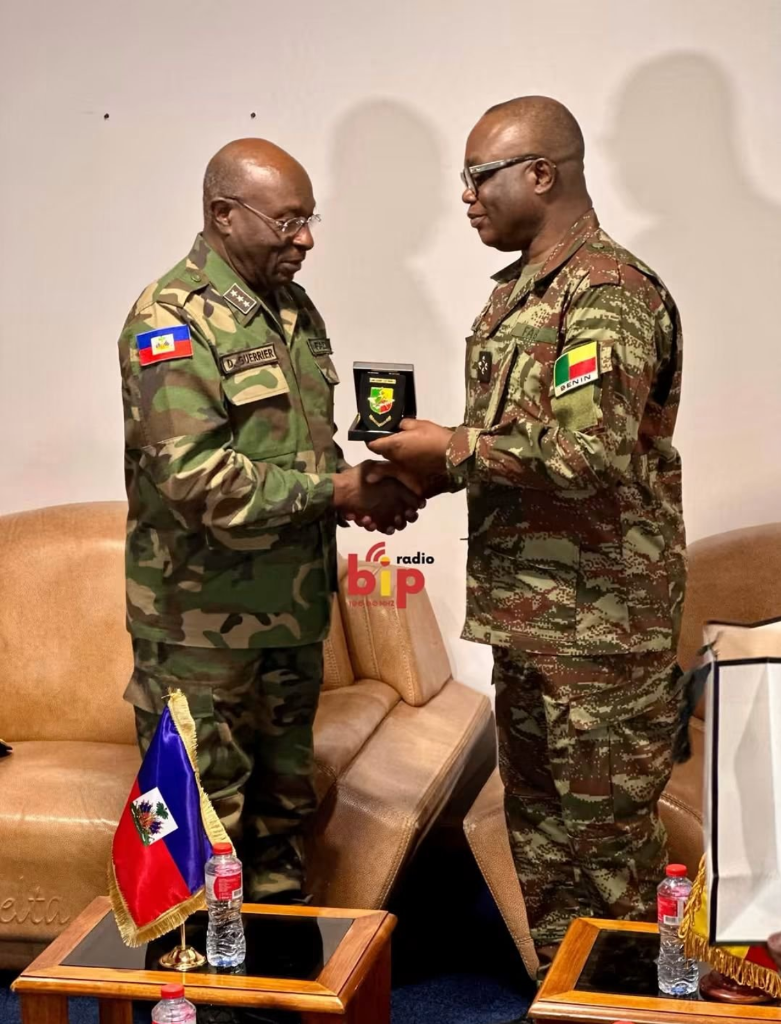

Behind the curtain of diplomatic protocol lies a pivotal moment for Haiti-Benin military relations. The unannounced visit by Haiti’s Chief of Staff, Lieutenant General Derby Guerrier, to Cotonou on November 3, 2026, was no ordinary courtesy call. It unfolded against the backdrop of Haiti’s spiraling security crisis—marked by armed gang expansion, crumbling state institutions, and overwhelmed security forces—while simultaneously tapping into Benin’s long-standing pledge to bolster international stabilization efforts in the Caribbean nation.
The unspoken dynamics driving Benin’s security calculus
The meeting at Benin’s General Staff headquarters between General Guerrier and his counterpart, Chief of Staff General Fructueux Gbaguidi, was far more than ceremonial. It came at a time when both nations face urgent security imperatives: Haiti struggles to restore order amid gang violence and state fragility, while Benin grapples with rising terrorism in its north and the looming threat of regional instability from the Sahel.
This convergence is not accidental. It reflects a deeper strategic rethinking within West African defense circles about how to address shared threats—both within borders and across the Atlantic. The visit signalled Benin’s renewed willingness to engage, not only through past commitments but through a pragmatic reassessment of what such cooperation could realistically deliver.
The 2024 offer that never materialized
In February 2024, Benin’s President Patrice Talon announced the country’s readiness to deploy up to 2,000 military personnel as part of the UN-authorized Multinational Security Support Mission (MSS), led by Kenya. Though framed as a bold step toward hemispheric solidarity, the proposal was later shelved due to unresolved operational concerns: command structure under a Kenyan police-led mission, funding mechanisms, rules of engagement, and the role of Benin’s military command in decision-making.
These unresolved issues now cast a long shadow over the Cotonou talks. While no new deployment decision has been made, the timing of Guerrier’s visit—amid Haiti’s escalating chaos and Benin’s evolving security doctrine—suggests both sides are probing the feasibility of a renewed partnership.
A partnership rooted in shared challenges and mutual learning
The potential of this military dialogue extends beyond humanitarian support. It opens a channel for technical exchange in critical areas: counter-insurgency tactics, intelligence sharing, operational planning, and crisis response—all fields where Benin has gained hard-earned experience in combating Islamist militants along its northern frontier.
For Haiti, where gangs operate like quasi-military units and state security institutions are under severe strain, insights from Benin’s counterterrorism posture could prove invaluable. For Benin, Haiti offers a strategic foothold in the Americas, a region where West African nations are increasingly seeking diplomatic influence.
Both militaries are in the midst of transformation. Benin is modernizing its armed forces with new equipment and training programs, while Haiti’s FAd’H is under pressure to rebuild credibility and operational capacity. A structured exchange could help both institutions address institutional weaknesses and adapt to evolving threats.
Why this visit matters more than it appears
The significance of General Guerrier’s trip lies not in the formalities, but in what it reveals about the unstated forces shaping regional security policy. It underscores a growing realization across Africa that Haiti’s crisis is not just a Caribbean issue—it is a transatlantic security concern with implications for migration, illicit trafficking, and geopolitical realignment.
Benin’s cautious re-engagement suggests a shift from symbolic gestures to practical outcomes. It reflects a sober reassessment of what international missions can achieve—and what risks they entail. For Haiti, it offers a glimmer of hope: a potential pathway to capacity building that goes beyond foreign troops on the ground.
Yet, the greatest uncertainty remains: will these conversations lead to action? Or will they fade into another diplomatic footnote, overtaken by shifting political winds and operational constraints?
From dialogue to deployment: the road ahead
While no public announcements have been made, the groundwork for deeper cooperation is being laid. The Cotonou meeting likely focused on identifying low-risk, high-impact avenues for collaboration: joint training exercises, medical support, logistical aid, or advisory roles—rather than full-scale deployments.
What is clear is that both nations are at a crossroads. Haiti needs operational support; Benin needs to expand its strategic footprint with minimal exposure. A bilateral military partnership could offer a middle path—one that strengthens Haiti’s institutions while allowing Benin to contribute meaningfully without overstretching its forces.
The next phase will depend on three key factors: the willingness of both governments to commit politically, the resolution of command and funding issues, and the ability of their militaries to translate intent into coordinated action. If successful, this behind-the-scenes diplomacy could redefine South-South cooperation in security—proving that even in times of crisis, partnership is still possible.